Ranked: The World’s Most Populous Countries by 2050
India's lead over China could grow from 24 million to 338 million by 2050. Explore the countries rising and falling in the rankings.
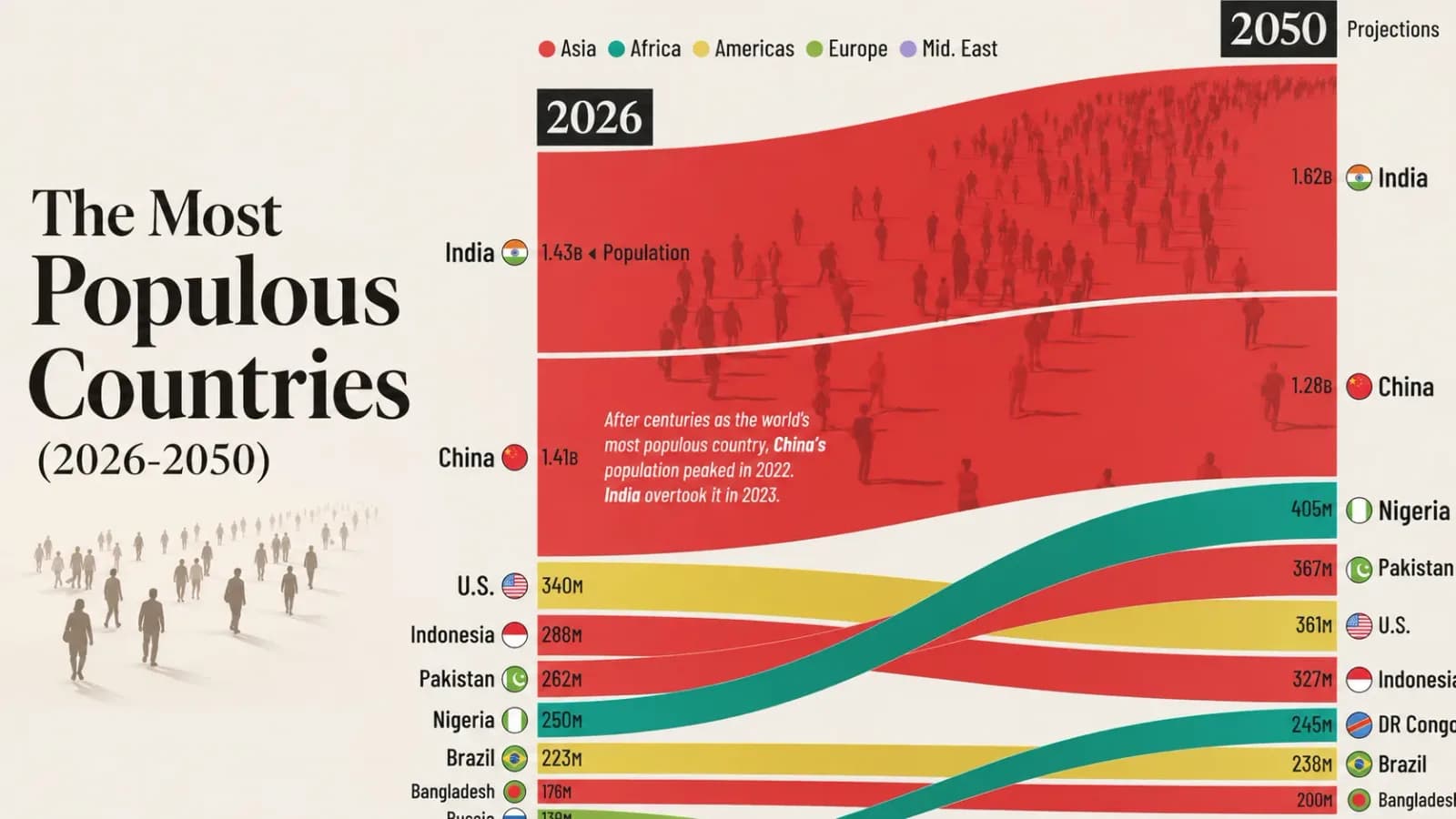
How the World’s Most Populous Countries Will Change by 2050
Key Takeaways
India is projected to reach 1.62 billion people by 2050, widening its population lead over China to nearly 338 million.
Nigeria is projected to become the world’s third-most populous country by 2050, overtaking the United States as its population grows from 250 million to 405 million.
DR Congo is projected to nearly double its population to 245 million, climbing from 11th to seventh place globally.
The world’s population rankings are set for a major reshuffle by 2050. While some of today’s largest countries face population declines, others are projected to add tens or even hundreds of millions of people over the next 24 years.
This graphic compares the world’s 25 most populous countries in 2026 and 2050, using midyear estimates and projections from the U.S. Census Bureau’s International Database.
Two Countries, One-Third of Humanity
India and China dominate the global population rankings in 2026, each home to more than 1.4 billion people. Together, they account for roughly one-third of humanity, while the United States ranks a distant third at 340 million.
RankCountryPopulation (Midyear 2026)Region
1 India1,429,700,205Asia
2 China1,405,918,803Asia
3 U.S.339,513,045Americas
4 Indonesia287,996,059Asia
5 Pakistan261,714,024Asia
6 Nigeria250,228,859Africa
7 Brazil222,624,000Americas
8 Bangladesh175,927,589Asia
9 Russia139,450,252Europe
10 Mexico132,807,523Americas
11 DR Congo125,166,115Africa
12 Ethiopia124,224,192Africa
13 Japan121,600,532Asia
14 Egypt114,438,165Africa
15 Philippines113,757,432Asia
16 Vietnam105,811,421Asia
17 Türkiye90,079,945Middle East
18 Iran88,815,177Middle East
19 Germany83,899,469Europe
20 Thailand74,536,425Asia
21 Tanzania71,133,853Africa
22 UK69,027,283Europe
23 France68,653,168Europe
24 South Africa61,727,446Africa
25 Italy60,896,213Europe
India alone has more than four times the population of the United States. Indonesia and Pakistan round out the top five, underscoring Asia’s dominance among the world’s most populous countries.
India Pulls Further Ahead of China
By 2050, India’s population is projected to grow by 193 million, while China’s contracts by 121 million. As a result, India’s lead over China is expected to widen from just 24 million in 2026 to nearly 338 million.
RankCountryPopulation (2050P)Region
1 India1,622,372,511Asia
2 China1,284,485,617Asia
3 Nigeria404,675,108Africa
4 Pakistan366,569,839Asia
5 U.S.360,638,734Americas
6 Indonesia327,121,892Asia
7 DR Congo244,912,509Africa
8 Brazil238,435,974Americas
9 Bangladesh199,913,429Asia
10 Ethiopia195,558,207Africa
11 Mexico152,646,592Americas
12 Egypt150,738,197Africa
13 Philippines130,900,288Asia
14 Tanzania129,304,995Africa
15 Russia124,975,435Europe
16 Vietnam115,754,061Asia
17 Japan103,931,603Asia
18 Iran95,873,868Middle East
19 Türkiye94,668,047Middle East
20 Sudan88,749,624Africa
21 Afghanistan85,750,247Asia
22 Kenya85,368,657Africa
23 Angola80,863,084Africa
24 Germany79,776,607Europe
25 Uganda77,126,980Africa
Elsewhere in Asia, Pakistan is projected to add 105 million people, surpassing the United States to become the world’s fourth-most populous country. Indonesia, meanwhile, is expected to grow by 39 million, reaching 327 million.
Africa Climbs the Rankings
African countries are projected to make some of the largest gains in the global population rankings by 2050.
Nigeria is expected to add 154 million people between 2026 and 2050, rising from sixth to third place globally. DR Congo is projected to add another 120 million people, nearly doubling its population and overtaking Brazil.
Together, Nigeria, DR Congo, and Ethiopia are projected to add roughly 346 million people, nearly equivalent to the entire projected U.S. population in 2050. This reflects a broader demographic shift, with sub-Saharan Africa’s population expected to increase by 79% between 2024 and 2054, reaching 2.2 billion.
Two Very Different Demographic Futures
By 2050, China’s median age is projected to reach 53.1, more than twice Nigeria’s at 24.9. This nearly 28-year gap highlights the contrasting demographic futures of two of the world’s most populous countries.
For China, an aging workforce and growing retiree population could intensify pressure on pensions and economic growth. Nigeria faces a different challenge: creating enough jobs for its young and growing population. Its demographic advantage will depend on its ability to translate workforce growth into employment and productivity gains.
Learn More on the Voronoi App
To explore this topic further, check out this map showing projected population changes by country through 2050.
Source: https://www.visualcapitalist.com/the-worlds-most-populous-countries-by-2050/
Get the latest news delivered to your inbox.
Related articles