Continuous spin lets single-propeller drone see in every direction without extra sensors
Researchers at the University of Hong Kong (HKU) have developed a single-propeller autonomous drone that...
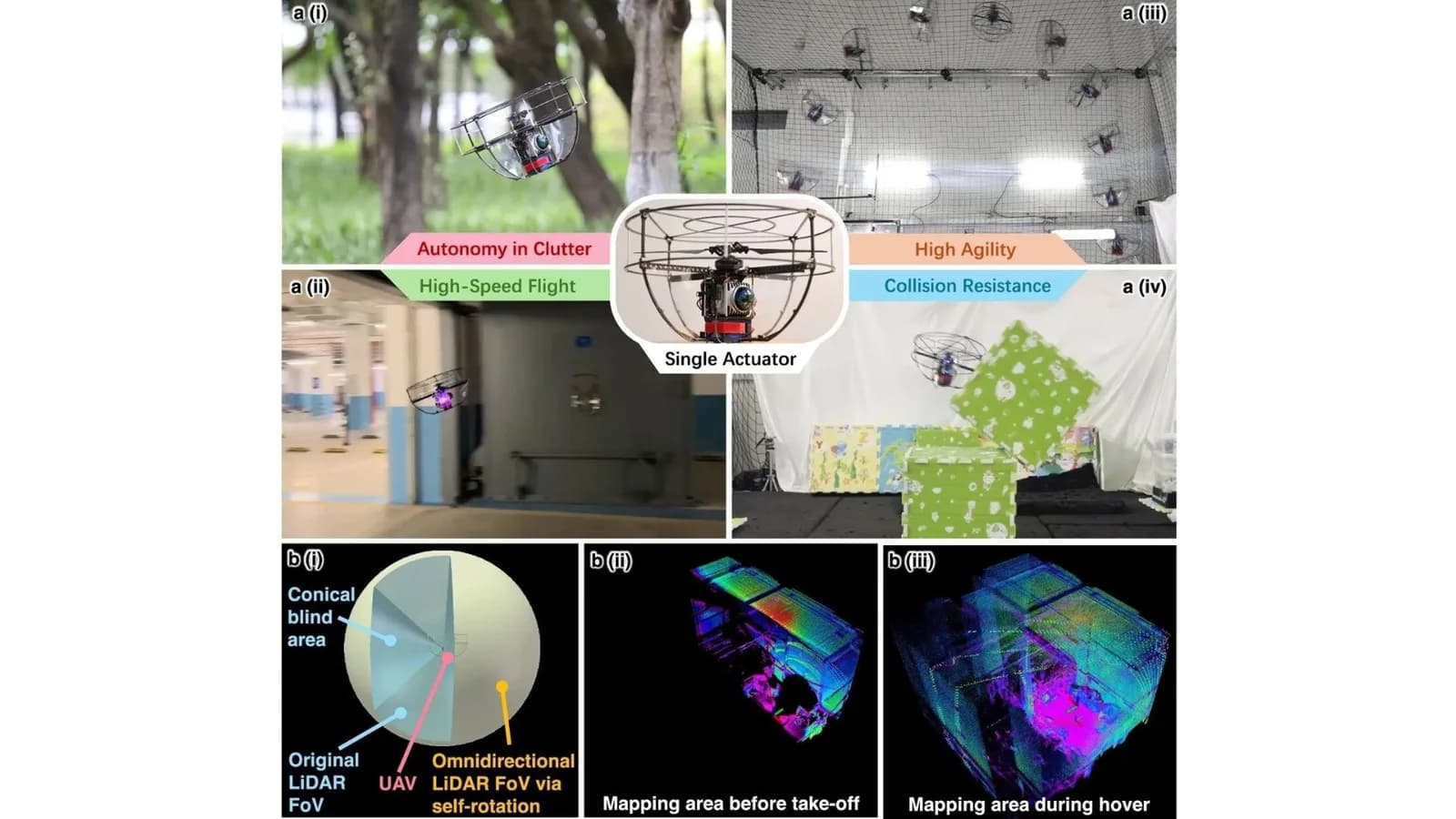
Researchers at the University of Hong Kong (HKU) have developed a single-propeller autonomous drone that uses just one motor to fly and scan its surroundings in all directions.
Named PULSAR II, the drone uses continuous body rotation to detect obstacles above, below, and around it with a single LiDAR sensor.
The design eliminates the need for multiple sensors or a rotating gimbal while enabling high-speed flight in complex environments such as forests and underground parking lots.
The drone has also demonstrated controlled flight during collision tests. “The key is to coordinate the mechanical structure, environmental sensing, and flight control so that this simple design can also handle complex environments,” said Fu Zhang, an associate professor at HKU, in a statement.
Single-motor drone
The HKU team has developed a single-propeller autonomous drone that uses its own rotation to scan its surroundings in all directions.
PULSAR II runs on a single motor and uses one LiDAR sensor to detect obstacles above, below, and around it. Instead of relying on multiple sensors or a mechanical rotating assembly, it exploits its natural body spin to expand its field of view. The technology could help small drones navigate complex environments such as dense forests, caves, tunnels, and underground facilities, where GPS signals may be unavailable.
Conventional quadrotor drones use four motors to control their flight. Expanding their sensing coverage often requires additional cameras, LiDAR sensors, or rotating mechanisms, increasing weight, power consumption, and system complexity. PULSAR II takes a different approach. Its specially designed, swashplate-less propulsion mechanism uses a single motor to drive two propeller blades.
The drone uses its natural body spin to combine efficient flight with omnidirectional sensing.
Researchers say that by precisely adjusting the motor’s rotational speed during each revolution, the system changes the angle of attack of the blades. This generates the torque needed to control the drone’s flight direction.
The drone’s body continuously rotates during flight, allowing a vertically mounted LiDAR sensor to scan its surroundings as the aircraft spins. LiDAR works by emitting laser signals and measuring their reflections to calculate distances to nearby objects. The resulting measurements help build three-dimensional (3D) maps of the environment.
In PULSAR II, the combination of body rotation and LiDAR allows the sensor to capture areas that would otherwise remain outside its field of view, including ceilings, floors, and surrounding obstacles.
During indoor experiments, the drone initially generated only partial maps before takeoff. Once airborne, its rotating LiDAR collected additional measurements to produce more complete 3D point-cloud maps with fewer blind spots.
Operating with a single motor also presents challenges in maintaining precise flight control. The propulsion system does not respond consistently at different rotational speeds, making accurate trajectory tracking difficult. To address this, the researchers developed an experimental propulsion model and a compensation method. They also introduced model predictive control on manifolds to improve flight accuracy.
Autonomous forest navigation
In tests, PULSAR II completed high-speed figure-eight trajectories and in-air flipping maneuvers. Its trajectory-tracking error was substantially lower than that of the conventional control method used for comparison.
The team also developed a collision-resistant control system and installed a lightweight carbon-fiber protective frame around the drone. During experiments, researchers dropped a soft ball onto the hovering aircraft and arranged for it to collide with and push away obstacles while flying forward. The drone maintained stable flight during these tests.
The researchers tested PULSAR II in tree-dense forests and underground parking garages containing pillars, doorways, and overhead pipes. The drone navigated narrow passages and avoided obstacles at speeds exceeding 6 meters per second (20 feet per second).
Its onboard system independently handled mapping, obstacle avoidance, path planning, and flight control. The tests did not rely on GPS navigation, external motion-capture equipment, or a ground-based computer. The drone weighs approximately 1.12 kilograms (2.5 pounds) and recorded a measured hovering time of 15 minutes and 50 seconds.
The researchers see potential applications in search and rescue, disaster response, and 3D terrain mapping, particularly in environments where satellite navigation signals are weak or unavailable. They plan to improve the drone’s localization capabilities in open environments with insufficient laser-reflecting features.
Source: https://interestingengineering.com/innovation/drone-see-in-every-direction
Get the latest news delivered to your inbox.
Related articles