New underwater robot dives 328 feet deep to spot hull damage before it sinks your trip
A Chinese underwater robot that lets boat owners inspect propellers, check hull damage, and explore...
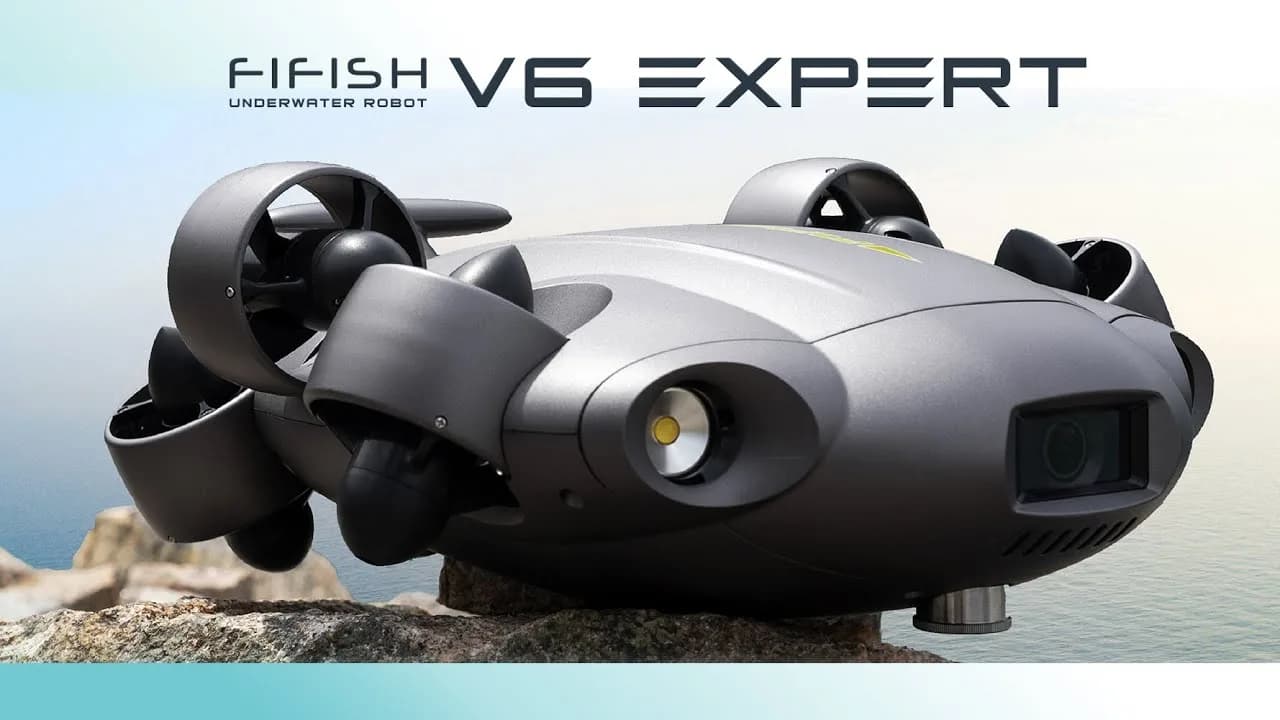
A Chinese underwater robot that lets boat owners inspect propellers, check hull damage, and explore submerged areas without getting wet is now available for $3,499.
Developed by underwater robotics specialist QYSEA, the FIFISH V6 EXPERT is a tethered remotely operated vehicle (ROV) with a modular design that includes detachable components for its motor, lighting, camera, and battery.
The system combines 4K cameras, multidirectional movement, and an optional robotic arm to capture footage and handle small objects underwater.
The system allows users to investigate potential damage, check for tangled ropes, and examine submerged objects from the surface.
Robotic diving expert
Designed to operate in environments that are difficult or unsafe for divers to access, the ROV combines a high-definition camera, six degrees of freedom (6-DOF) movement, powerful LED lighting, and compatibility with several underwater tools. It can descend to depths of up to 100 meters (328 feet), allowing users to examine boat hulls, propellers, underwater structures, and other submerged objects.
The robot measures 38.3 centimeters long, 33.1 centimeters wide, and 14.3 centimeters high. It weighs approximately 4.6 kilograms (10.14 pounds), making it relatively compact for transportation and deployment. Its propulsion system uses multiple thrusters to provide movement in six directions: forward and backward, left and right, and up and down. It can also rotate through 360 degrees in yaw, pitch, and roll, allowing it to change orientation without needing to turn around. QYSEA lists its maximum speed at 3 knots (1.5 meters per second).
The V6 EXPERT uses a 1/2.3-inch Sony CMOS image sensor with 12-megapixel resolution and an f/2.5 lens. Its camera offers a 166-degree field of view above water and a 96-degree field of view underwater. It can record 4K video at 25 or 30 frames per second, while 1080p footage can be captured at up to 120 frames per second.
To improve visibility in dark underwater environments, the ROV carries two LED lights producing a combined 6,000 lumens. The lights have a 5,500K color temperature and a 120-degree beam angle. Users can save footage and photographs using its removable microSD storage system, which comes with a 128GB card and supports cards up to 256GB according to QYSEA’s current specifications.
Precision diving technology
The robot also incorporates onboard sensors to help maintain its position and orientation underwater. These include a gyroscope, accelerometer, magnetometer, depth sensor, and temperature sensor.
According to the firm, its depth-lock function can maintain a selected depth with an accuracy of approximately ±1 centimeter, helping the vehicle remain steady while inspecting a particular section of a boat or underwater structure. Other intelligent features include Vision Lock, Diver Tracking, and Q-STEADY 2.0 stabilization technology. Arm+1
Power comes from a 156Wh battery, with an operating duration of approximately one to four hours depending on working conditions. QYSEA also advertises fast charging, with the battery reaching 90 percent capacity in about an hour, although actual charging times can vary. An optional Onshore Power Supply System (OPSS) allows extended operations using a surface-based power source rather than relying entirely on the onboard battery.
The V6 EXPERT connects to its surface controller through a tether cable available in 100-meter (328-foot) and 200-meter (656-foot) configurations. The cable has a tensile strength of 100 kilogram-force and neutral buoyancy underwater, helping prevent it from pulling the vehicle down or interfering with its movement. The remote controller uses 5GHz Wi-Fi connectivity and offers up to four hours of operating time.
One of its most useful features is the Q-IF interface, which supports additional equipment for different underwater tasks. Compatible accessories include a robotic arm with parallel grippers for retrieving objects, a retrieval hook, a 2D imaging sonar for locating objects in poor visibility, and measurement tools such as laser scalers and distance meters. Water-quality sensors can also measure dissolved oxygen, salinity, turbidity, and pH.
For boat owners, the robotic arm is particularly useful for handling small objects, while the camera provides a closer look at damaged or obstructed areas. However, the robot’s capabilities depend on the accessories fitted and underwater conditions.
Get the latest news delivered to your inbox.
Related articles