PAC-MAN capsules use turbulence to filter particles at scales from 1 cm to 5 micrometers
A hollow capsule with a single hole can sort particles using nothing but the churning...
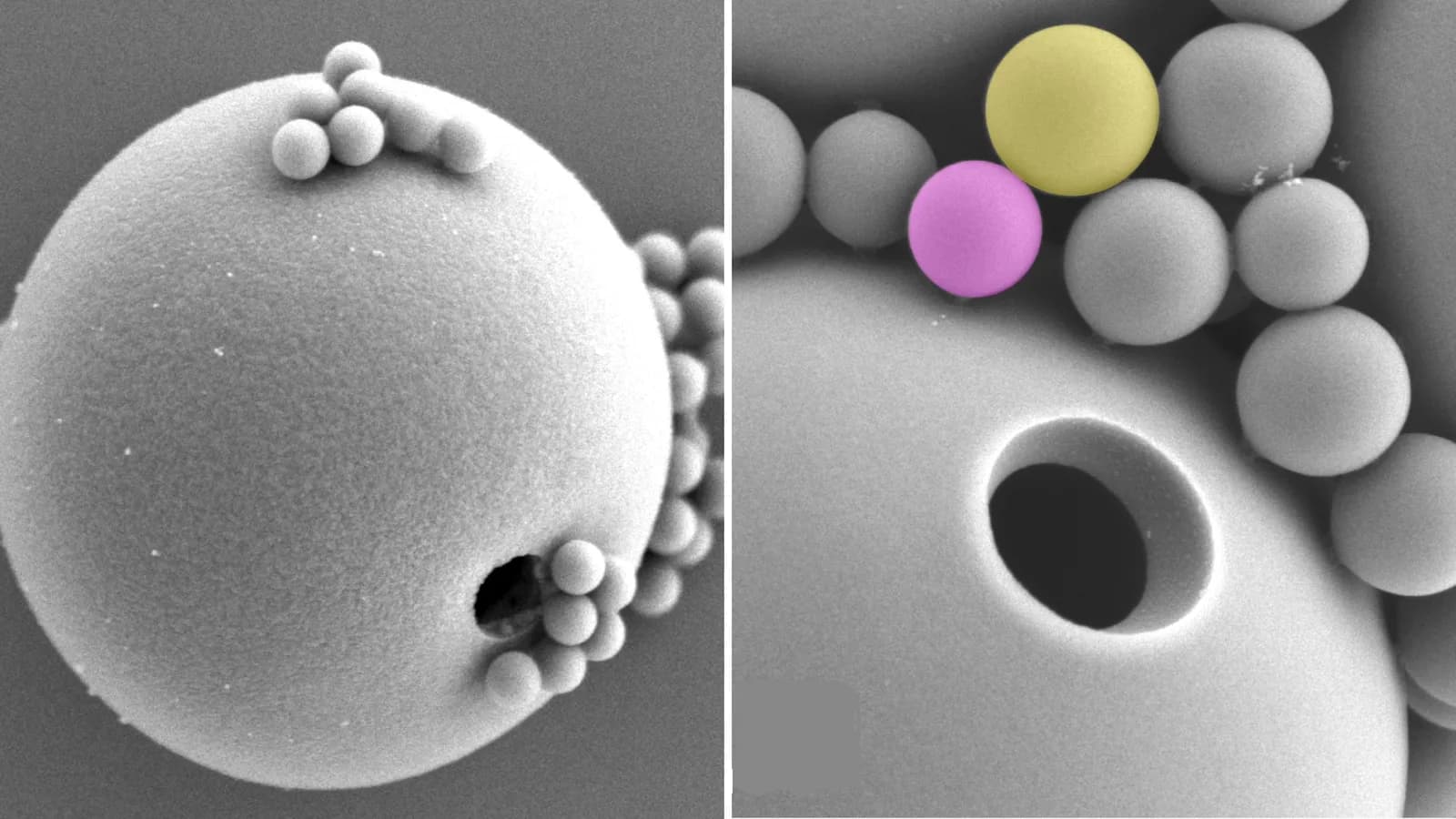
A hollow capsule with a single hole can sort particles using nothing but the churning water around it, and the trick works for capsules from the size of a pea down to those smaller than a red blood cell.
The team, co-led by Stefano Sacanna of New York University and William Irvine of the University of Chicago, built capsules that rely on geometry and turbulence, not chemistry, to take in or push out particles. At times, they gobble particles up like PAC-MAN eating dots.
Putting chaos to work
Turbulence is irregular, chaotic flow at many scales, from cream swirling into coffee to whirlpools in river rapids. “Turbulence is usually thought of as pure chaos: it mixes, scatters, and wastes energy,” Sacanna said. “We asked whether that chaos could be put to work.”
A turbulence shelter
The team made hollow polymer capsules, each with one hole, and placed them in liquid that was stirred or shaken. The walls shield the interior from the swirling flow, creating what the researchers call a “turbulence shelter.” Only swirls smaller than the hole get in, so the inside stays calm while the outside churns.
That difference turns the opening into a selective gate. When small particles were added, the capsule either took them in or kept them out, depending on the turbulent flow and the hole size.
“Inside the capsule, it’s fairly calm. But outside, the environment is raging,” Irvine said. “This creates a gradient, so particles flow, and functions emerge.”
Depending on how well a particle fits the hole, Sacanna said, a shell either gobbles particles up until it is packed or keeps them out almost completely. Hence the name: the “PAC-MAN effect.”
The selectivity needs no chemistry, and the capsule isn’t a sieve, Sacanna said. Particles that would slip easily through the hole can be kept out, while ones that barely fit get packed in. The capsule reshapes the turbulence at its opening, and that decides which particles end up inside.
Same design, three scales
To see whether the effect holds across sizes, the team repeated the experiment with capsules about 1 centimeter (0.4 inch), 1 millimeter, and 5 micrometers across. The two larger sizes were made with specialized 3D printers at the University of Chicago, and the smallest were made with synthetic methods in Sacanna’s lab.
All three took in or released particles according to the size of the hole. In the centimeter-sized shells, changing the hole size by less than 10% was enough to switch a shell from collecting particles to rejecting them. In the much smaller capsules, the shells could tell particles apart by size or density.
Uses and limits
The researchers see uses in filtering fluids, sorting particles and environmental cleanup, where certain contaminants need to be pulled from water. Because the capsules can be tuned to release cargo at rates from seconds to years, they also see potential for drug delivery.
The report describes lab experiments, so these applications remain possibilities, not demonstrated products.
“This gives us a new way of thinking about filtration,” Sacanna said. “Instead of spending energy to control a flow, you let the energy already present in turbulence do the work.”
The research was published in Science.
Get the latest news delivered to your inbox.
Related articles