Ranked: The Fastest Mobile Internet by Country in 2026
The UAE's median mobile download speed is about 3.6 times America's, with Gulf countries taking the top three spots.
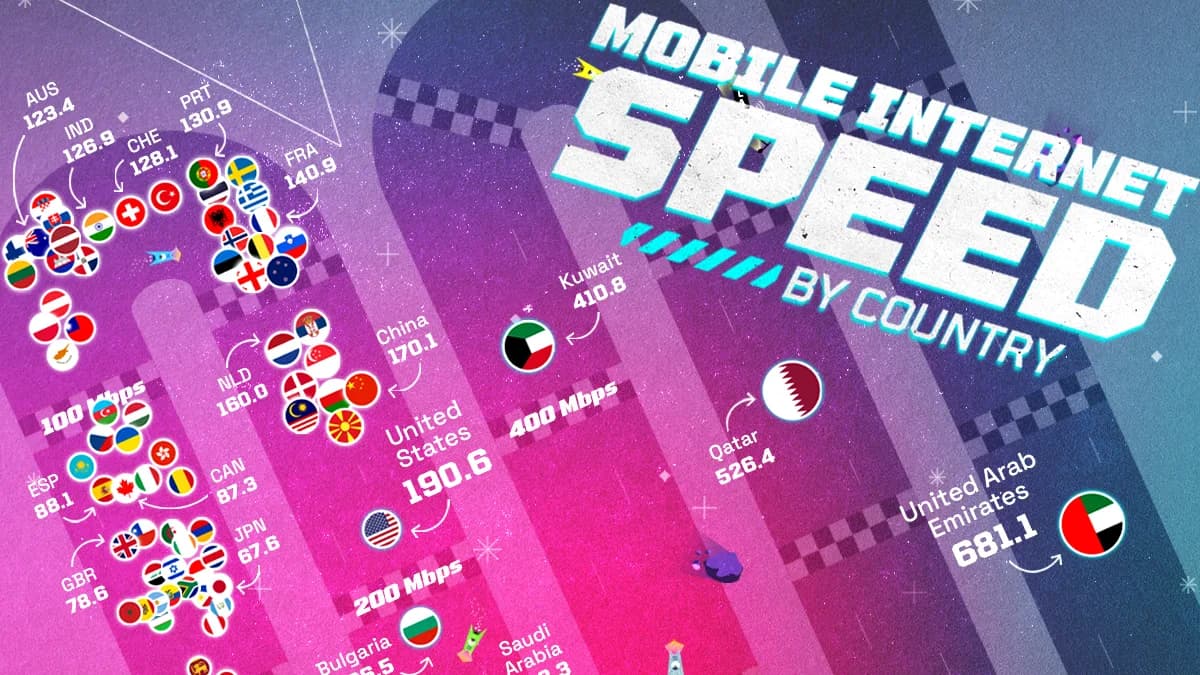
Which Countries Have the Fastest Mobile Internet in 2026?
Key Takeaways
The UAE’s mobile speed is about 3.6 times the U.S. median, at 681.1 Mbps versus 190.6 Mbps.
Five of the top 10 fastest countries are in the Middle East, reflecting strong 5G infrastructure and high-capacity networks.
The world’s fastest mobile networks are found in some surprising places, with several Middle Eastern countries outperforming major economies like the United States, China, and Japan.
This graphic compares median mobile download speeds across 100 countries and areas using Ookla’s Speedtest Global Index for September 2026.
Middle Eastern Countries Lead in Mobile Internet Speed
The United Arab Emirates tops the global ranking with a median mobile download speed of 681.1 Mbps, more than 150 Mbps ahead of second-place Qatar (526.4 Mbps). Kuwait follows in third at 410.8 Mbps, giving Gulf countries a clean sweep of the top three positions.
Five of the top 10 countries are in the Middle East, with Bahrain (241.4 Mbps) and Saudi Arabia (222.3 Mbps) also ranking among the world’s fastest mobile networks.
The table below shows the median mobile download speeds across 100 countries and areas in 2026:
RankCountry / areaMedian mobile download speed in 2026 (Mbps)
1 United Arab Emirates681.1
2 Qatar526.4
3 Kuwait410.8
4 Germany299.8
5 Brazil274.4
6 South Korea244.2
7 Bahrain241.4
8 Vietnam230.3
9 Saudi Arabia222.3
10 Bulgaria206.5
11 United States190.6
12 North Macedonia174.2
13 China170.1
14 Malaysia169.8
15 Oman169.6
16 Denmark166.2
17 Singapore163.7
18 Netherlands160.0
19 Serbia158.4
20 New Zealand148.1
21 Georgia147.5
22 Slovenia145.6
23 Estonia144.8
24 Belgium144.3
25 Norway141.7
26 France140.9
27 Albania138.0
28 Greece137.0
29 Thailand133.7
30 Sweden133.2
31 Portugal130.9
32 Türkiye129.4
33 Switzerland128.1
34 India126.9
35 Dominican Republic124.8
36 Latvia124.5
37 Slovakia124.5
38 Croatia124.1
39 Cambodia123.9
40 Australia123.4
40 Finland123.4
42 Lithuania123.2
43 Austria116.0
44 Poland113.2
45 Taiwan110.8
46 Cyprus109.5
47 Azerbaijan98.9
48 Hungary96.7
49 Czechia95.0
50 Ukraine94.8
51 Kazakhstan93.0
52 Hong Kong (SAR)90.8
53 Spain88.1
54 Canada87.3
55 Italy87.1
56 Romania85.4
57 Chile80.8
58 United Kingdom78.6
59 Algeria77.7
60 Armenia75.9
61 Ireland75.0
62 Iraq71.9
63 Israel71.5
64 Costa Rica71.3
65 Indonesia70.8
66 South Africa69.0
67 Ecuador68.8
68 Morocco68.4
69 Argentina68.2
70 Moldova68.1
71 Japan67.6
72 Philippines67.0
73 Uzbekistan66.8
74 Guatemala65.2
75 Peru63.1
76 Sri Lanka57.2
77 Egypt53.7
78 Kyrgyzstan51.9
79 Jordan49.6
80 Tunisia49.0
81 Mexico47.7
82 Colombia47.5
83 Laos44.4
84 Honduras44.2
85 Nigeria43.4
86 Kenya43.1
87 Bangladesh40.1
88 Panama39.6
89 El Salvador39.5
90 Lebanon37.4
91 Ghana33.8
92 Tanzania32.4
93 Pakistan32.4
94 Venezuela29.2
95 Nicaragua28.1
96 Bosnia and Herzegovina25.8
97 Paraguay25.8
98 Bolivia23.4
99 Afghanistan20.3
100 Libya19.9
Ookla linked the leading trio’s strong 5G performance to ample radio spectrum, extensive coverage, and competition among operators. More spectrum gives networks greater capacity to move data, while wider coverage brings faster connections to more locations.
Germany (299.8 Mbps), Brazil (274.4 Mbps), and South Korea (244.2 Mbps) lead among countries outside the Gulf region.
Brazil is a standout performer, ranking fifth globally at 274.4 Mbps, ahead of South Korea and the United States. Its median speed is more than three times that of Chile (80.8 Mbps) and nearly four times Argentina’s (68.3 Mbps), reflecting the impact of extensive 3.5 GHz spectrum allocations and nationwide 5G rollouts.
Rounding out the top 10 are Vietnam (230.3 Mbps) and Bulgaria (206.5 Mbps), the latter ahead of every Western European country except Germany.
How the U.S. and Other Major Economies Compare
The United States sits just outside the top 10 at 11th (190.6 Mbps), well above the global median of 110.4 Mbps and ahead of major economies like China (170.1 Mbps), France (140.9 Mbps), and Australia (123.4 Mbps).
Several wealthy nations fall below the global median, including Canada (87.3 Mbps), Italy (87.1 Mbps), and the United Kingdom (78.6 Mbps). Japan is particularly surprising: despite its reputation for technological innovation, it ranks just 71st globally, with a median mobile download speed of 67.6 Mbps.
By contrast, fast-growing markets such as India (126.9 Mbps) and smaller European countries like North Macedonia (174.2 Mbps) and Serbia (158.4 Mbps) all outpace these countries, showing that national wealth alone does not guarantee faster mobile networks.
Even the slowest country on the list clears a common everyday benchmark: Libya’s 19.9 Mbps median is above the 15 Mbps connection Netflix recommends for 4K streaming.
Learn More on the Voronoi App
If you enjoyed today’s post, check out The Percentage of Internet Users by Country on Voronoi.
Source: https://www.visualcapitalist.com/mobile-internet-speed-by-country-2026/
Get the latest news delivered to your inbox.
Related articles