Robot submarine finds hidden volcanism inside world’s deepest ocean trench at 21,325 feet
At nearly 11,000 meters (36,089 feet) below the ocean’s surface, the Mariana Trench is a...
At nearly 11,000 meters (36,089 feet) below the ocean’s surface, the Mariana Trench is a realm of crushing pressure and near-freezing darkness. Fire seems impossible here. But scientists exploring the trench’s rugged walls have uncovered evidence of the deepest explosive volcanic eruptions ever documented on Earth.
The University of Texas at Dallas’s discovery upends what geologists thought was possible in one of Earth’s harshest environments.
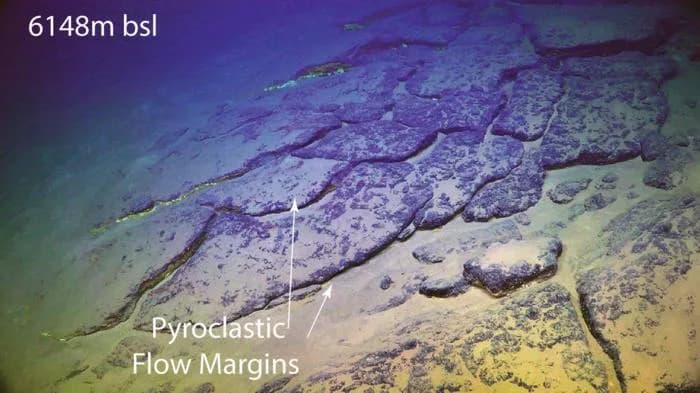
Pyroclastic flow discovered at 6,148 meters below sea level. Credit: Dr Robert J. Stern
Discovery through rocks
The Mariana Trench was born 52 million years ago when the Pacific tectonic plate began sliding beneath the Philippine Sea plate. Today, it holds the Challenger Deep, the deepest known valley on the ocean floor.
Researchers have long wondered what drives its extraordinary depth. Seeking clues, Dr. Robert J. Stern’s team sailed to the western Pacific in late 2024 and deployed the remotely operated vehicle (ROV) Jason/Medea across a 550-kilometer (341 miles) stretch of the forearc near the Deep.
Jason/Medea reached 6,500 meters (about 21,325 feet), well above the trench floor. That was still deep enough to make history.
Over seven dives, the ROV revealed a geological split personality. The eastern section of the trench wall is steeper and deeper, with the boundary between Earth’s crust and upper mantle sitting closer to the seafloor.
The western segment held a startling surprise. There, the team found thin, flat layers of pyroclastic rock, which is the hardened debris left behind by explosive eruptions.
“Explosive volcanism near trenches is unusual, so we were very surprised,” said Stern, lead author. “These are the deepest pyroclastic rocks documented to date from anywhere in the ocean.”
Stretching differently from east to west
Subduction forearcs are cold. Under normal circumstances, the mantle beneath them lacks the heat required to melt and produce fresh magma. Finding young volcanic deposits there challenges long-standing tectonic assumptions.
Erupting under kilometers of seawater also changes the physics of a blast. Immense hydrostatic pressure prevents volcanic gases from expanding the way they do on land or in shallow seas, muting the violent blasts seen at surface volcanoes. Still, these deep flows packed serious heat.
“We haven’t identified the eruption sites yet,” said Stern. “We know that these hot pyroclastic flows moved down slopes, but we don’t think they moved very far. They retained enough heat to re-weld themselves into pretty hard rocks, and that heat would’ve been lost if the pyroclastic flows traveled great distances.”
The rocks show the seafloor is stretching differently from east to west, with older eastern rocks indicating mechanical pulling and younger western volcanic rocks suggesting magma-driven expansion that researchers plan to date.
At the same time, weak coupling allows the narrow Pacific plate to bend sharply and sink steeply. It explains the Challenger Deep’s extreme depth while widening the subduction zone and potentially shifting western Pacific plate motion. Still, the volcanic vents behind these pyroclastic flows remain unlocated, as reaching them requires deep-diving gear most scientists lack.
“We were unable to study the seafloor between the depths of 6,500 meters and 11,000 meters, the depth of the Challenger Deep,” Stern said. “Only Chinese scientists and some wealthy entrepreneurs now have research tools capable of working down to the bottom of the Challenger Deep.”
Until deeper-diving vehicles become more widely available to researchers, the fiery origins of Earth’s darkest abyss will keep some of their secrets locked beneath the waves.
The findings were published in the journal Frontiers in Earth Science.
Source: https://interestingengineering.com/science/robot-submarine-finds-volcanic-activity
Get the latest news delivered to your inbox.
Related articles