Ranked: The World’s Longest Place Names
Explore the world's longest place names, from an 85-letter New Zealand hill to a Welsh village famous for its railway history.
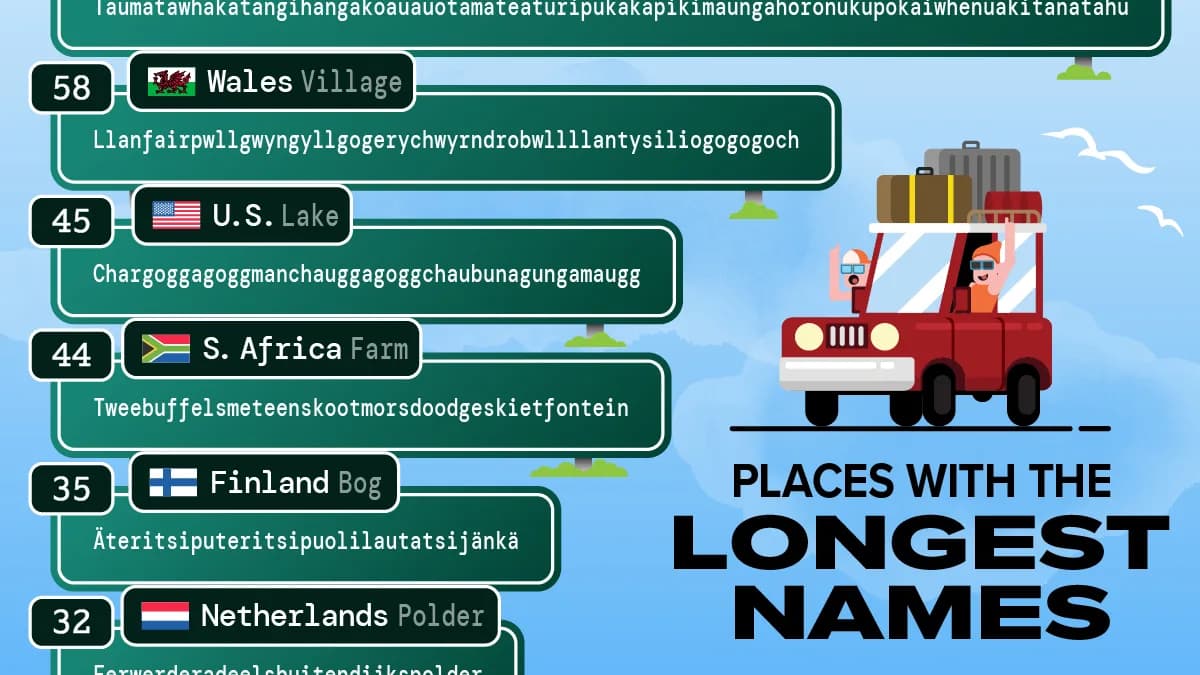
Where Are the World’s Longest Place Names?
Key Takeaways
A hill in New Zealand tops this selection with an 85-letter Māori name, followed by a Welsh village with a 58-letter name.
Finland accounts for 11 of the 45 documented names, more than any other country in the selection. India and the Netherlands each have seven.
The Welsh village of Llanfairpwll adopted its extended name in the 19th century as a publicity attraction to draw railway visitors.
Some place names are so long that fitting them onto a road sign is a challenge. From a hill in New Zealand to a lake in Massachusetts, these unusually long names reveal stories about language, history, and local identity.
This visualization ranks 45 documented examples of single-word place names with at least 25 letters, spanning settlements, lakes, farms, and other geographic features. The selection draws on national censuses, government gazettes, geographic records, and other published sources.
Places With the Longest Documented Names
The dataset was compiled from sources including GeoNames, government place-name records, and official tourism and railway publications.
The table below ranks the 45 selected examples by the number of letters in their displayed spellings.
Documented nameCountryFeature typeLetters
Taumatawhakatangihangakoauauotamateaturipukakapikimaungahoronukupokaiwhenuakitanatahu New ZealandHill85
Llanfairpwllgwyngyllgogerychwyrndrobwllllantysiliogogogoch UK (Wales)Village58
Chargoggagoggmanchauggagoggchaubunagungamaugg United StatesLake45
Tweebuffelsmeteenskootmorsdoodgeskietfontein South AfricaFarm44
Äteritsiputeritsipuolilautatsijänkä FinlandBog35
Ferwerderadeelsbuitendijkspolder NetherlandsPolder32
Minnertsgaasterzuidermiedpolder NetherlandsPolder31
Modutakampaddankaddikudiyiruppu Sri LankaVillage31
Pekwachnamaykoskwaskwaypinwanik CanadaLake31
Thalaivasalkarupanakoundanpudur IndiaHabitation31
Ganapathisundaranatchiyarpuram IndiaHabitation / village panchayat30
Sirigirirajubadrarajukhandriga IndiaVillage / locality30
Nondraisilisilinayalewatonga FijiStream28
Pavilupaddankaddikudiyiruppu Sri LankaVillage28
Vanhainpiikainmarkkinaplassi FinlandHill / elevation28
Venkatanarasimharajuvaripeta IndiaRailway station28
Vijftienhonderdgemetenpolder NetherlandsPolder28
Gopalakrishnarangarayapuram IndiaVillage27
Kanthaudaiyarpuvarasankulam Sri LankaVillage27
Thandavarayansozhaganpettai IndiaHabitation / village panchayat27
Kaksikymmentäviisipenninen FinlandIsland26
Kuusivaaranpäällystäjänkkä FinlandBog26
Mamungkukumpurangkuntjunya AustraliaHill26
Neljänkymmenenpenninkangas FinlandHill / elevation26
Pulithariththapuliyankulam Sri LankaVillage26
Schmedeswurtherwesterdeich GermanyLocality26
Sebaldebuurstermolenpolder NetherlandsPolder26
Swartwitpensbokfonteinberg South AfricaMountain26
Ánnábearttoščielggeboatka FinlandRavine25
Cuokkajárgeašádjatsuotnju FinlandMarsh25
Gasselterboerveenschemond NetherlandsHamlet25
Grootjongensfonteinstrand South AfricaBeach25
Huitebuursterbuitenpolder NetherlandsPolder25
Naakenavaaranalapääkummut FinlandHills25
Narasimhanayakkanpalaiyam IndiaTown (documented variant)25
Njøølvenguevtelenjaevrieh NorwayLake25
Pavilukkilavankudiyiruppu Sri LankaVillage25
Pihâšsuolluučuálmjávrádâh FinlandLake section25
Srikaverirajulingavaripet IndiaHabitation / village panchayat25
Sruffaunoughterluggatoora IrelandStream25
Ulâšjävrnuorttiibelnláddu FinlandLake25
Uudenniitynsalmenkuusikko FinlandForest area25
Valkkeenvaarankurunjärvet NorwayPond25
Westerbroekstermadepolder NetherlandsPolder25
Ylimmäisenaituuksenkynnäs FinlandHill / elevation25
The gap between the top two names is striking. New Zealand’s 85-letter hill name is 27 letters longer than the Welsh village name in second place. A Massachusetts lake (45 letters) and a South African farm (44 letters) round out the top four.
Beyond the leading examples, the selection includes a wide range of geographic features. Sri Lanka contributes five entries, while Finland and the Netherlands stand out for their long names associated with natural landscapes and reclaimed land.
The Stories Behind the Longest Names
New Zealand’s famous hill name is rooted in Māori tradition. Commonly shortened to Taumata, its extended form refers to Tamatea and includes a story of his travels and playing a flute for a loved one, as described by Tourism New Zealand.
A roadside sign displaying the long-form Māori name of the New Zealand hill. Not every unusually long place name developed in the same way. In Wales, the village of Llanfairpwll on the island of Anglesey adopted its extended 58-letter name in the 19th century as a publicity attraction for railway travelers.
The name roughly translates to “St. Mary’s Church in the hollow of white hazel near a rapid whirlpool and the Church of St. Tysilio near the red cave,” according to NASA’s Earth Observatory.
The extended name of Llanfairpwll displayed at its railway station in Wales. In Massachusetts, Webster Lake is also known by the 45-letter name Chargoggagoggmanchauggagoggchaubunagungamaugg.
The lake’s name has roots in the language of the Nipmuc people, who are Indigenous to the region. An earlier form, Chaubunagungamaug, is commonly interpreted as meaning “fishing place at the boundary,” according to historical research published by the Town of Webster.
The name evolved over time, and several spellings appear in historical records.
Webster Lake in Massachusetts is associated with one of the longest place names in the United States. Elsewhere, long names often reflect the way languages combine words to describe places. Finnish place names frequently incorporate references to natural features such as lakes, forests, and bogs, while Dutch names can combine descriptions of settlements, directions, and reclaimed land.
Several Dutch entries refer to polders, low-lying areas protected by dikes and managed through drainage systems. In India, long settlement names can combine personal names, local identifiers, and geographic descriptions.
These naming conventions help explain why certain countries appear frequently in the selection. However, the results also depend on which names have been documented, how they are transliterated, and whether they meet the dataset’s single-word criteria.
Data & Methodology
This dataset includes 45 documented examples of unhyphenated, single-word place names containing at least 25 Latin letters. It covers settlements, natural features, farms, polders, and railway stations, but is not an exhaustive global ranking.
Letter counts are based on the displayed Latin-script spellings. Accented letters count as one, digraphs are counted separately, and standalone descriptors such as “Lake” are excluded. Some entries use established long-form variants rather than everyday names.
Sources include national censuses, government gazettes, geographic records, GeoNames, and published reporting. Additional references include Tourism New Zealand and official Indian government and railway records.
Learn More on the Voronoi App
If you enjoyed this visualization, check out Ranked: The Highest Mountain on Every Continent on the Voronoi app.
Get the latest news delivered to your inbox.
Related articles