
Smart sensors track 932°F molten salt to spot hidden faults in US nuclear reactors
A novel monitoring system developed by scientists in the US combines fiber-optic temperature sensors with...
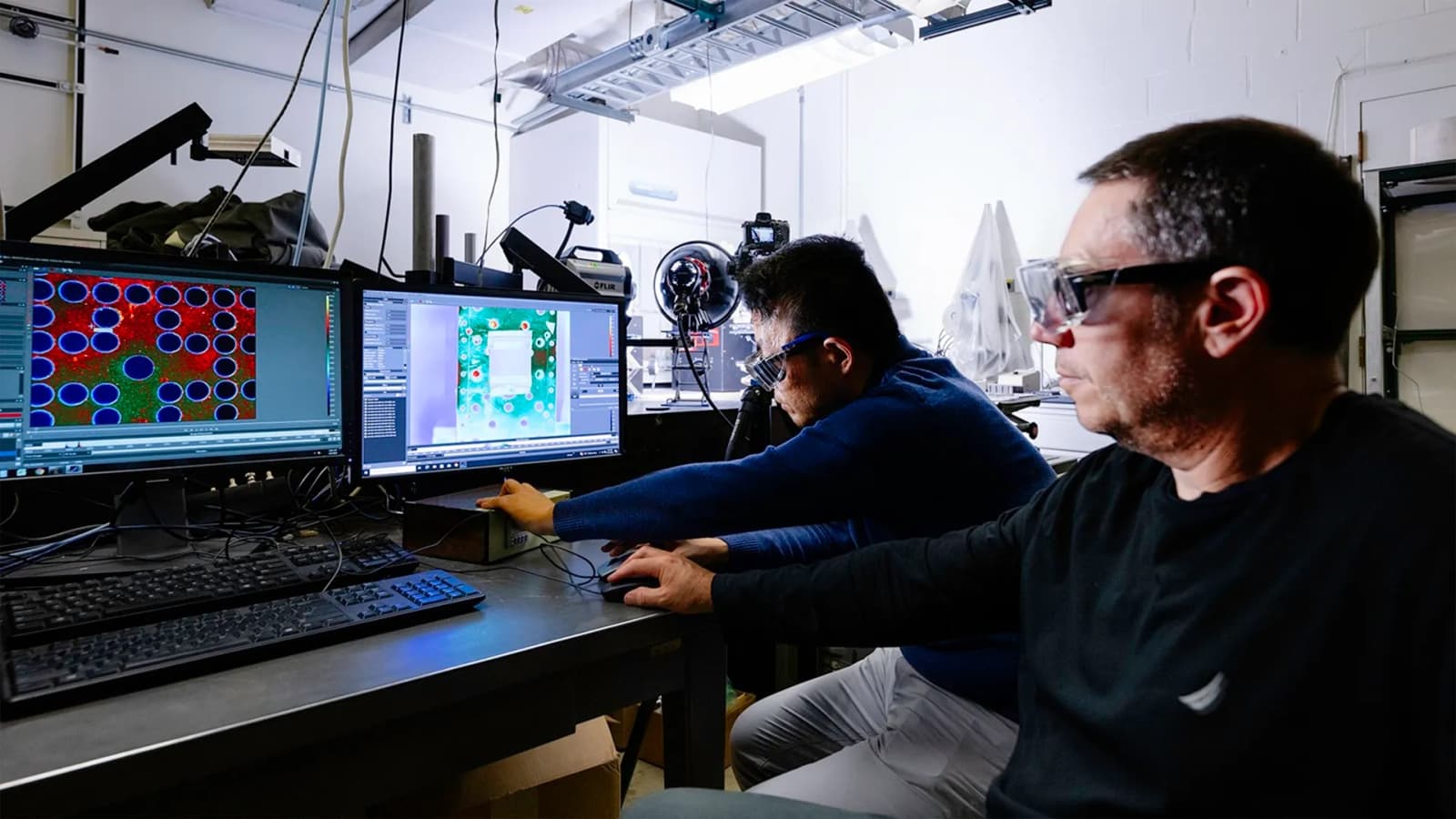
A novel monitoring system developed by scientists in the US combines fiber-optic temperature sensors with artificial intelligence (AI) to find hidden blockages inside nuclear reactors before they cause costly failures and shutdowns.
The technology was made by researchers at the US Department of Energy’s (DOE) Argonne National Laboratory (ANL). It is designed for heat exchangers used in molten-salt-cooled reactors (MSCRs).
Heat exchangers are essential for nuclear plants as they move heat away from the reactor core. In an MSCR, hot salt carries thermal energy from the core to another fluid, which can ultimately be used to produce steam and generate electricity.
However, the salt can solidify if its temperature falls too close to its freezing point. This can, in turn, partially or fully block the thousands of small channels inside a heat exchanger and restrict coolant flow. This prompted the team to develop a way to spot such blockages early.
Thousands of channels
According to ANL, a matrix-type heat exchanger can contain between 2,000 and 4,000 small channel. Larger versions can have more. Most heat exchangers today monitor temperature and flow rates only at their inlet and outlet.
This, however, provides limited data about what occurs inside individual channels, which allows the smaller blockages to go unnoticed. To tackle the issue, the team proposed embedding distributed fiber-optic temperature sensing into the heat exchanger’s support structures.
The sensors work by collecting large amounts of temperature data in real time. AI algorithms then analyze the information to identify unusual temperature patterns that could indicate solidified salt is blocking a channel.
Argonne scientists study heat transfer transients in a metallic structure for applications in nuclear reactor systems. Credit: Argonne National Laboratory
“If one of those channels becomes plugged either partially or completely we want to be able to detect it, locate it and determine the severity,” Alex Heifetz, PhD, an Argonne principal electrical engineer and co-author of the study, stated. ”It’s like getting a high-resolution look into where the fault is occurring in the system.”
Heifetz said that the sensors would be attached to mechanical support structures rather than placed directly inside the channels. As a result, they would not require penetration through the heat exchanger walls or interfere with its operation.
The AI is also designed to explain why it has raised an alarm. It provides operators with information about the detected problem and how it reached its conclusion.
Keeping reactors running
Early detection is particularly important for molten-salt-cooled reactors because they operate at much higher temperatures than conventional pressurized water reactors. The salt coolant used in these systems freezes at roughly 932 degrees Fahrenheit (500 degrees Celsius).
Detecting small temperature changes could give operators an early warning that coolant is beginning to solidify. According to the researchers, the AI can identify subtle patterns across large amounts of sensor data that would be difficult for a human operator to spot.
“Our approach can detect barely distinguishable patterns in large volumes of data that would be challenging for a human to inspect,” Konstantinos Prantikos, PhD, a Purdue University research assistant, and paper co-author, said in a press release. “Unlike humans, AI doesn’t get tired of looking at thousands of numbers. It also explains its decisions in a way that helps us to understand and trust the systems.”
Heifetz noted that finding a blockage early could allow the operators to develop a remediation plan before the entire heat exchanger fails. “Repairing or replacing a failed heat exchanger is an expensive procedure that will most likely force an unplanned reactor shutdown,” he concluded.
The study has been published in the journal Nature Scientific Reports.
Related articles

Trump says US is officially renaming AI ‘super intelligence’
In a speech Tuesday morning at the UN General Assembly, Donald Trump railed against Iran, "globalists," climate change, and transgender people while also claiming that the US is now "officially"…

The Beats 360 are what I’d bring to the gym if I hated earbuds
Everyone has seen someone at the gym or running around their neighborhood wearing headphones that were never designed for workouts. Quite often those headphones are Beats.
Elon Musk floats 30-minute Hyperloop trip idea between Austin and San Antonio
Elon Musk’s tunneling startup The Boring Company is working on a “simple precursor Hyperloop” that...

This quadcopter swaps propellers for 3D printed radial impellers and still flies
A drone builder known as QUADMOVR has swapped every propeller on a self-built quadcopter for...

US engineers 3D-print giant two-ton steel mold to make lighter aircraft doors
Inside a Tennessee laboratory, a robotic arm spent eight weeks 3D-printing a two-ton, six-foot-tall block...

Nvidia approves LG’s 5.1-MWh battery storage system to power AI factories
LG Energy Solution has qualified its battery energy storage system under NVIDIA’s DSX Ready program,...