
This quadcopter swaps propellers for 3D printed radial impellers and still flies
A drone builder known as QUADMOVR has swapped every propeller on a self-built quadcopter for...
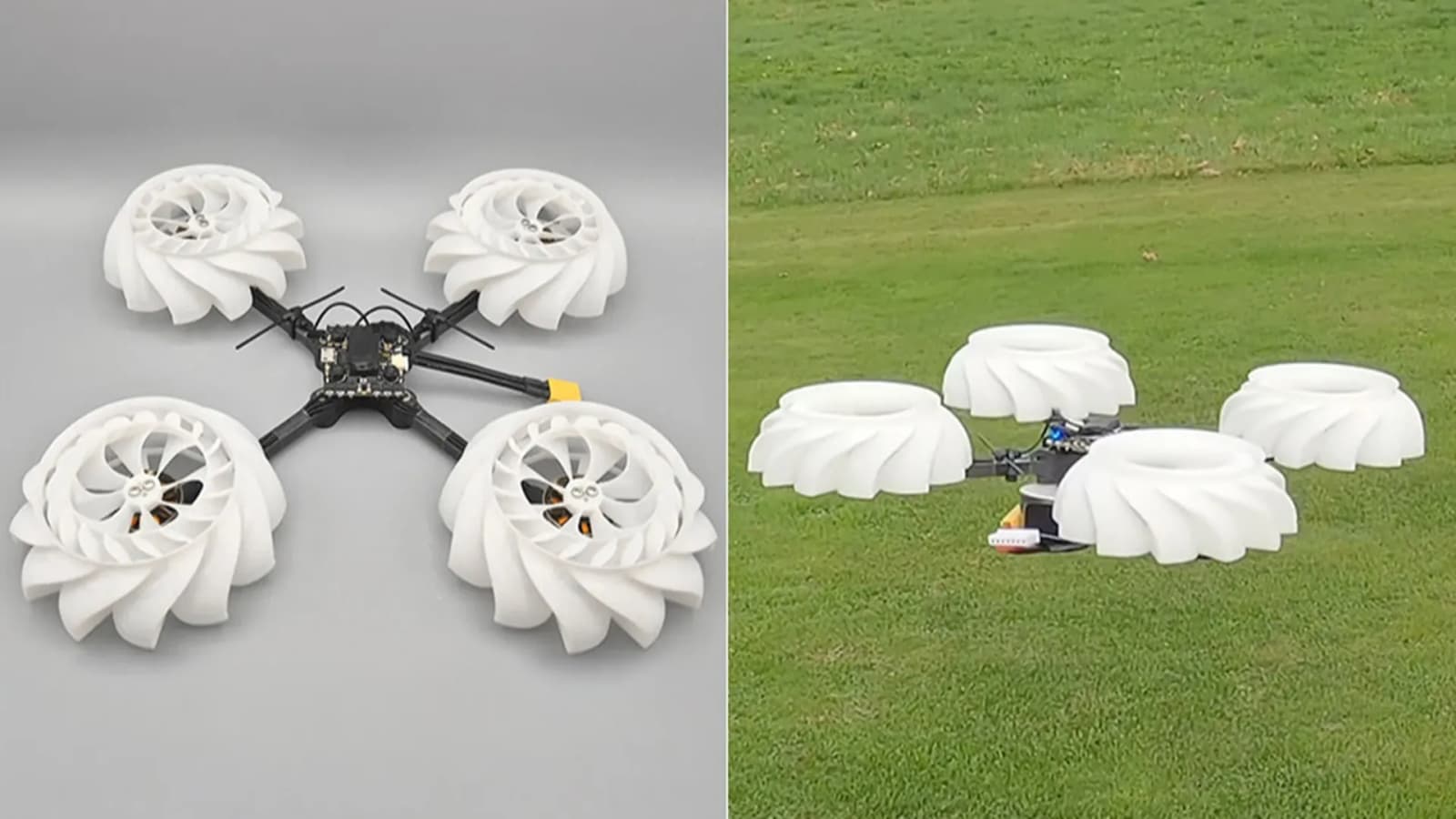
A drone builder known as QUADMOVR has swapped every propeller on a self-built quadcopter for 3D printed centrifugal wheels, each sealed inside its own vaned housing. The design departs sharply from the standard propellers that have long dominated quadcopter flight.
Each impeller measures about 2.4 inches (60 millimeters) across and is printed in PETG plastic. It bolts directly onto a standard T-mount motor using two M2 screws. A matching housing about 3.5 inches (90 millimeters) wide and 1.1 inches (28 millimeters) tall sits between the motor and the carbon arm, leaving a gap of just 0.3 millimeters around the spinning wheel.
How airflow works
Air enters through an open center on top of each unit. Curved vanes then fling that air outward, much like a shop blower does. Fixed vanes built into the housing redirect the outward blast downward, and four of these assemblies together lift the drone’s movr200cp2 X frame.
The design builds on earlier work by a maker known as Baba, who released an original radial impeller propeller in 2024. QUADMOVR modified that design in May to fit NewBeeDrone FLOW 2004 motors, adjusting the mounting, stiffness and cable routing. The video credits Felix Niessen as the impeller’s original designer.
Weighing tradeoffs
Switching to the impellers carries a real weight cost. The drone weighs about 6.7 ounces (189 grams) without its battery when fitted with the impellers, compared to about 5 ounces (141 grams) with standard three-blade propellers. Each impeller alone weighs roughly 0.55 ounces (15.7 grams), against just 0.1 ounces (2.9 grams) for a typical propeller.
Despite the added weight and drag, the drone still climbs, translates and performs the same acrobatic moves as its propeller-equipped counterpart, based on flight footage shared alongside the project. It does so without GPS or self-leveling assistance. Some viewers described the impellers’ sound as jet-like, while still noting they run quieter than open propeller blades.
Built-in safety margin
The enclosed housing offers a practical safety advantage, wrapping protectively around the spinning parts much like the guards found on early toy quadcopters. QUADMOVR still labels the design experimental, and Baba’s original listing warns that motor height, wheel-to-duct alignment and motor speed rating all need to line up closely for reliable flight.
Some pilots who tried an earlier 60-millimeter version reported it would simply shake in place if anything was off, and one tester who mounted it on a heavier 5-inch quadcopter watched parts break under the added strain.
The print files are freely available on MakerWorld under a Creative Commons non-commercial license. Builders will need a capable FDM 3D printer and a T-mount 2004 motor to attempt the project themselves. Printing the two plates takes about 7 hours using 0.16-millimeter layers, five walls and no infill, and the parts require no balancing once removed from the printer, though slight sanding may help them fit properly.
Related articles

The Beats 360 are what I’d bring to the gym if I hated earbuds
Everyone has seen someone at the gym or running around their neighborhood wearing headphones that were never designed for workouts. Quite often those headphones are Beats.
Elon Musk floats 30-minute Hyperloop trip idea between Austin and San Antonio
Elon Musk’s tunneling startup The Boring Company is working on a “simple precursor Hyperloop” that...

US engineers 3D-print giant two-ton steel mold to make lighter aircraft doors
Inside a Tennessee laboratory, a robotic arm spent eight weeks 3D-printing a two-ton, six-foot-tall block...
Nvidia approves LG’s 5.1-MWh battery storage system to power AI factories
LG Energy Solution has qualified its battery energy storage system under NVIDIA’s DSX Ready program,...
Kairos Power teams up with Samsung to build 50-megawatt nuclear reactor for Google
Kairos Power has chosen Samsung Construction and Trading to help build its 50-megawatt nuclear demonstration...

It’s time for the Mac Neo
The Mac Mini is a great little desktop computer, and back when it cost $599, it was easy to recommend to anyone who wanted something speedy, simple, and cheap.