US Abrams tank gains new kit to launch kamikaze drones at targets beyond 18 miles
General Dynamics Land Systems has unveiled PERCH 2.0, an upgraded launcher kit that equips M1A2...
This story was prepared automatically by software.
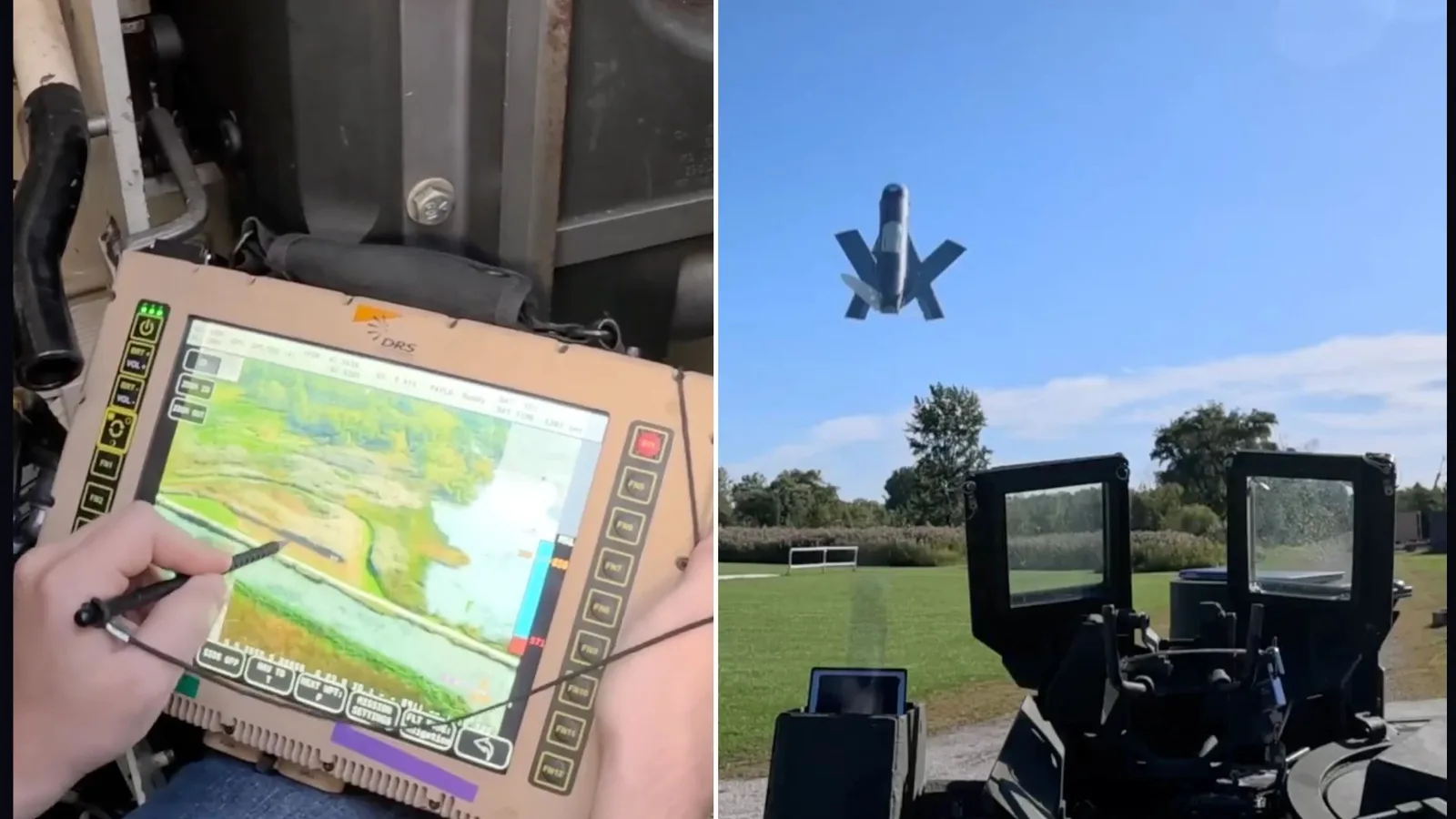
General Dynamics Land Systems has unveiled PERCH 2.0, an upgraded launcher kit that equips M1A2 Abrams tanks and Stryker armored vehicles with AeroVironment Switchblade 300 loitering munitions. The system is designed to give vehicle crews extended-range surveillance and the ability to strike targets beyond their direct line of sight.
PERCH, short for Precision Effects & Reconnaissance, Canister-Housed, was developed in partnership with AeroVironment. The latest version, announced by General Dynamics on social media, introduces changes intended to improve the system’s integration with armored vehicles and expand its reconnaissance and strike capabilities.
The company says PERCH 2.0 supports beyond-line-of-sight surveillance and over-the-horizon lethality using Switchblade 300 variants, letting crews identify threats and engage targets farther away without exposing their vehicles to direct fire.
Bringing loitering munitions to armored vehicles
The Switchblade 300 is a small, tube-launched loitering munition that can be used for reconnaissance and precision strikes. After launch, it can remain airborne while its operator searches for a target, then directs the aircraft toward it.
By integrating the weapon into a vehicle-mounted launcher, PERCH is intended to give tank and armored vehicle crews an organic reconnaissance and strike capability. Instead of relying entirely on dismounted troops or external reconnaissance assets, crews could use the drones to observe areas beyond the vehicle’s immediate field of view.
General Dynamics said PERCH 2.0 supports extended-range surveillance and anti-armor strikes using the Switchblade 300 Block 20 (18-mile range), as well as strikes against softer targets using Block 10 and Block 20 variants.
The system also supports target handoffs between vehicles and between mounted and dismounted forces, according to the company. This could help units share information as they move through complex terrain, although the announcement does not detail the precise communications architecture or the conditions under which these handoffs take place.
Updated design frees up space on the Abrams
One of the changes highlighted in the PERCH 2.0 announcement is its more space-efficient configuration. General Dynamics says the upgraded system returns 41% of the sponson-box volume compared with the original PERCH design.
PERCH 2.0
Our Precision Effects & Reconnaissance, Canister-Housed technology, created in partnership with AV, has been upgraded for 2026.
The PERCH common modular kit integrates onto M1A2 Abrams SEPv3 tanks and Stryker vehicles to provide beyond line of sight (BLOS)… pic.twitter.com/nD6zlijGUJ
— General Dynamics Land Systems (@GD_LandSystems) October 21, 2026
On the Abrams, the sponson box is a storage compartment mounted along the side of the turret. Replacing or adapting this space for a drone-launching system introduces a trade-off between adding new capabilities and retaining room for equipment and supplies.
The original PERCH kit was designed to attach to existing vehicle mounting points without requiring welding or cutting, according to previous descriptions of the system. Its modular approach is intended to simplify integration while avoiding major modifications to the host vehicle.
The upgraded kit is intended for the M1A2 Abrams SEPv3 and Stryker vehicles, extending the concept beyond heavy tanks to wheeled armored platforms.
From field trials to an expanded capability
The original PERCH system was demonstrated during a US Army obstacle-breaching exercise at Fort Hood, Texas, in October 2025. During the Machine Assisted Rugged Sapper event, an Abrams equipped with the system launched Switchblade 300 and Switchblade 600 munitions to support reconnaissance and targeting ahead of troops negotiating an obstacle.
That demonstration showed how vehicle-launched drones could support forces operating in difficult terrain. PERCH 2.0 now emphasizes the Switchblade 300 family and improvements to the launcher’s packaging and capabilities. By combining protected mobility with remotely operated surveillance and precision-strike options, PERCH could help crews detect and respond to threats without moving the vehicle directly into view of the target.
Related articles