
World’s most powerful rocket reaches orbit, deploys 26 Starlink V3 satellites
The world’s largest and most powerful launch vehicle, SpaceX’s Starship, has just launched into orbit...
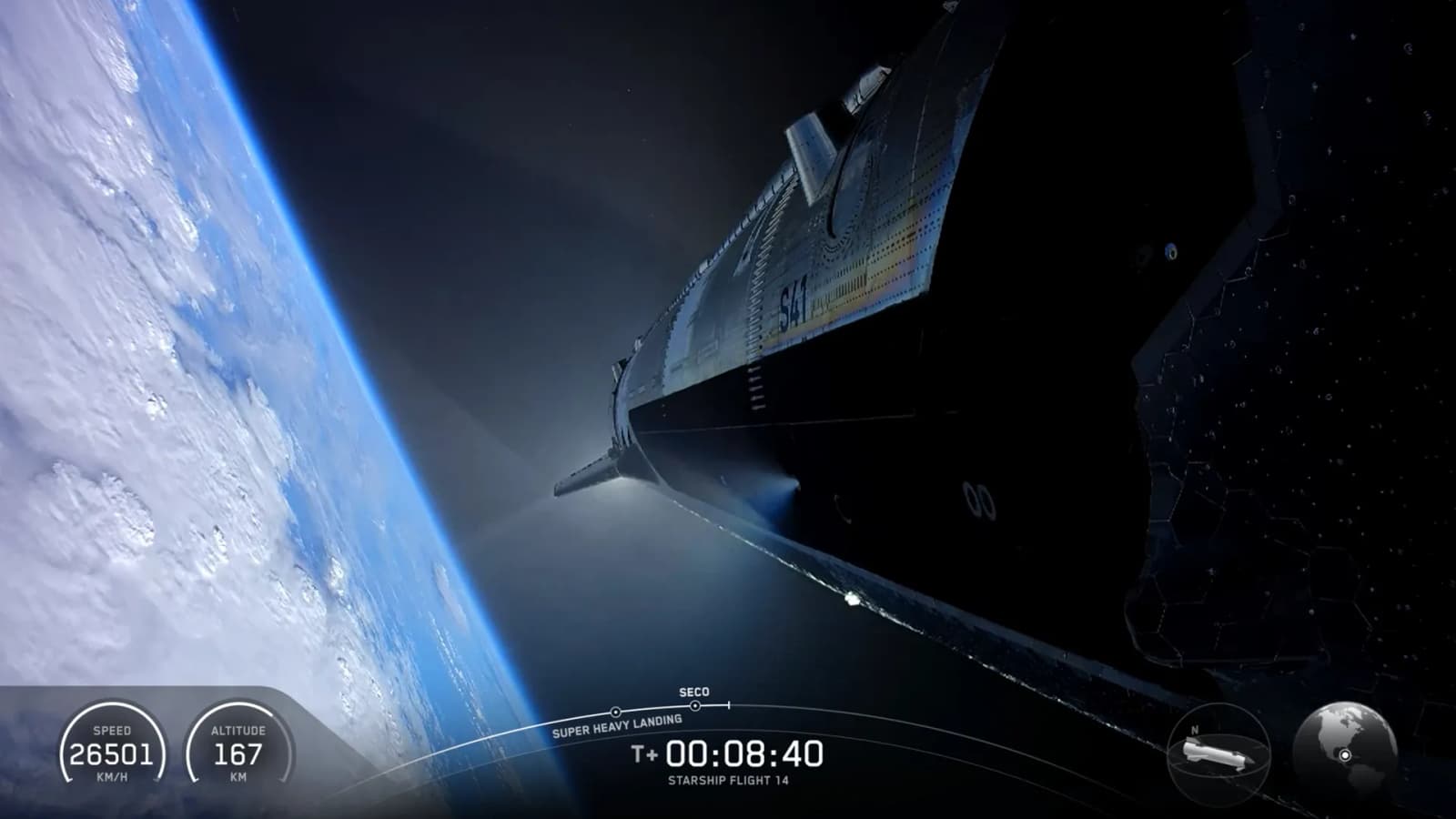
The world’s largest and most powerful launch vehicle, SpaceX’s Starship, has just launched into orbit for the first time and deployed 26 of the company’s higher-performing Starlink V3 internet satellites.
The uncrewed Starship Flight 14 lifted from the company’s Starbase site in Texas at around 7:46 am CT, on Monday, September 28. The historic departure marked the vehicle’s 14th integrated flight and the first aimed at sending the vehicle into orbit around Earth.
The 407-foot-tall (124 meter) rocket consists of the Super Heavy booster and the Starship upper stage. If the mission proceeds as planned, Starship will reportedly complete about six orbits around Earth during a nearly 10-hour flight, its longest mission to date.
It will then splash down in the Pacific Ocean west of Chile. The flight also marks the first time Starship is carrying operational satellites into space. “Payload deploy complete. All 26 Starlink V3 satellites are in orbit,” one of SpaceX’s latest posts on the social media platform X, stated.
First flight headed for orbit
SpaceX plans to deploy 26 Starlink V3 satellites during Flight 14, marking the first operational satellite deployment from Starship. Every satellite is designed to add one terabit per second (Tbps) of capacity to the company’s internet network.
Together, the 26 satellites could add a total of 26 Tbps of capacity, which is about 10 times as much as a single Falcon 9 launch carrying V2 Mini Starlink satellites. In addition, the satellites are set to unfold their antennas and solar arrays. They will then make initial contact with ground stations as well as the rest of the Starlink constellation through radio-frequency and laser links.
Starship completing its ascent burn. Credit: SpaceX / Screenshot
They will afterward use their onboard thrusters to raise their orbits and undergo checks before beginning service. “Following their on-orbit checkouts the satellites should begin serving customers as soon as a few weeks after launch,” SpaceX representatives, said.
What’s more, SpaceX has equipped three of the satellites with cameras made to look back at Starship and capture images of its heat shield following deployment. The images will allow the team to better study the condition of Starship’s thermal protection system, as SpaceX works toward eventually returning the spacecraft directly to its launch site.
Six trips around Earth
All 13 previous Starship flights since 2023 were suborbital. Flight 14 is designed to send the spacecraft into orbit for the first time. Starship is expected to fly roughly 171 miles (275 kilometers) above Earth.
Nevertheless, the spacecraft will only perform its orbital insertion burn after flight controllers confirm there is sufficient redundancy in systems necessary for its later deorbit burn. By the end of the mission, it will fire a single Raptor engine in space to leave orbit before making a controlled reentry and splashdown.
Starship deploying its payload of 26 Starlink V3 satellites. Credit: SpaceX / Screenshot
Flight 14 also includes changes after the previous test. During Starship’s Flight 13, Super Heavy used all 33 engines for its boostback burn for the first time. Ice later clogged three center engines, and ended the maneuver early. The firm therefore made hardware changes to improve engine filtering and software changes aimed at improving relight reliability.
SpaceX is further testing several heat-shield upgrades on Starship. These include additional mechanisms to keep tiles attached and curved tiles designed to reduce heating in the gaps between them. Two heat-shield tiles recovered from Ship 40 are being used again on Ship 41. This is the first time Starship has reused heat-shield tiles.
Related articles

Dreame’s step-climbing X50 Ultra mopping vacuum is hundreds off
It’s been a while since we’ve seen a big price cut on a capable robot vacuum and mop hybrid that can scale over short steps and threshold to hunt messes.

The SaaSpocalypse that wasn’t, with Atlassian CEO Mike Cannon-Brookes
Today, I’m talking with Mike Cannon-Brookes, who is cofounder and CEO of Atlassian.

Nvidia says its new AI safety platform can contain rogue agents within ‘milliseconds’
Nvidia is launching a new safety platform designed to contain and monitor AI agents, a move that comes in response to a wave of rogue hacking incidents, as reported earlier by Reuters.

Honor’s Magic 9 Pro Max has a big camera and a bigger battery
Honor launches its new Magic 9 flagship phones in China today, and the 9 Pro Max features a design revamp, a capable camera, and a colossal battery.

OpenAI agents hit UN website more than 16,000 times, used aggressive techniques, bypassed a filter
OpenAI’s autonomous AI agents repeatedly queried a UN website and used techniques that appeared to...

Engram is a sampler that turns broken AI hallucinations into music
Music startup Thoughtful Things has just launched the Kickstarter campaign for its first instrument, Engram.