10% stealth coating loss could nearly double J-20 fighter radar signature, Chinese study finds
A new study by Chinese researchers suggests that damage to the radar-absorbing coating on the...
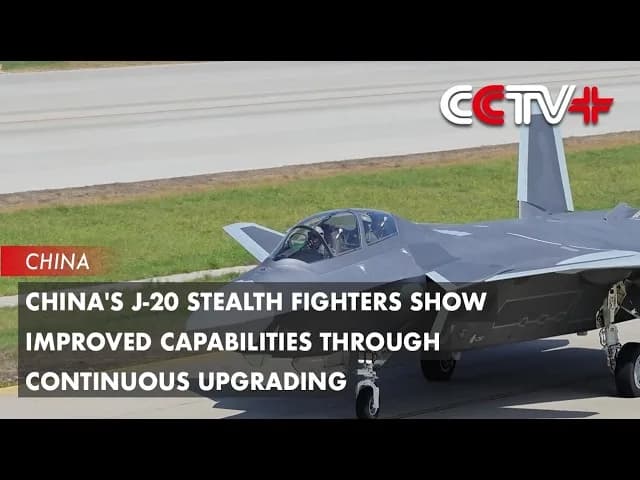
A new study by Chinese researchers suggests that damage to the radar-absorbing coating on the J-20 stealth fighter could significantly increase its radar signature.
Laboratory measurements indicate that losing just 10 percent of the coating could nearly double the amount of microwave energy reflected under certain experimental conditions.
The findings highlight how even relatively small areas of peeling or damaged material could weaken an aircraft’s ability to suppress radar reflections.
The research also underscores the maintenance challenges involved in preserving the stealth capabilities of advanced military aircraft.
Radar signature doubles
Chinese researchers have found that losing just 10 percent of a radar-absorbing coating could nearly double the amount of microwave energy reflected by a material, highlighting how relatively small areas of damage can weaken stealth technology.
The findings offer insights into a maintenance challenge facing advanced stealth aircraft, including China’s J-20 and the US Air Force’s F-22 Raptor. Although the researchers did not test either fighter’s proprietary coating, their laboratory experiments demonstrate how different forms of surface damage can affect a material’s ability to suppress radar reflections, reports the South China Morning Post (SCMP).
The researchers investigated how scratches, surface wear, and complete coating detachment affected microwave absorption. They prepared a composite material using carbonyl iron powder, a magnetic microwave absorber, and silicone resin, which provides heat resistance and environmental stability.
The composite was sprayed onto titanium alloy plates to create a coating 1 millimeter (0.04 inches) thick. The researchers then introduced different types of damage, varying the affected area, depth and location. They measured microwave reflections across frequencies ranging from 2 to 18 gigahertz.
The experiments showed that the impact on radar-absorbing performance depended heavily on the nature and extent of the damage. In one test, removing 10 percent of the coating increased the minimum reflection level from minus 12.73 decibels (dB) to minus 9.78 dB. This 2.95 dB difference represented an approximately 1.97-fold increase in reflected microwave power.
Peeling weakens stealth
Scratches had a relatively limited effect, even when they covered 50 percent of the sample’s surface, because most of the absorbing material remained intact. Similarly, mild surface wear caused limited deterioration when it affected no more than 20 percent of the surface and penetrated up to 0.4 millimeters into the coating.
More extensive wear produced a stronger effect. When damage covered 50 percent of the surface and penetrated 0.6 millimeters into the coating, the minimum reflection level increased to minus 7.37 dB. The researchers attributed this deterioration to changes in coating thickness that disrupted the electromagnetic matching conditions required to minimize reflected waves.
Complete detachment proved particularly damaging because it exposed the underlying titanium alloy. In an experiment involving central detachment, removing half the coating increased the minimum reflection level to minus 2.91 dB, compared with minus 9.12 dB when only 10 percent was removed.
The location and shape of the damage also influenced performance. Central and strip-shaped areas of detachment had a greater impact than damage near the edges of the sample. According to the researchers, exposed metal reflects electromagnetic waves strongly. The boundaries between the remaining coating and exposed substrate also create discontinuities that generate additional diffraction and scattering, further weakening the material’s ability to suppress radar reflections.
The findings highlight why maintaining the integrity of radar-absorbing materials is important for stealth aircraft. Earlier reports have identified coating deterioration and repair requirements as challenges for the F-22, while Chinese researchers continue to investigate more durable radar-absorbing materials. However, the study does not establish how the tested composite compares with the operational coatings used on either fighter.
Source: https://interestingengineering.com/military/stealth-coating-loss-doubles-j-20-signature
Get the latest news delivered to your inbox.
Related articles