
180 mph over water: US Seaglider program advances toward operational demonstrations
The US Marine Corps Warfighting Lab has expanded its collaboration with electric Seaglider developer REGENT...
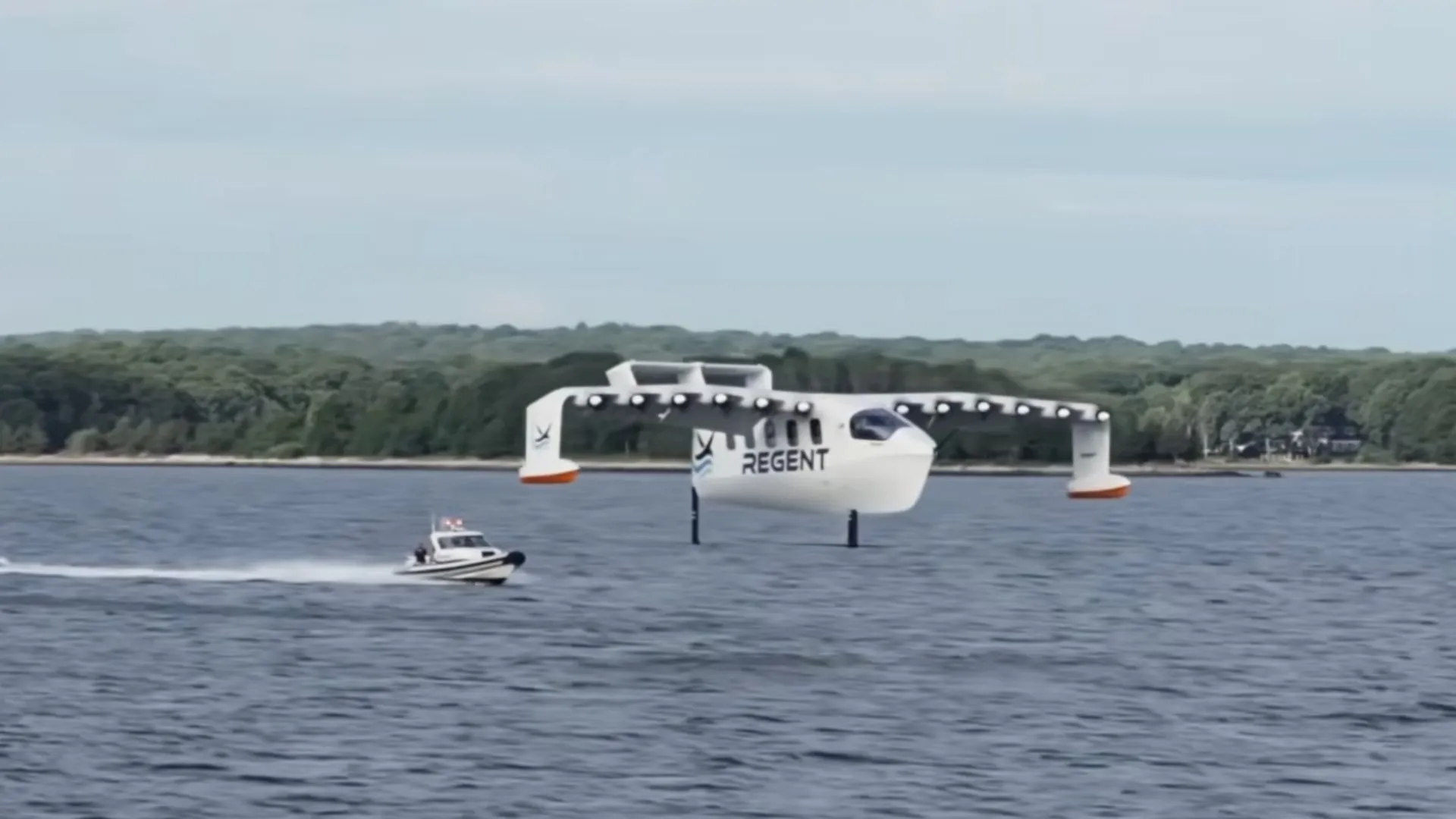
The US Marine Corps Warfighting Lab has expanded its collaboration with electric Seaglider developer REGENT Craft, adding $5 million for prototype capability demonstrations and command-and-control integration.
The extension, announced September 30, brings the partnership’s total value to $19.25 million.
The latest phase includes six deliverables focused on demonstrating the full-scale Seaglider prototype in operationally relevant environments and advancing its integration into defense operations.
The announcement follows the September 2 flight of REGENT’s Viceroy prototype in Narragansett Bay, Rhode Island, a milestone in the craft’s test campaign.
Partnership advances through four phases
The agreement between the Rhode Island-based developer and the Marine Corps Warfighting Lab has expanded in stages.
A $4.75 million Phase I/II base contract validated the Seaglider’s technical feasibility. Phase III added $9.5 million and advanced full-scale prototype demonstrations.
Phase IV adds $5 million in mission dollars. Alongside capability demonstrations, it includes command-and-control work to support how Seagliders would be tasked, tracked, and coordinated within defense operations.
“What started as a feasibility question has become a real operational program, and that trajectory says a lot about where this technology is headed,” said Billy Thalheimer, REGENT’s co-founder and CEO.
“The Marine Corps’ continued investment reflects growing confidence that Seagliders aren’t a future concept; they’re a capability the Marines can start integrating now into the force imminently,” he added.
The latest phase centers on demonstrating the prototype’s capabilities and supporting the coordination of Seagliders within defense operations.
Water takeoffs and electric propulsion
REGENT describes Seagliders as a transport option for contested logistics, including moving personnel and equipment into and out of conflict zones.
The Viceroy Seaglider is designed to travel at up to 180 mph on routes of up to 180 miles. These are planned performance specifications, rather than reported results from the September prototype flight.
Seagliders take off and land on water, removing the need for runway infrastructure. Their all-electric propulsion also allows recharging from shore or ship, which REGENT identifies as a benefit for maintaining an energy supply.
The company says the craft fly within one wingspan of the water. It describes this operating position as below radar and above high-range sonar, while saying electric propulsion minimizes heat and infrared signatures.
REGENT also says a simple design and fewer parts reduce operating and maintenance costs compared with legacy aviation and maritime platforms.
Demonstrations focus on Marine mission needs
The next phase gives the Marine Corps further opportunities to assess the technology against its mission requirements.
“This next phase of our MCWL partnership is about putting the technology in the hands of the warfighter so they can fully realize the advantages Seagliders bring to the forward-operating areas,” said Becky Russo, Director, Defense Mission Integration.
“We look forward to demonstrating this technology to the Marines so they can put it through its paces and ensure it’s designed to meet their mission needs,” Russo added.
The Viceroy prototype successfully flew in Narragansett Bay on September 2 as part of its test campaign. REGENT also reported that Squire continues a rapid test campaign, demonstrating its applicability across multiple mission sets.
The expanded Marine Corps agreement focuses on the full-scale Seaglider prototype’s capabilities and command-and-control integration.
Related articles
US Navy weighs MQ-9B SeaGuardian drone as maritime patrol force multiplier
The U.S. Navy recently evaluated General Atomics’ MQ-9B SeaGuardian drone at a tactical symposium held...

Frontline Robotics unveils Frodo, its new 6×6 UGV with 93-mile range and 25 mph top speed
Ukrainian defense company Frontline Robotics has unveiled Frodo, a universal 6×6 unmanned ground vehicle built...

Pewdiepie builds smaller, local AJAX AI model after OpenAI ban controversy
YouTube creator Felix Kjellberg, better known as PewDiePie, has unveiled Ajax, a small language model...

Pentagon backs Supra Technology to recover high-purity Scandium in U.S.
Supra Elemental Recovery, an Austin-based firm, has received the U.S. Department of Defense (DoD) contract...

Capcom is preparing for a ‘future where we create games together with AI’
Capcom's Pragmata might be all about the horrors of AI, but in practice the studio doesn't seem so down on the tech.

US Task Force 401 taps drone defenses that autonomously classify threats
Digital Force Technologies (DFT) has secured a US contract to supply counter-drone systems that combine...