
500-kW modular wind turbine with 82-foot blades can swap parts to test new tech
A new 500-kilowatt (kW) flexible and modular wind turbine that can be fitted with different...
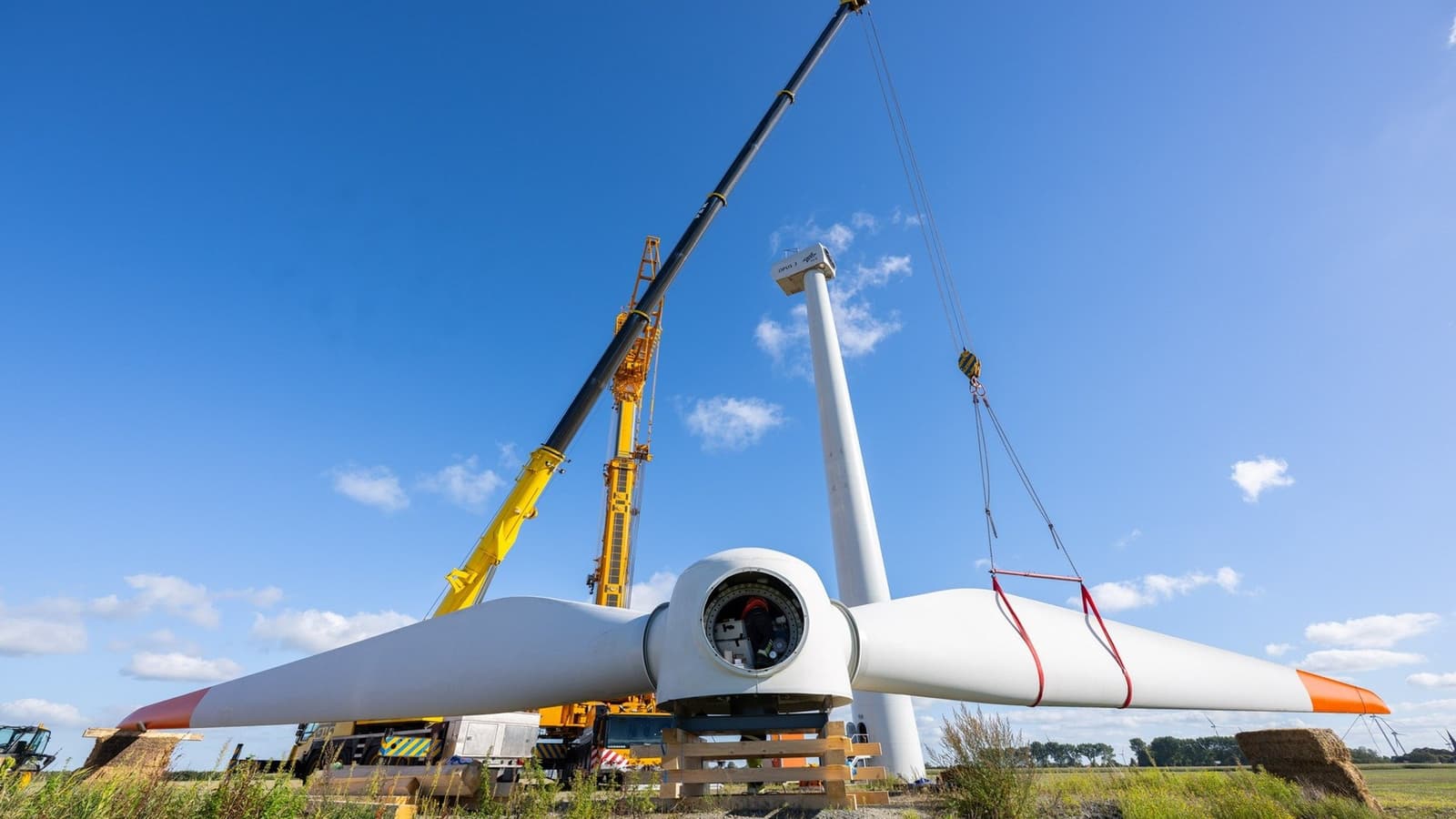
A new 500-kilowatt (kW) flexible and modular wind turbine that can be fitted with different blades, gearbox components, and control systems has been installed in Germany for real-world testing.
The German Aerospace Center (DLR) has completed the installation of OPUS 3, a modular research turbine, on Wednesday, 23 September. The turbine is located at the WiValdi wind energy research park in Krummendeich, Lower Saxony.
OPUS 3 will serve as a flexible research platform. It will allow the team to modify, replace or combine parts in different configurations, including rotor blades, parts of the gearbox, as well as the turbine’s control system. The team will also be able to test new algorithms as the turbine operates.
Lukas Firmhofer, DLR engineer and OPUS 3 project lead, stressed the importance of the turbine. “This means OPUS 3 closes an important gap in the development of new technologies for the wind energy industry,” Firmhofer elaborated.
Swappable turbine parts
According to the team, OPUS 3 has a rated output of 500 kW. It has a hub height of about 164 feet (50 meters) and a rotor diameter of around 164 feet. Its modest size makes it suitable for testing pre-industrial prototypes at a smaller scale under realistic weather and operating conditions.
The machine’s roughly 80-ton tower was delivered in two sections and assembled on site. A nacelle weighing approximately 30 tons sits at the top and contains the turbine’s gearbox and generator. The rotor hub weighs roughly 15 tons. Each of its three 82-foot (25-meter) blades weighs 2.5 tons.
The rotor hub before its assembly on the OPUS 3 turbine. Credit: DLR (CC BY-NC-ND 3.0)
Firmhofer explained that technologies that perform well on OPUS 3 could later be used in commercial turbines. Meanwhile, DLR is now commissioning the turbine, and preparing it for future research and testing at the site.
Engineers will test each system step by step, as well as how the different systems work together. Regular research operations are expected to begin in early 2027. “As a modular wind turbine, it forms an important stage between simulations and laboratory tests and deployment in large industrial plants,” Firmhofer added.
First turbine tests
The researchers said OPUS 3 began collecting scientific data before its rotor even started spinning. During construction, they measured how the tower behaved in the wind before the heavy nacelle was installed. Without the nacelle’s weight at the top, the structure exhibited different vibration characteristics.
Firmhofer said studying these conditions could provide a better understanding of critical vibrations that can occur during wind turbine assembly. Such information could become important as turbines grow larger. This could improve construction planning, reduce risks and refine structural simulations.
The rotor hub being hoisted into place. Credit: DLR (CC BY-NC-ND 3.0)
The team has already planned future experiments for OPUS 3. These include tests of flexible rotor blades built to make future turbines lighter and more efficient while reducing structural loads.
OPUS 3 will join the OPUS 1 and OPUS 2 turbines that were installed at WiValdi in 2023. The two feature about 2,000 sensors that measure loads, airflow, vibrations and how the turbines interact with each other.
“Within the context of the DLR WiValdi wind energy research park, it enables application-oriented research and development under real weather and operating conditions,” Firmhofer concluded in a press release.
Related articles
Russia builds second reactor to power 106 MW floating nuclear plant for Arctic mining
A new floating nuclear power unit will soon bring electricity to a massive copper mining...
Lockheed Martin builds dedicated center to weaponize quantum tech for US troops
Lockheed Martin has opened a new center dedicated to turning quantum research into technologies that...

Roku’s first OLED TVs are up to $400 off, starting at $699
Roku recently launched its first-ever OLED TVs. The $999 starting price was already impressive for the 55-inch Pro Series model that has a 120Hz refresh rate OLED panel (with four HDMI 2.

These camera apps give you more control over the iPhone 18 Pro’s aperture
One of the questionable limitations of the iPhone 18 Pro's new main camera with a variable aperture is that you're limited to just four settings in the native iOS' camera app in manual mode: f/1.

Phones don’t have lights
Mark Zuckerberg has a new defense of the Ray-Ban Meta glasses: they're actually doing more to signal they're taking a photo than phones do.

Leaks reveal a new Apple HomePod mini, iPad mini, and Apple TV 4K
Apple is expected to announce more hardware before the end of the year following the debut of the iPhone 18 Pro and folding iPhone Duo earlier this month.