
Blue pigment pushes platinum-free fuel cell to record 902 mW/cm2 power density
An international group of researchers has recently developed a carbon-supported blue-pigment catalyst that helped a...
An international group of researchers has recently developed a carbon-supported blue-pigment catalyst that helped a platinum-free fuel cell reach a record power density of 902 milliwatts per square centimeter (902 mW/cm2).
The catalyst was developed by Hiroshi Yabu, PhD, a professor at Tohoku University’s Advanced Institute for Materials Research, and Dario R. Dekel, PhD, a professor at the Technion – Israel Institute of Technology. Yasutaka Matsuo, PhD, a professor at Hokkaido University and AZUL Energy were also involved in the project.
The breakthrough catalyst could reportedly slash anion-exchange membrane fuel cells’ (AEMFCs) reliance on high-priced platinum. “This work shows that careful molecular design can close the performance gap between platinum catalysts and platinum-free catalysts,” Yabu explained.
By modifying the molecular structure of the pigments, the team achieved a peak power density of 902 milliwatts per square centimeter. It is the highest reported performance for an AEMFC cathode based on a metal phthalocyanine.
A cheaper alternative to platinum
Fuel cells produce electricity via electrochemical reactions instead of combustion. They rely on catalysts to accelerate these reactions. The cathode commonly uses carbon-supported platinum nanoparticles to speed up the oxygen reduction.
While highly effective, platinum is expensive and is priced at approximately USD 54 per gram. It is also in limited supply, which makes other alternatives attractive for lowering the cost of fuel-cell systems.
AEMFCs could provide one route around the problem. Considering they operate under relatively mild alkaline conditions, they can more easily use catalysts made without platinum.
Schematic illustration of chemical structures of catalysts and preparation method of catalysts on carbons. Credit: Hiroshi Yabu / Dario R. Dekel
For the project, the team turned to metal phthalocyanines, a group of synthetic blue pigments used in a wide range of industries. Built around a metal complex, they’re inexpensive and their molecular structure can be modified.
The researchers synthesized two iron tetra-azaphthalocyanines in which nitrogen-containing heterocycles swapped the peripheral benzene rings in conventional iron phthalocyanine. The first catalyst, FeAzPc-4N supported on conductive Ketjen Black carbon, was named AZ-FT-30.
A more nitrogen-rich version, FeAzPc-8N8Me, was designated AZ-FO-30. Electron microscopy and elemental analysis revealed that the iron-containing molecules were dispersed across the carbon at atomic and molecular scales rather than forming larger particles.
Record cell performance
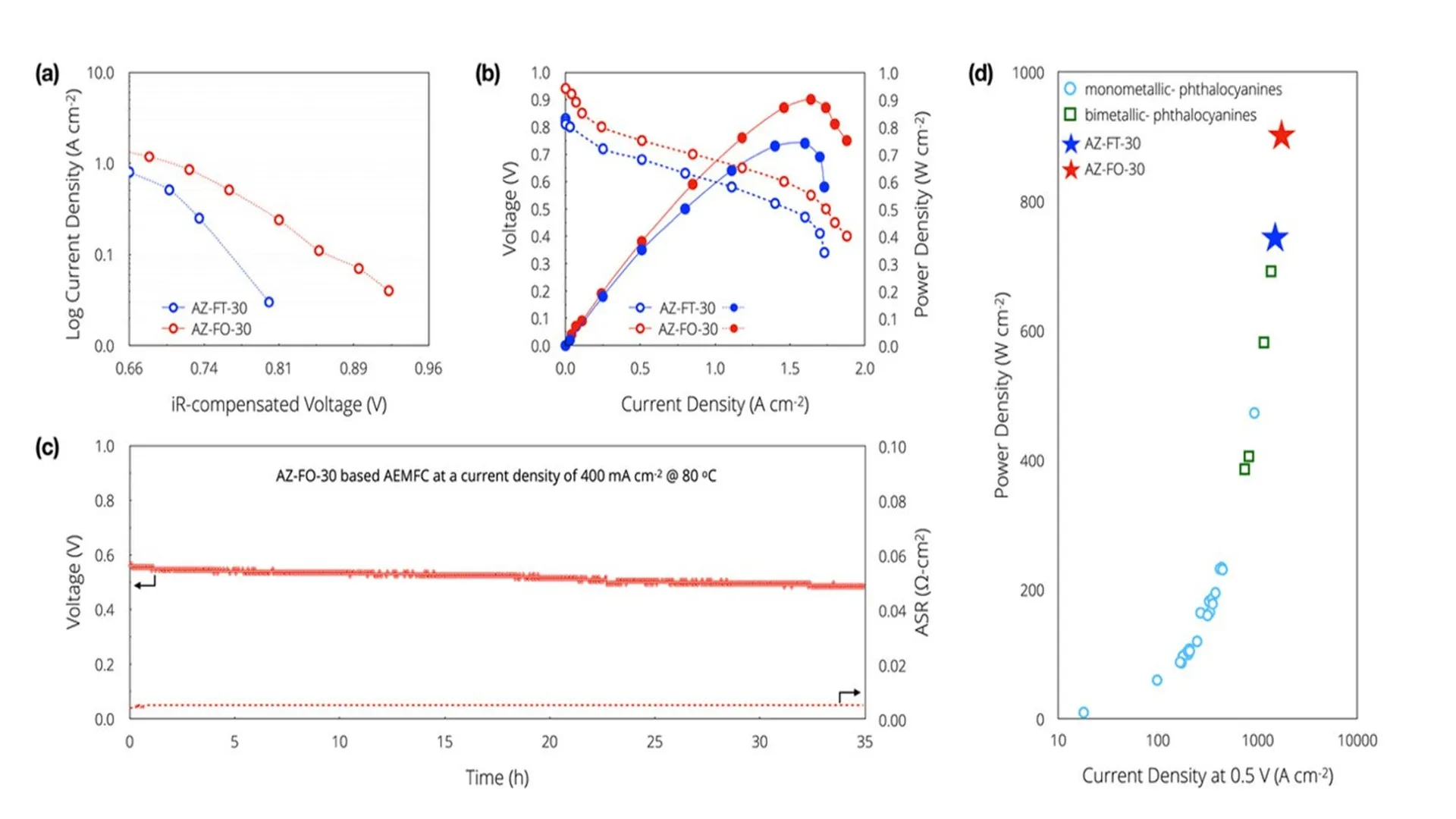
Subsequent tests carried out by the researchers showed a significant performance difference between the catalysts. At 176 degrees Fahrenheit (80 degrees Celsius), AZ-FT-30 achieved a peak power density of 744 milliwatts per square centimeter. AZ-FO-30, meanwhile, reached 902 milliwatts per square centimeter.
According to the researchers, this represents the highest power density reported for an AEMFC cathode using a metal phthalocyanine. The stronger catalyst also demonstrated encouraging durability. AZ-FO-30 operated for 35 hours under a constant load of 400 milliamperes per square centimeter, recording an average decay rate of 2.4 millivolts per hour.
The catalysts had nearly identical electrochemical surface areas at 155.8 and 157.5 square meters per gram. This allowed the team to link the performance difference to the intrinsic properties of the molecules rather than the amount of available surface. Computational modeling then provided another clue.
Density functional theory calculations showed that the iron-oxygen distance was shortest in AZ-FO-30. This indicated a stronger interaction at its iron active site. The trend remained even when the team added an explicit water molecule to the model. “By tuning the structure of these blue pigment molecules, we were able to strengthen the interaction at the active site and translate that into real gains in fuel cell performance,” Yabu concluded in a press release.
The findings have been published in the journal ACS Catalysis.
Related articles
China sets world record with 116 underwater drones navigating with zero human input
China has set a new world record for simultaneous autonomous underwater vehicles after 116 small...
$4M funding backs plasma systems designed to work across different fusion reactors
Fusion developers could soon get standardized plasma diagnostic systems instead of building complex measurement hardware...




Protesters gather at OpenAI’s DevDay
On Tuesday, OpenAI's annual DevDay event began with protests, flyers, and chants.