European scientists spot new quantum state of matter at room temperature
A collaborative effort from researchers across various institutes in Europe has led to the observation...
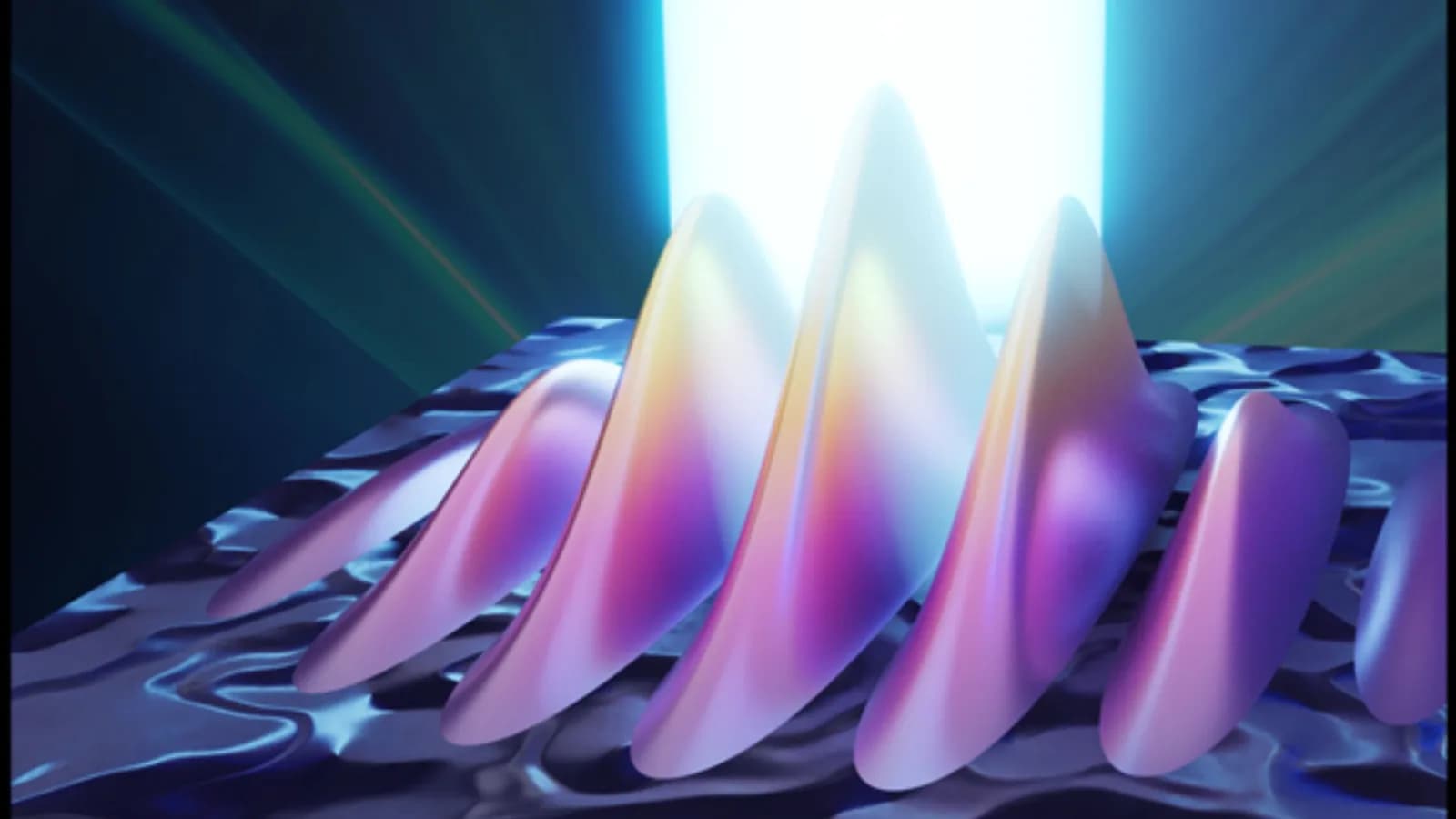
A collaborative effort from researchers across various institutes in Europe has led to the observation of a new quantum state of matter called a supersolid in an exciton-polariton Bose-Einstein condensate. The quantum state is electrically tunable and is seen at room temperature, paving the way for quantum photonic devices in the future.
As early as the 1960s, physicists theorized that a superfluid could develop in a crystal-like structure. A superfluid is an extraordinary state of matter where viscosity is completely lost and the fluid can move through narrow channels without any resistance. That it can exist in a rigid structure of a crystal seems contradictory.
Yet in 2017, the resultant phase of their coexistence, called supersolid, was experimentally observed in ultracold atomic Bose-Einstein condensates. A team of researchers from the University of Warsaw, the Military University of Technology (Poland), IBM Research Zurich, and the French National Center for Scientific Research (CNRS) took the other route to see if such a quantum state could be reached at room temperature.
Quantum state using light
In their approach, the researchers used strong coupling between light and matter inside an optical microcavity to generate exciton polaritons – hybrid quasiparticles. The optical microcavity was filled with a specially designed liquid crystal and coated with an organic semiconductor, which enabled coupling even at room temperature.
While these quasiparticles last for only a few picoseconds, it is long enough to form a Bose-Einstein condensate that then behaves like a quantum superfluid. When this superfluid transitions into a supersolid is known by observing regularly spaced bright fringes of light emitted from the sample.
Interestingly, though, every laser pulse used to excite the sample generated bright fringes at different positions. ““This is a textbook example of spontaneous symmetry breaking,” explained Guillaume Malpuech, a professor at the Institut Pascal (CNRS). “Theory predicted that the supersolid could choose among several equivalent states, and that is exactly what we observed.”
The team also observed two distinct forms of order simultaneously: one in polarization, the other in light intensity.
Challenging research
Since the organic semiconductor reacted with the liquid crystal, the researchers needed to ensure that all measurements were completed within a few hours of the sample being assembled. Repeating an experiment would mean starting off with a new sample, making the research more challenging than anticipated.
IBM Research Zurich was tasked with making the measurements and depositing thin films of organic semiconductors on the photonic structures made by Military University of Technology.
While IBM Research Zurich has worked with organic semiconductor films for years and even observed Bose-Einstein condensates in them, this is the first time they have worked with a liquid-crystal microcavity, the press release said.
Most studies of exotic quantum states require ultracold temperatures hovering near absolute zero. This study, however, shows that using photonic systems, such quantum states can also be observed at room temperature.
“Our liquid-crystal microcavities can operate even at temperatures approaching 60°C,” added Wiktor Piecek, a professor at the Military University of Technology.
Because optical microcavities can be tuned and their properties changed with an external voltage, they enable more practical quantum photonic devices and can also help study quantum phases of light and matter.
The research findings were published in Science Advances.
Source: https://interestingengineering.com/science/scientists-spot-new-room-temperature-quantum-state
Get the latest news delivered to your inbox.
Related articles