Strange gas spikes above Mars volcano may reveal activity beneath its surface
A team led by Alexander Trokhimovskiy of Russia’s Space Research Institute has detected hydrogen chloride...
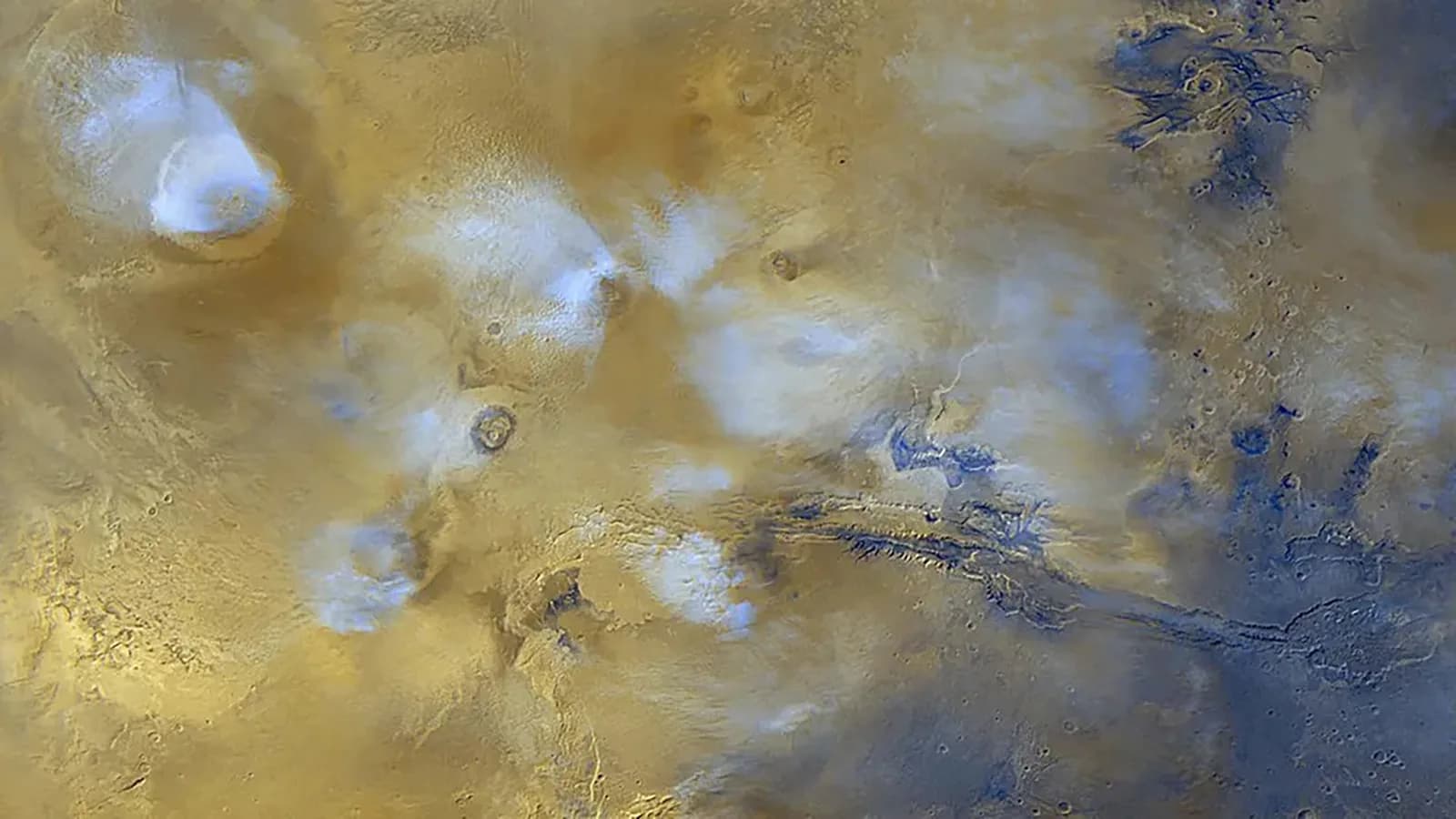
A team led by Alexander Trokhimovskiy of Russia’s Space Research Institute has detected hydrogen chloride gas above Mars’ Alba Mons volcano, that may come from magma, according to a paper published in Science Advances and a European Space Agency release.
Hydrogen chloride (HCl) is a noxious gas that escapes from magma vents on Earth. The ExoMars Trace Gas Orbiter, a European Space Agency and Roscosmos spacecraft that samples Mars’ atmosphere from orbit, first detected it there in 2021. Alba Mons is the largest volcano on Mars by surface area, though Olympus Mons is taller.
The orbiter’s Atmospheric Chemistry Suite, a set of three infrared spectrometers, picked up the gas at parts-per-billion levels outside its usual season, the team reports. Kevin Olsen, a visiting researcher at the University of Oxford and a co-author, told Live Science the pattern was more suggestive of “a puff of gas” than of regular atmospheric chemistry.
Gas above the fissures
In the Science Advances paper, the authors say the low-altitude detections, which atmospheric models cannot explain, and the region’s geology hint at an igneous origin (tied to magma). The gas normally peaks in northern winter and mostly vanishes in summer, the ESA release said, yet spikes appeared in early summer above fissures on Alba Mons’ flanks.
Olsen said a targeted campaign lasted two Mars years, roughly four Earth years, according to Live Science. Over four Mars years of observations, the out-of-season gas appeared locally and nowhere else, he said.
Images from three cameras, including the orbiter’s CaSSIS camera, show narrow fissures under the detection sites, some only tens of centimeters wide, according to a Sci.News summary. The release adds that color changes around the fissures may be gas deposits.
Assuming the gas lasts one sol (a Martian day) in the atmosphere, the authors estimate seepage below three kilograms per second. That sits near the low end for volcanoes on Earth, which emit a few to more than 100 kilograms per second, the authors note.
Limits of the evidence
Several points are unproven. Olsen said the link to volcanic activity remains a hypothesis. Earlier readings showed no sulfur, another gas volcanoes release, and the hydrogen chloride looked seasonal, which kept scientists from tying it to magma, he told Live Science.
No new lava flows or eruptions have ever been observed on Mars, the ESA release said. The much larger seasonal release of the gas, estimated at about 180 kilograms per second, is not thought to be directly volcanic, the authors say.
The team said Alba Mons may host an environment similar to hydrothermal vents on Earth, where life likely arose. Daniel Mège, a professor at the Polish Academy of Sciences and a co-lead author, said magma activity is not in itself a sign of life. Conditions would need to stay favorable for at least millions of years, he cautioned, which is hard to assume for a site as small as the seeps.
More research is needed to confirm that the gas comes from magma, the team said.
Source: https://interestingengineering.com/science/mars-volcano-fissures-magma
Get the latest news delivered to your inbox.
Related articles