Former OpenAI researcher says six Chinese AI models carry fingerprints of export-controlled Nvidia Blackwell chips
In a November 12 report, Will DePue of Unemployment Labs said published weights from DeepSeek, Moonshot AI, MiniMax and Ant Group match Nvidia's restricted Blackwell hardware. The analysis does not prove where the chips were located.
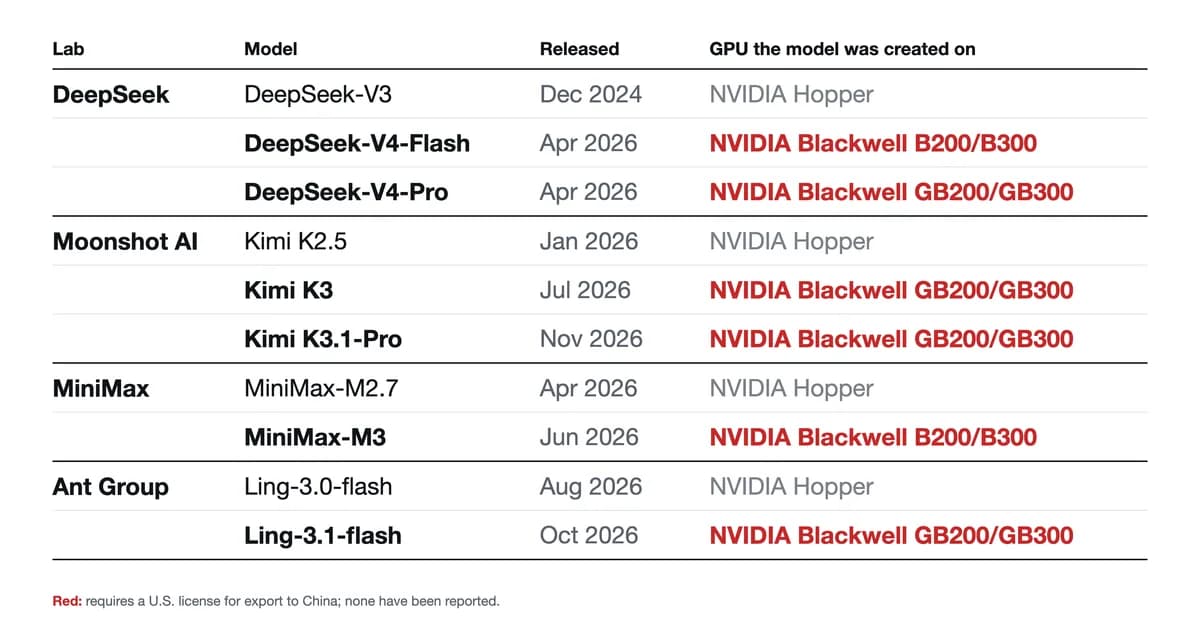
Will DePue, a former OpenAI researcher who leads the nonprofit Unemployment Labs, published a forensic report on November 12 concluding that six models from leading Chinese labs carry the numerical "fingerprint" of Nvidia Blackwell processors that require a U.S. license for export to China. TechCrunch, The Register and Tom's Hardware reported the findings on November 13.
What the report found
DePue analyzed publicly released model weights, recovered traces of their initial values, and searched for the chip layouts and seeds that reproduce those patterns. According to the report, DeepSeek-V4-Flash and MiniMax-M3 match 148-core B200 or B300 chips, while DeepSeek-V4-Pro, Moonshot's Kimi K3 and Kimi K3.1-Pro, and Ant Group's Ling-3.1-flash match 152-core GB200 or GB300 systems. Earlier models from the same labs match Nvidia's older Hopper generation.
DePue said he searched more than six trillion combinations of chip layout and seed, and confirmed the DeepSeek-V4-Flash and Kimi K3 matches on physical Blackwell hardware. The report presents this as the first public technical evidence linking MiniMax and Ant Group to Blackwell. It estimates about 12,000 Blackwell GPUs across five training runs, with the largest cluster around 4,500 chips and a possible cost of $200 million to $300 million.
What it does not prove
The report is explicit that the method shows how the weights were initialized. It does not establish where the chips were located, how access was obtained, or whether export-control rules were broken. The processors could have sat in data centers outside China. The only alternative technical explanation DePue identified is specially configured AMD hardware, which is also restricted; he said he ruled that out for DeepSeek-V4-Flash.
The findings are separate from a Reuters document review, published on egov.mn on November 14, of more than $3 billion in Chinese projects planned around Nvidia H100, H200 and H800 chips. DePue's work instead offers forensic evidence in open-weight models of access to the newer Blackwell generation.
Sources: Unemployment Labs, TechCrunch, The Register, Tom's Hardware
Get the latest news delivered to your inbox.
Related articles