Google DeepMind opens the SatWeave and PARDIG datasets behind its AI weather models
On November 13, DeepMind released historical archives and live feeds of SatWeave, a global satellite mosaic, and PARDIG, an AI precipitation dataset used to train WeatherNext 3.
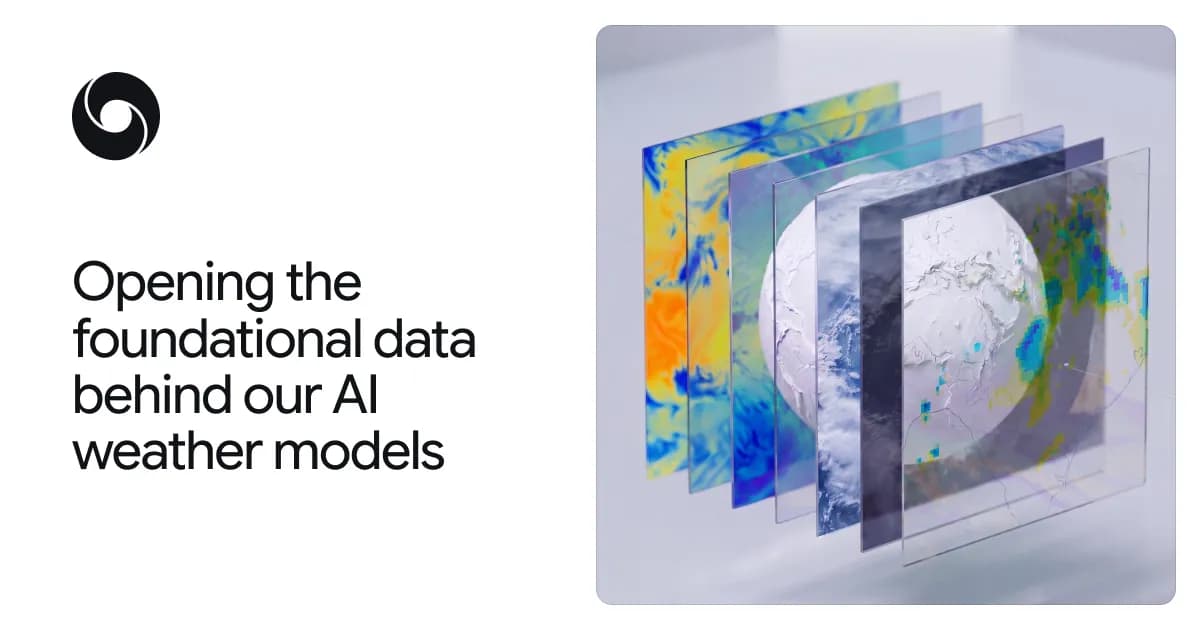
Google DeepMind said on November 13 that it is opening two foundational datasets used in its WeatherNext 3 AI weather model: SatWeave and PARDIG. The company is publishing historical archives and live feeds so researchers and developers can build weather, hydrology and climate applications.
SatWeave: a unified view from space
SatWeave is a global mosaic that blends imagery from geostationary satellites including GOES-East, GOES-West, Meteosat and Himawari across 17 visible, water-vapor and infrared channels. DeepMind said most existing global composites offer only a handful of channels or update every few hours. SatWeave updates hourly, giving WeatherNext 3 a fresher starting point than analysis fields that refresh every six hours. The historical archive spans more than a decade.
PARDIG: global precipitation
PARDIG (Precipitation AI Reanalysis: Densely Inferred GPM) is an AI precipitation dataset trained directly on sparse spaceborne radar observations from NASA's GPM Core Observatory, using SatWeave imagery and atmospheric fields from the ECMWF as inputs. It produces a global map at 15-minute temporal resolution and roughly 10-kilometer spatial resolution, with average latency of about five hours.
DeepMind said it evaluated PARDIG against ground radar networks in the United States, Europe and Japan, and against more than 36,000 weather stations worldwide. It reported that PARDIG outperformed NASA's IMERG-Final product across all rain rates analyzed, improving hourly precipitation detection skill by more than 30% for light-to-moderate rain. Historical archives from 1999 to 2026 are being released with the live feed.
Both datasets are now openly available on Google Cloud Storage, and PARDIG's historical catalogs are also available in Google Earth Engine.
Sources: Google DeepMind
Get the latest news delivered to your inbox.
Related articles