German researchers show how graphene could be used to build solar cells
Researchers at the Helmholtz-Zentrum Dresden-Rossendorf (HZDR) in Germany have proposed a new way to make...
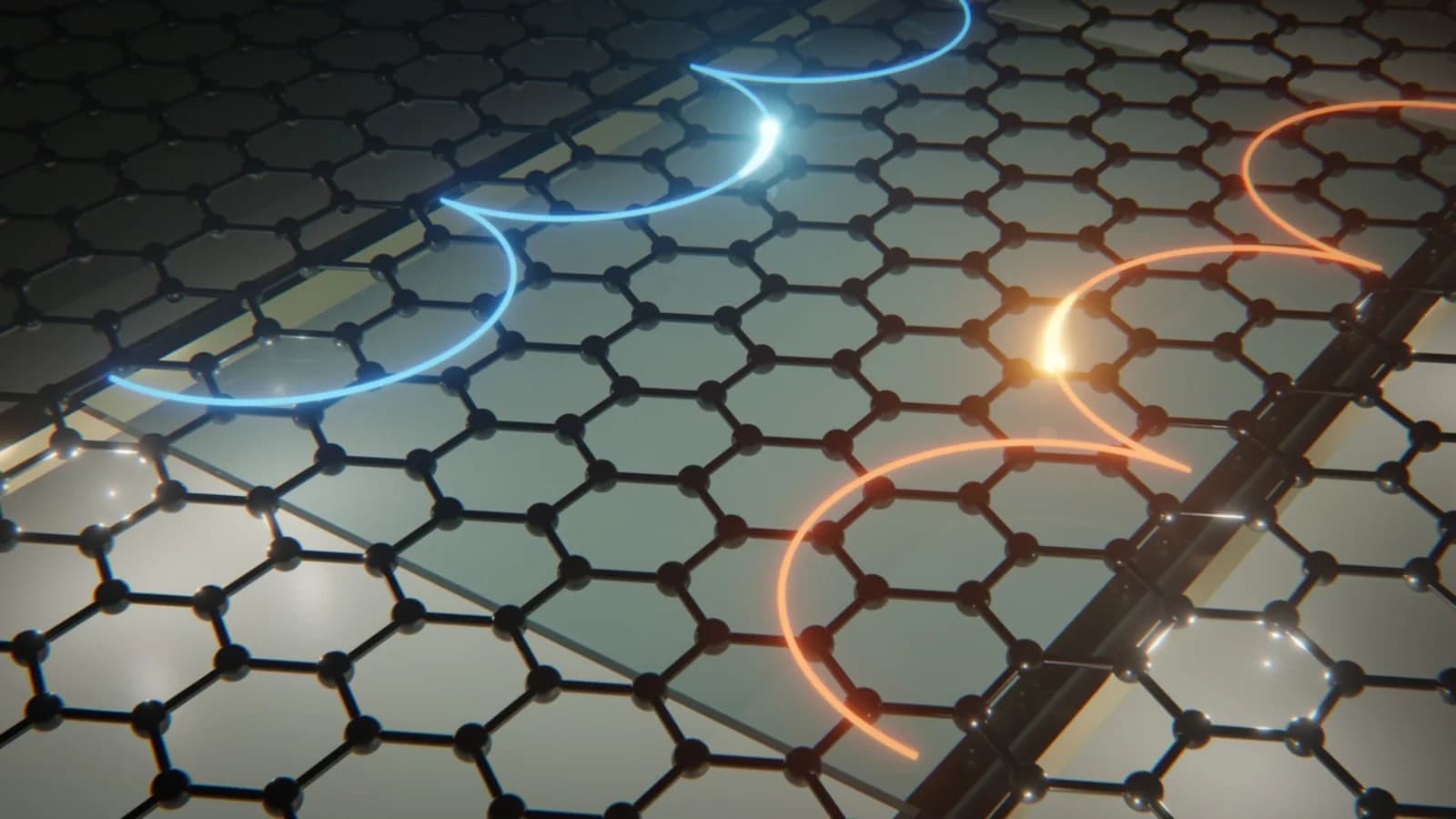
Researchers at the Helmholtz-Zentrum Dresden-Rossendorf (HZDR) in Germany have proposed a new way to make solar cells, light sensors, and light-based electronics by using graphene as a core material instead of silicon. This could open a new area of electronics in the future, where light could be used directly as a power source.
Graphene is a two-dimensional sheet of carbon atoms arranged in a hexagonal lattice pattern but only one atom thick. It serves as a building block for carbon nanotubes and graphite and is used in applications varying from flexible displays to lithium batteries.
The material is great at conducting electrons but not very efficient at converting light into electricity. While light does excite electrons in graphene, these electrons cannot be used as electricity, since the ‘holes’ left behind by the electrons are not separated and cannot be directed to electrodes, something silicon can do extremely well.
How graphene can act like silicon
Semiconductors like silicon are used in solar cells because they have a bandgap. This is the energy required to excite an electron from its low-energy state to the higher-energy conduction band where it can move freely and conduct electricity. Graphene, on the other hand, does not have such a bandgap.
Ralf Schützhold, a professor at theoretical physics at HZDR, therefore suggests making such a bandgap through other means, such as cutting and folding the graphene to create tiny edges. When incident light creates electrons and holes in the modified graphene, a magnetic field can be applied to make the charge carriers move in circular paths.
The edges in the setup are meant to be guardrails that direct the charge carriers in opposite directions. Thus, electrons and holes can be separated and made to carry electricity.
When voltage does the job
While this approach can work, it is not scalable and therefore cannot be deployed in real-world scenarios. Instead of using edges, HZDR researchers then looked at electric voltage as a guardrail, which is relatively simple to deploy in graphene.
Narrow metal electrodes placed on an insulating layer are sufficient to apply voltage to a graphene sheet and create potential barriers to electron and hole flow. When a magnetic field is applied to the graphene, electrons and holes follow circular paths, which can be converted into directed motion using the voltage-created barriers.
A negatively charged barrier reflects electrons, while a positively charged barrier attracts them; these barriers are used to direct their flow. The researchers determined how high the barriers must be and their necessary width for electrons to flow through.
The experimental setup looks much like a sandwich with a graphene layer caught between two electrodes. The advantage of this approach is that the charge transport can be adjusted to different light energies by changing the voltage or switching off the electrodes.
While silicon can work with visible light, a graphene-based solar cell could also work with infrared photons, which are considered too weak to generate electron-hole pairs in silicon.
According to the researchers, when looking to convert infrared light into electricity, a magnetic field of 0.1 Tesla and a spacing of a few micrometers would be sufficient. To increase light absorption, several layers of graphene separated by insulating layers can be added.
The research findings were published in the journal Physical Review Applied.
Related articles