Lasers and neutrons reveal long-lived quantum state in magnetic material at ORNL
Researchers at Oak Ridge National Laboratory (ORNL) and their collaborators have observed a long-lived quantum...
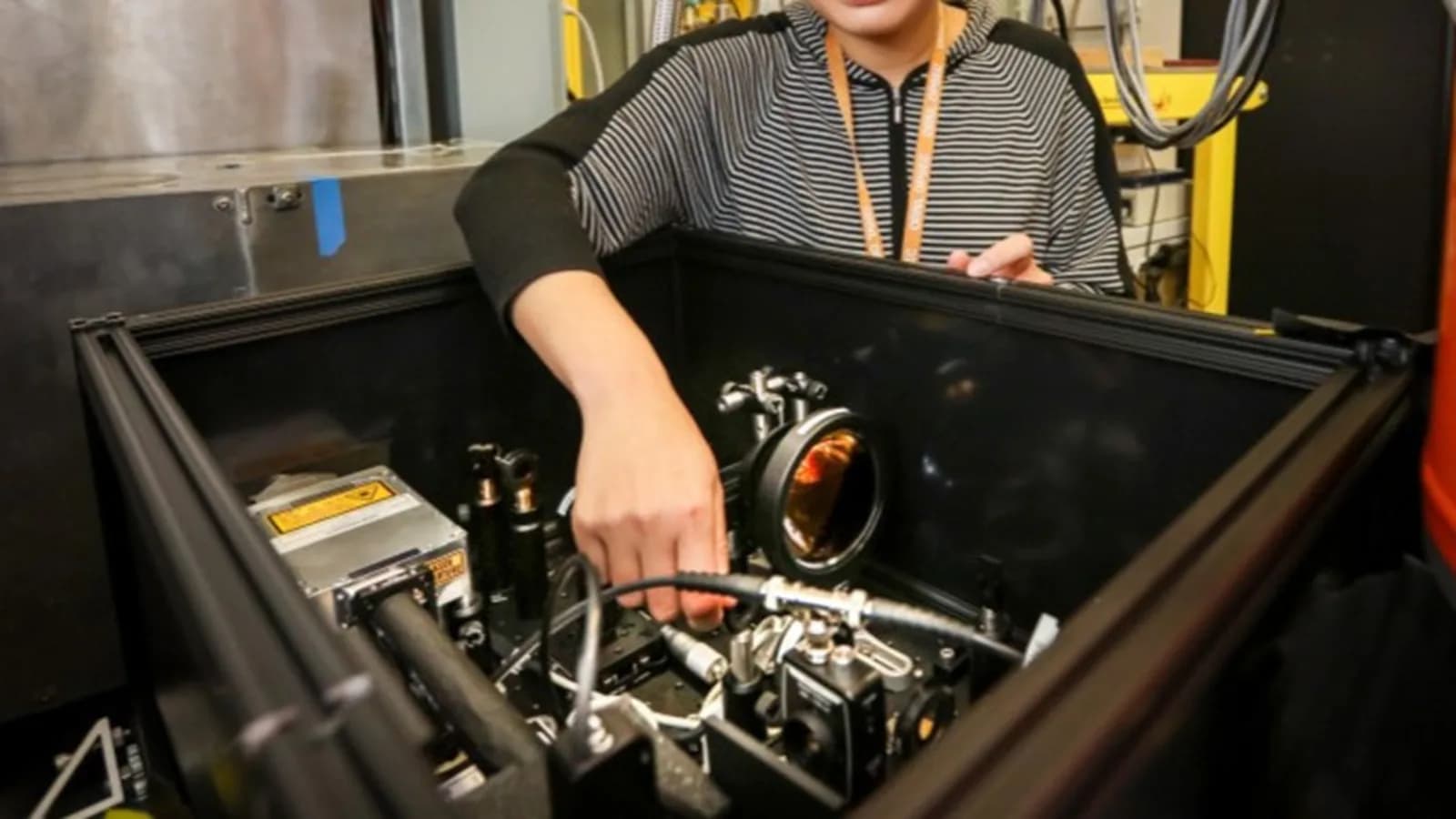
Researchers at Oak Ridge National Laboratory (ORNL) and their collaborators have observed a long-lived quantum state in a magnetic material by combining lasers with neutrons. The approach opens a new way to study materials driven far from equilibrium, and ORNL announced the findings.
Manipulating quantum magnets matters for quantum information science and could reduce loss of transported information, improve memory devices, and benefit other quantum technologies.
Magnons driven by lasers
The team studied magnons, quantum quasiparticles whose wave-like excitations are critical to magnetic behavior. Magnons can carry information, and quantum magnets can support long lifetimes and memory for data transfer.
In the experiment, rapid laser pulses drove the material out of its normal resting state. ORNL’s Spallation Neutron Source, a DOE Office of Science user facility, let the researchers study the microscopic details of the magnetic behavior inside the material. Neutron scattering probes the structure and behavior of materials at the atomic and nanoscale, which makes it well suited to resolving magnetic excitations.
That pairing, a pump-probe setup using neutron scattering, is not typically used for nonequilibrium studies. Making it work took a multidisciplinary effort, said ORNL’s Chengyun Hua, with mechanics, safety personnel, hardware and software engineers and researchers all thinking outside the box.
A broken physical rule
The measurements showed the material violated detailed balance, a physical rule that, in a system at rest, links energy-gaining and energy-losing events in a predictable way. Under the rapid laser pulses, the balance broke, and the neutron data showed extra signals only on one side.
The nonequilibrium state did not quickly disappear, and the lopsided excess of magnons persisted, indicating the team was not seeing a brief heating effect. Instead, it was a long-lived nonequilibrium steady state sustained by periodic laser pulsing.
No one had directly probed a detailed balance violation in a condensed matter system before, Hua said. Theory predicted it could happen, but seeing it experimentally was “pretty awesome.”
New quantum test platform
The rule-breaking behavior makes the system a strong platform for studying other nonequilibrium quantum physics in real time. Insights from other materials may guide future work on quantum materials, coherent transport and low-loss electronics.
The study also gives scientists a new benchmark for what neutron scattering can reveal when materials are observed while actively driven rather than at rest.
The approach was first envisioned by Hua, Barry Winn and Alan Tennant, who built on a sustained, multiyear ORNL effort to develop the specialized infrastructure for such measurements. An ORNL seed grant enabled their early explorations of high-risk, high-reward nonequilibrium physics.
For ORNL, the study builds an experimental foundation for understanding new quantum materials. It also supports exploring how such materials may eventually be studied with quantum computers and used in future information technologies.
The DOE Office of Science’s Basic Energy Sciences program supported the inelastic neutron scattering, simulation, data analysis, and modeling. Additional theory work was supported by the Quantum Science Center, a DOE National Quantum Information Science Research Center.
The study was published in Nature Communications on November 9.
Source: https://interestingengineering.com/science/lasers-neutrons-long-lived-quantum-state
Get the latest news delivered to your inbox.
Related articles