
Mapped: Unemployment Rates Across Europe in 2026
Explore unemployment rates across Europe in 2026, from Finland and Spain's high joblessness to the countries with the lowest rates.
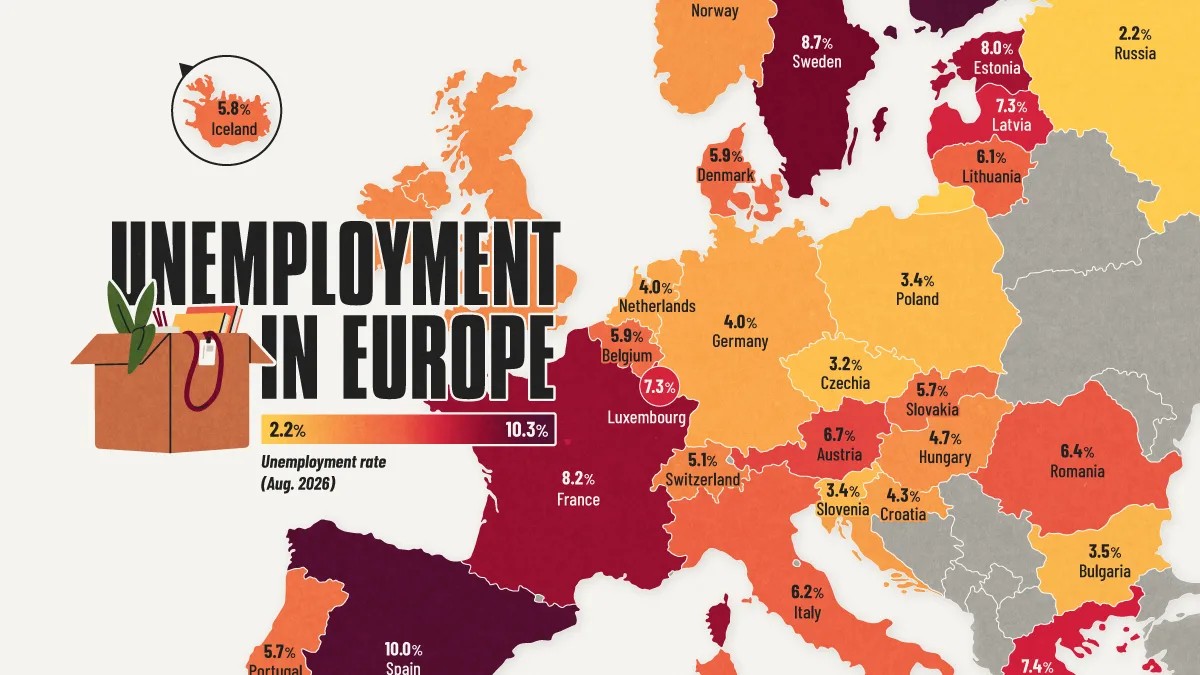
European Countries With the Highest Unemployment Rates
Key Takeaways
Finland (10.3%) has the highest unemployment rate in Europe, narrowly ahead of Spain (10.0%).
Unemployment in Germany and the Netherlands (both 4.0%) is less than half the rate in France (8.2%).
Czechia has the lowest unemployment rate in the European Union at 3.2%.
Europe’s unemployment picture is changing. Spain has long been associated with high joblessness, but a Nordic country now tops the continent’s unemployment rankings.
This map compares unemployment rates across Europe in August 2026, using figures from Eurostat, ONS, and Rosstat figures. Data for the UK and Switzerland reflects June 2026, the latest available month.
Europe’s Shifting Unemployment Divide
Finland’s position marks a notable shift in Europe’s unemployment rankings. Spain held the top spot a year earlier, but Finland has since moved ahead.
Elsewhere, Greece’s unemployment rate fell from 8.8% to 7.4% over the year, continuing its labor market recovery. France moved in the opposite direction, with its rate rising from 7.8% to 8.2%.
The table below ranks European countries by their unemployment rates in August 2026.
RankCountryUnemployment Rate (%)
1 Finland10.3
2 Spain10.0
3 Sweden8.7
4 France8.2
5 Estonia8.0
6 Greece7.4
7 Latvia7.3
7 Luxembourg7.3
9 Austria6.7
10 Romania6.4
11 Italy6.2
12 Lithuania6.1
13 Belgium5.9
13 Denmark5.9
15 Iceland5.8
16 Portugal5.7
16 Slovakia5.7
18 Switzerland5.1
19 Ireland5.0
20 United Kingdom4.9
21 Hungary4.7
22 Norway4.5
23 Croatia4.3
24 Cyprus4.1
25 Germany4.0
25 Netherlands4.0
27 Bulgaria3.5
28 Malta3.4
28 Poland3.4
28 Slovenia3.4
31 Czechia3.2
32 Russia2.2
In Finland, stronger exports and investment have yet to translate into widespread hiring. Demand for workers remains weak, leaving many jobseekers waiting for the economic recovery to reach the labor market.
Russia’s low unemployment rate (2.2%) has a different backdrop. Smaller generations entering the workforce, wartime emigration, and the shift toward military production have contributed to labor shortages, intensifying competition for workers.
Germany’s Car Industry Cuts Deep
Germany has one of the lowest unemployment rates among Europe’s major economies, but its automotive industry tells a different story.
The sector shed 42,300 jobs in the year to June 2026, bringing employment to its lowest level since 2005. The contrast illustrates how weakness in a major industry can coexist with relatively low unemployment across the wider economy.
U.S. tariffs and Chinese competition are putting pressure on German automakers. Volkswagen, Europe’s largest automaker, has warned that competition is intensifying both within China and as Chinese brands expand into Europe, making previously planned cost reductions insufficient.
The cuts extend beyond major car brands. Employment at German parts and accessories suppliers fell 7.6% over the year, compared with a 6.1% decline at vehicle and engine manufacturers. The industry’s troubles are also affecting businesses throughout the automotive supply chain.
Spain’s Tourism Boom Supports Its Recovery
Spain still has a double-digit unemployment rate, but it has made substantial progress. In 2013, more than one in four people in the country’s labor force were unemployed.
Tourism continues to support that recovery. The sector employed 3.18 million people in the second quarter of 2026, up 5.4% from a year earlier. Growth in accommodation, food services, and passenger transport helped create jobs across the visitor economy. Spain’s economy is forecast to grow by 2% in 2026.
Yet job creation has not erased longstanding gaps between workers’ skills and employers’ needs. Northern and central Spain tend to have more diversified economies and lower unemployment than southern regions, where tourism and hospitality play larger roles.
Tourism is helping drive Spain’s recovery, but significant regional and structural challenges remain.
Learn More on the Voronoi App
For a longer-term perspective, check out Unemployment in the European Union declined to the lowest point in over three decades on Voronoi.
Related articles

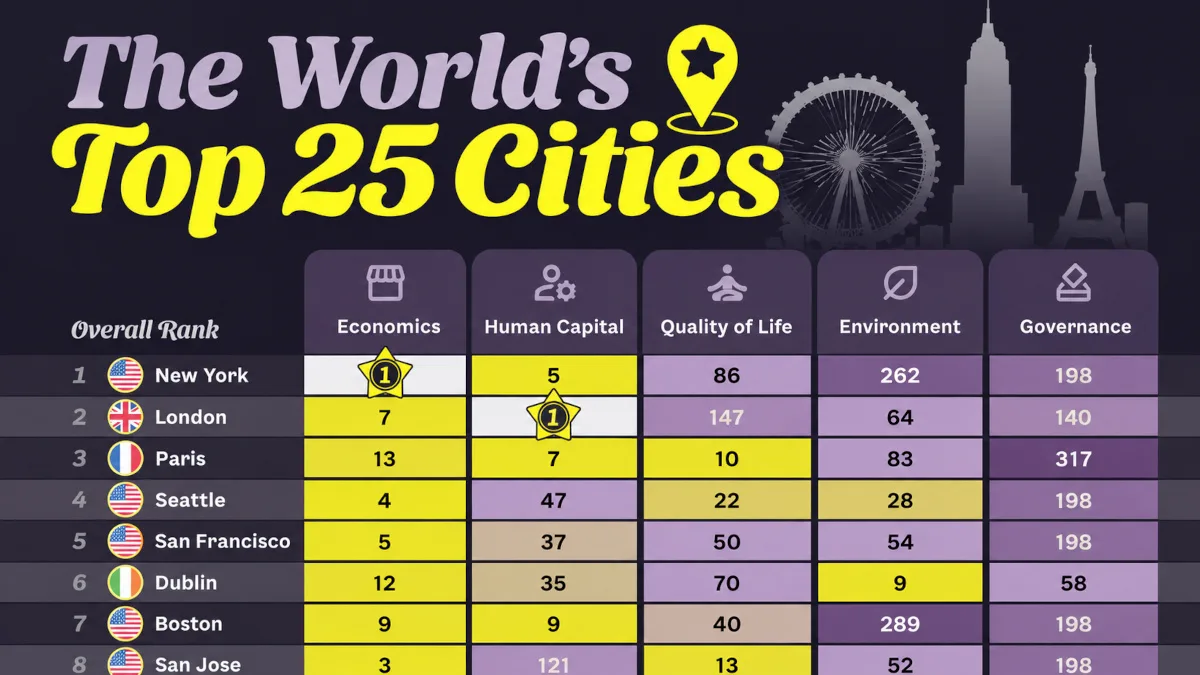
Ranked: The World’s Top 25 Cities in 2026
Discover the world's top 25 cities in 2026, ranked by Oxford Economics across economic strength, quality of life, human capital, and more.
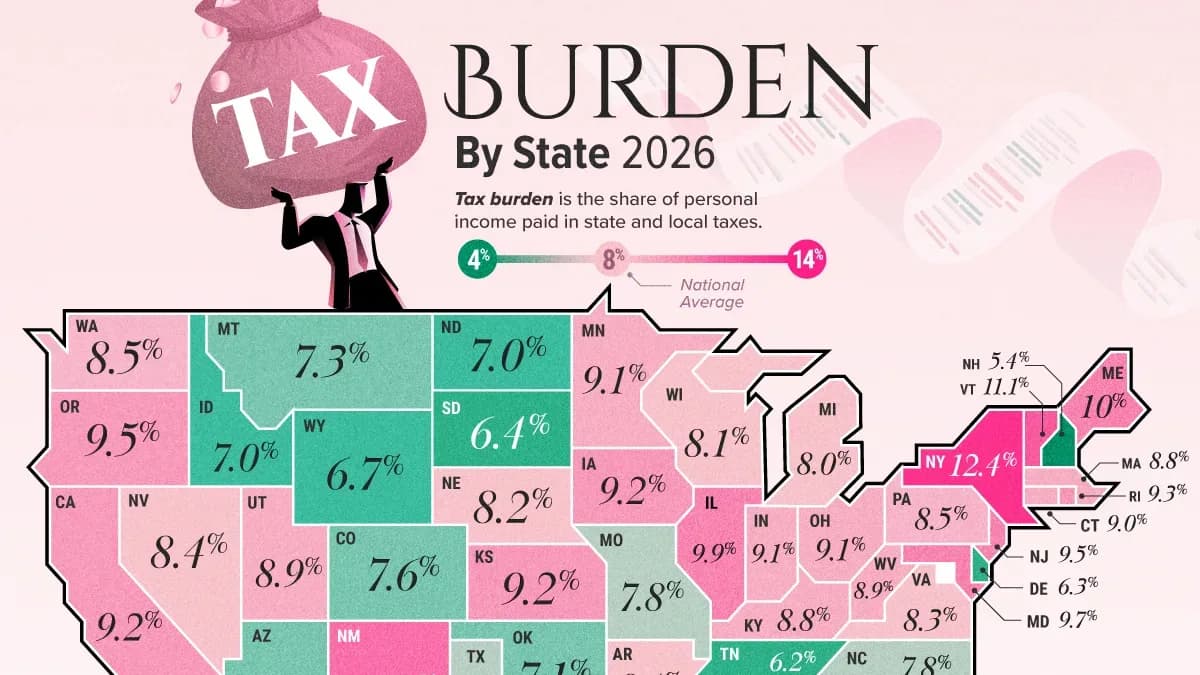
Mapped: U.S. States With the Highest Tax Burden in 2026
Hawaii's state and local tax burden is 13.3% of personal income, nearly triple Alaska's 4.9%. See where your state ranks in 2026.

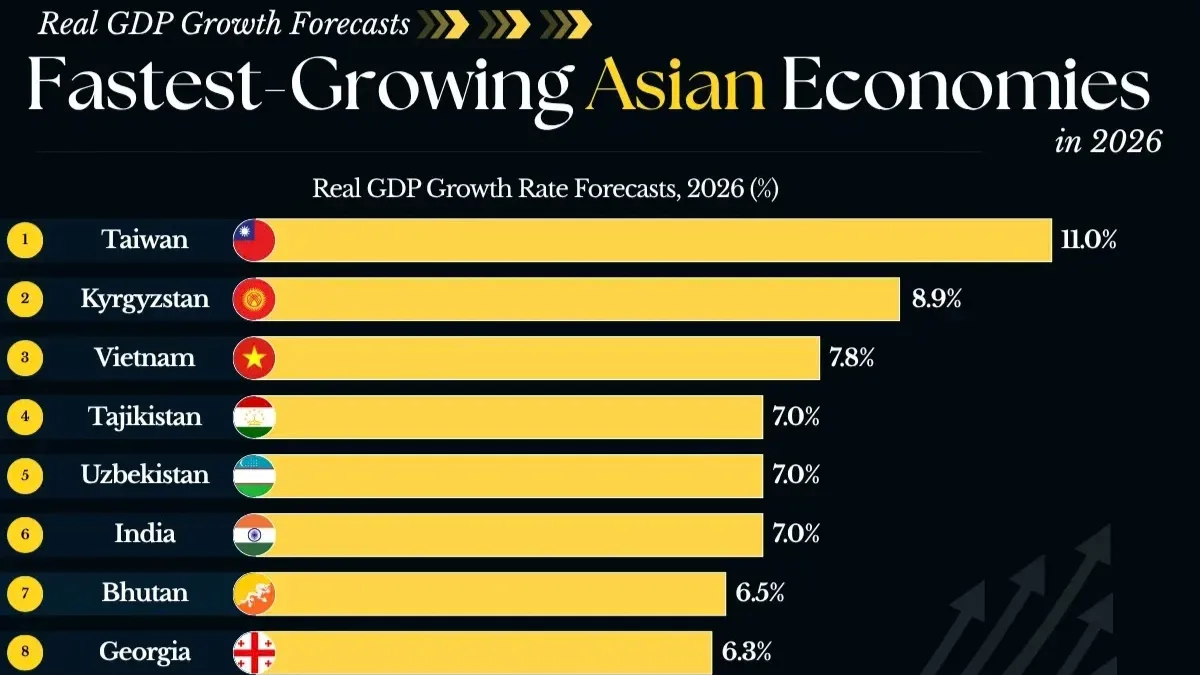
Ranked: The Fastest-Growing Asian Economies in 2026
Taiwan leads Asia’s fastest-growing economies in 2026, fueled by booming AI and semiconductor demand.
Ranked: Countries With the Highest Consumer Confidence
Californians and New Yorkers may face high taxes, but residents of one state can expect to pay over $100,000 more over their lifetimes.