
Mapped: Where U.S. Jobs Are Most Exposed to AI
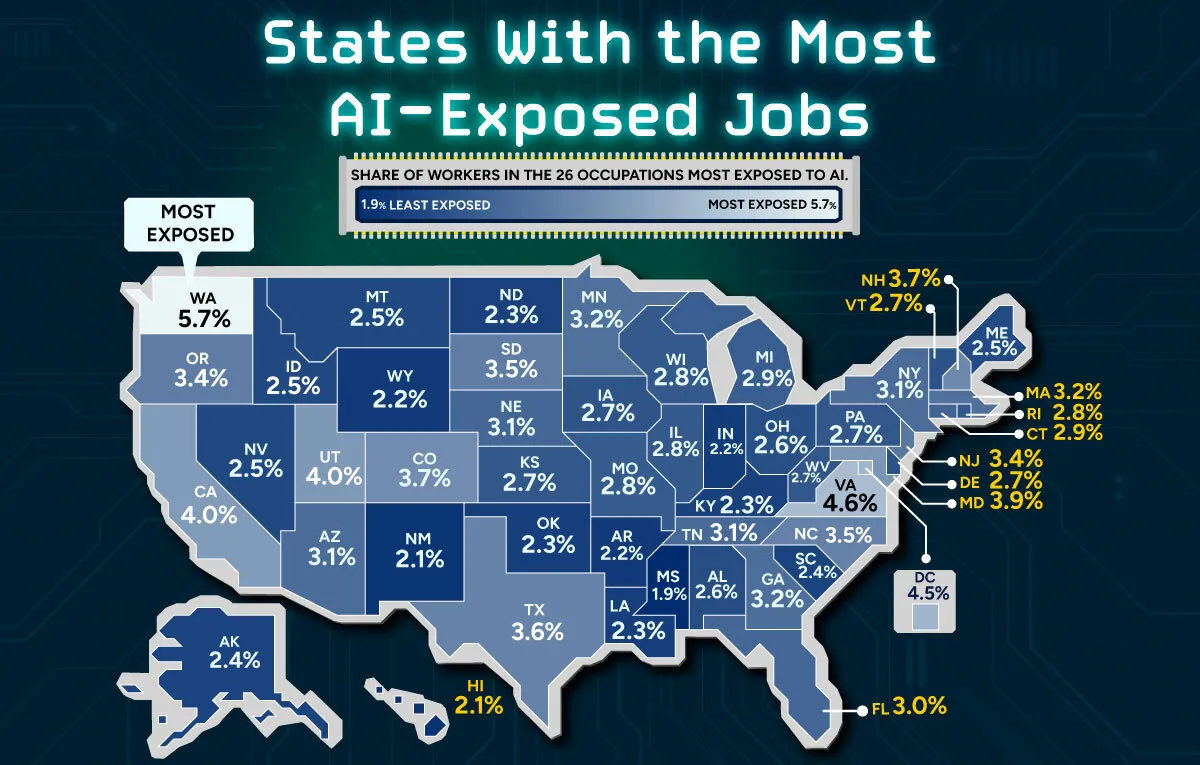
See which U.S. states have the highest share of AI-exposed jobs, led by Washington, Virginia, and Washington, D.C.
Where AI Exposure Is Highest Across the U.S.
Key Takeaways
Washington has the highest share of AI-exposed jobs, at 5.7% of its workforce.
California has the largest number of AI-exposed positions overall, at roughly 724,000 jobs.
Mississippi has the lowest share of AI-exposed jobs in the study, at 1.9%.
Artificial intelligence is becoming capable of performing tasks across a growing range of white-collar and technical occupations.
This visualization maps all 50 states and Washington, D.C., by the share of workers employed in occupations considered highly exposed to AI-related disruption. It also highlights the states with the largest and smallest numbers of workers in these roles.
The data for this visualization comes from SmartAsset, using U.S. Bureau of Labor Statistics data and research from the Virginia Economic Information and Analytics Division. The analysis covers 26 occupations identified as having particularly high exposure to potential AI-related disruption.
AI exposure does not necessarily mean these jobs will disappear. Instead, it reflects how susceptible their tasks may be to changes such as automation, weaker hiring demand, wage pressure, or restructuring as AI tools become more capable.
Why Washington Tops the Map
Washington ranks first, with 5.7% of its workforce employed in highly AI-exposed occupations.
The state’s large technology sector helps explain its position, with companies such as Microsoft and Amazon supporting a significant concentration of software developers, programmers, database specialists, and other digital roles.
RankState or DistrictAI-Exposed Jobs (%)
1Washington5.7%
2Virginia4.6%
3District of Columbia4.5%
4California4.0%
5Utah4.0%
6Maryland3.9%
7Colorado3.7%
8New Hampshire3.7%
9Texas3.6%
10North Carolina3.5%
11South Dakota3.5%
12Oregon3.4%
13New Jersey3.4%
14Massachusetts3.2%
15Minnesota3.2%
16Georgia3.2%
17Arizona3.1%
18New York3.1%
19Tennessee3.1%
20Nebraska3.1%
21Florida3.0%
22Connecticut2.9%
23Michigan2.9%
24Missouri2.8%
25Illinois2.8%
26Wisconsin2.8%
27Rhode Island2.8%
28West Virginia2.7%
29Kansas2.7%
30Pennsylvania2.7%
31Iowa2.7%
32Delaware2.7%
33Vermont2.7%
34Ohio2.6%
35Alabama2.6%
36Maine2.5%
37Idaho2.5%
38Montana2.5%
39Nevada2.5%
40Alaska2.4%
41South Carolina2.4%
42North Dakota2.3%
43Kentucky2.3%
44Oklahoma2.3%
45Louisiana2.3%
46Indiana2.2%
47Arkansas2.2%
48Wyoming2.2%
49New Mexico2.1%
50Hawaii2.1%
51Mississippi1.9%
Virginia follows at 4.6%, reflecting its mix of technology firms, federal contractors, and knowledge-based employment. Washington, D.C., ranks third at 4.5%, while California and Utah round out the top five at 4.0% each.
At the other end of the ranking, Mississippi has the lowest share in the study, at 1.9%.
California Has the Most AI-Exposed Jobs
California has the largest absolute number of workers in highly exposed occupations, with approximately 724,000 positions.
Texas follows with about 500,000, while New York and Florida each have roughly 301,000.
RankStateStates With the Most AI-Exposed Jobs
1California724K
2Texas500K
3New York301K
4Florida301K
5Washington202K
At the other end of the scale, Wyoming has just 6,000 AI-exposed positions, followed by Alaska and Vermont at about 8,000 each.
Rank StateStates With the Fewest AI-Exposed Jobs
1Wyoming6K
2Alaska8K
3Vermont8K
4North Dakota10K
5Montana13K
What Types of Jobs Are Most Exposed to AI?
The 26 occupations span technology, communications, administration, finance, and other knowledge-based fields.
Mathematicians rank as the most exposed occupation, followed by proofreaders, correspondence clerks, court reporters, and media and communication workers. Computer programmers, database administrators, web developers, software developers, writers, translators, payroll clerks, and bookkeeping workers also appear on the list.
Many of these roles involve processing information, generating or reviewing text, working with structured data, or performing routine digital tasks, all areas where generative AI and other automation tools have advanced quickly.
Still, exposure should be interpreted as the potential for jobs to change rather than a direct estimate of how many positions will ultimately be eliminated.
Learn More on the Voronoi App
To learn more about this topic, check out this graphic on the smartest AI models in 2026.
Source: https://www.visualcapitalist.com/mapped-where-u-s-jobs-are-most-exposed-to-ai/
Related articles

Can VR glasses save VR?
I'm pretty sure I won't be buying the $1,299 Meta VR Glasses. That's too rich for my blood in today's economy, and my feelings about Meta are… conflicted.

Sony brings AI graphics upscaling to the regular PS5
Sony is launching a new AI upscaling technology specifically for the regular PS5.

Blackbird awakens? NASA quietly eyes resurrecting historic SR-71A aircraft after 27 years
NASA may be quietly working to return one of its historic SR-71 Blackbird aircraft to...

Chicago Metra’s new battery-electric train charges through regenerative braking
Chicago’s commuter rail system is preparing for a major shift away from diesel power. Metra...


Inside Microsoft’s big Copilot rethink
Last week, Microsoft CEO Satya Nadella hosted an intimate, invite-only event for leaders from some of its key enterprise customers.