
MindOn’s new Mind-1 model brings human-speed execution to robots
MindOn has unveiled Mind-1, a new physical AI model designed to make robots perform everyday...
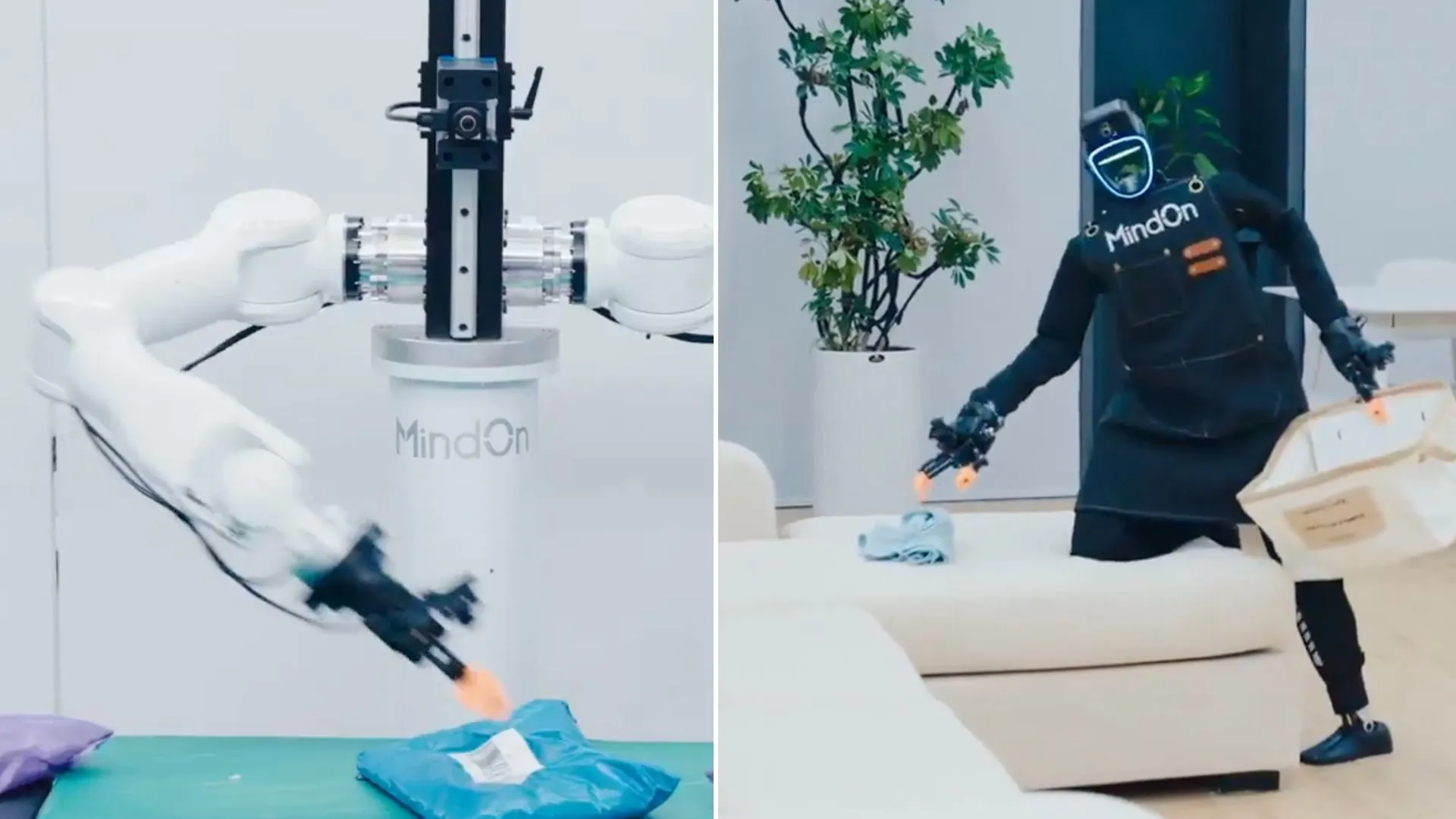
MindOn has unveiled Mind-1, a new physical AI model designed to make robots perform everyday manipulation tasks at what the company describes as human-level speed.
The September 30 demonstration shows robots handling parcels, folding shirts and collecting laundry, with the footage marked “1.0x Speed” and “Fully Autonomous.” Rather than introducing another humanoid robot body, MindOn is presenting Mind-1 primarily as an intelligence system that can operate across different robotic platforms.
The company says the model is intended to move physical AI beyond simply completing tasks toward performing them at the pace required for practical work.
One AI model across different robots
The demonstration switches between several configurations. Dual-arm robots handle parcels around a conveyor and fold clothing on a work surface, while a humanoid moves through a furnished environment and collects laundry.
MindOn’s broader approach is to develop a robot intelligence model that can transfer between different physical platforms. The company’s website describes the system as a universal robot intelligence model designed to combine perception, reasoning and action rather than relying on separate task-specific models for every machine.
The latest demonstration therefore focuses as much on the software as the hardware. A robot’s physical design determines what it can manipulate, but the underlying intelligence needs to interpret its surroundings and translate that understanding into coordinated movements.
Mind-1: Physical AI at Human Speed, Built for Real Work
Completing a task is only the beginning. Doing it at a pace that works in the real world is the next step—and that is what Mind-1 is built to achieve. pic.twitter.com/xIrk978nsx
— MindOn (@MindOn_Tech) September 30, 2026
Humanoids Daily reported on the demonstration, noting that the footage does not provide quantified human-versus-robot comparisons, task success rates, or intervention statistics. Those measurements will be important for determining whether the demonstrated speed translates into sustained productivity outside a controlled demonstration.
Speed becomes the next robotics benchmark
Robot demonstrations have increasingly focused on whether machines can perform useful tasks autonomously. MindOn is now emphasizing another metric. How quickly they can do so.
The distinction matters in environments such as logistics and manufacturing, where productivity depends on throughput rather than simply completing an individual movement. A robot that successfully performs a task but takes considerably longer than a human may still have limited practical value.
MindOn’s new demo shows the robots operating at the speed represented by the company’s 1.0x label. However, the video itself does not establish that the machines consistently match human workers across comparable tasks.
The company says Mind-1 can perform complex manipulation at human-level cycle times and, for some tasks, faster than humans. Those are company-reported claims rather than independently measured results.
From household chores to real-world work
MindOn has previously demonstrated its intelligence systems on household and logistics tasks. Its latest presentation expands that direction by showing multiple robot configurations handling different forms of physical work.
The approach could allow improvements to the underlying AI model to benefit different types of robots rather than being tied to a single humanoid platform.
For now, however, Mind-1 remains a demonstration of the capabilities MindOn is targeting. Longer runs, independently measured cycle times, task-success rates, and human intervention data will be needed to establish how reliably the system can maintain human-level productivity.
The new demo nevertheless highlights an increasingly important challenge for physical AI. Getting robots not only to perform useful work, but to perform enough of it, quickly and consistently enough to matter.
Related articles

Who Controls the Critical Minerals Powering AI?
AI’s rapid growth depends on critical minerals. Here’s which countries dominate production of gallium, rare earths, and tantalum.

Steam Deck 2: Is AMD Gainsborough the chip Valve’s been waiting for?
The Steam Deck is four and a half years old, and handheld gamers are eagerly awaiting a Steam Deck 2 - but Valve has consistently said it needs a new chip with a "generational leap" in performance…

US Navy adds M-Code GPS to shield carrier landings from jamming threats at sea
BAE Systems has secured a $16 million award to modernize GPS guidance aboard U.S. Navy...

Judge dismisses antitrust lawsuits over Google’s AI Overviews
A federal judge has dismissed a pair of antitrust lawsuits filed by Chegg and Rolling Stone parent company Penske Media Corporation, which accused Google of driving away web traffic with its…

Airbus A350F takes maiden flight with 111-ton payload and 5,400-mile range
Airbus’s A350F cargo jet has taken to the skies for the first time and completed...

Deep-sea ‘doomsday fish’ could inspire the next generation of stealth submarines
Sometimes nature can be the best inspiration even for robots. Cornell engineering professor Rob Shepherd...