
New aircraft paint cuts heat-related errors by 25% in tests above Mach 5 speeds
Engineers at The University of Manchester have developed a pressure-sensitive paint that could make wind...
Engineers at The University of Manchester have developed a pressure-sensitive paint that could make wind tunnel tests more accurate at high speeds. The team reported that the new paint is far less affected by temperature than existing pressure-sensitive coatings.
Pressure-sensitive paint is used on scale models to map how air moves across an aircraft or spacecraft surface. The coating glows when exposed to light, with the intensity changing according to the pressure around it. Engineers can then use the glow to create detailed pressure maps during wind tunnel tests.
The technique has an important limitation. The paint also reacts to changes in temperature. A model can heat up significantly during high-speed testing, causing changes in the paint’s light output that are unrelated to air pressure. Engineers must account for these effects before they can interpret the measurements.
A coating designed to resist heat effects
Researchers from the university’s Departments of Mechanical and Aerospace Engineering and Chemistry developed a new formulation to reduce this temperature-related error. The material contains a light-emitting platinum-based compound that is locked into a specially engineered plastic.
Tests showed that its temperature sensitivity fell to about 0.3 percent per degree Celsius. That is 25 percent lower than the current industry benchmark, according to the researchers.
Dr. Elliott Nunn, from the Department of Chemistry at The University of Manchester and first author of the paper, said, “When you’re testing a vehicle at high speed, it can heat and cool dramatically based on its aerodynamic design. By creating a pressure-sensitive paint which doesn’t respond as strongly to this heat, we’ve got something that’s much closer to measuring exactly what we want to measure.”
“Our hope is that this will really help the engineers designing the next generation of high-performance and more sustainable aircraft and spacecraft to make better-informed decisions through cleaner data.”
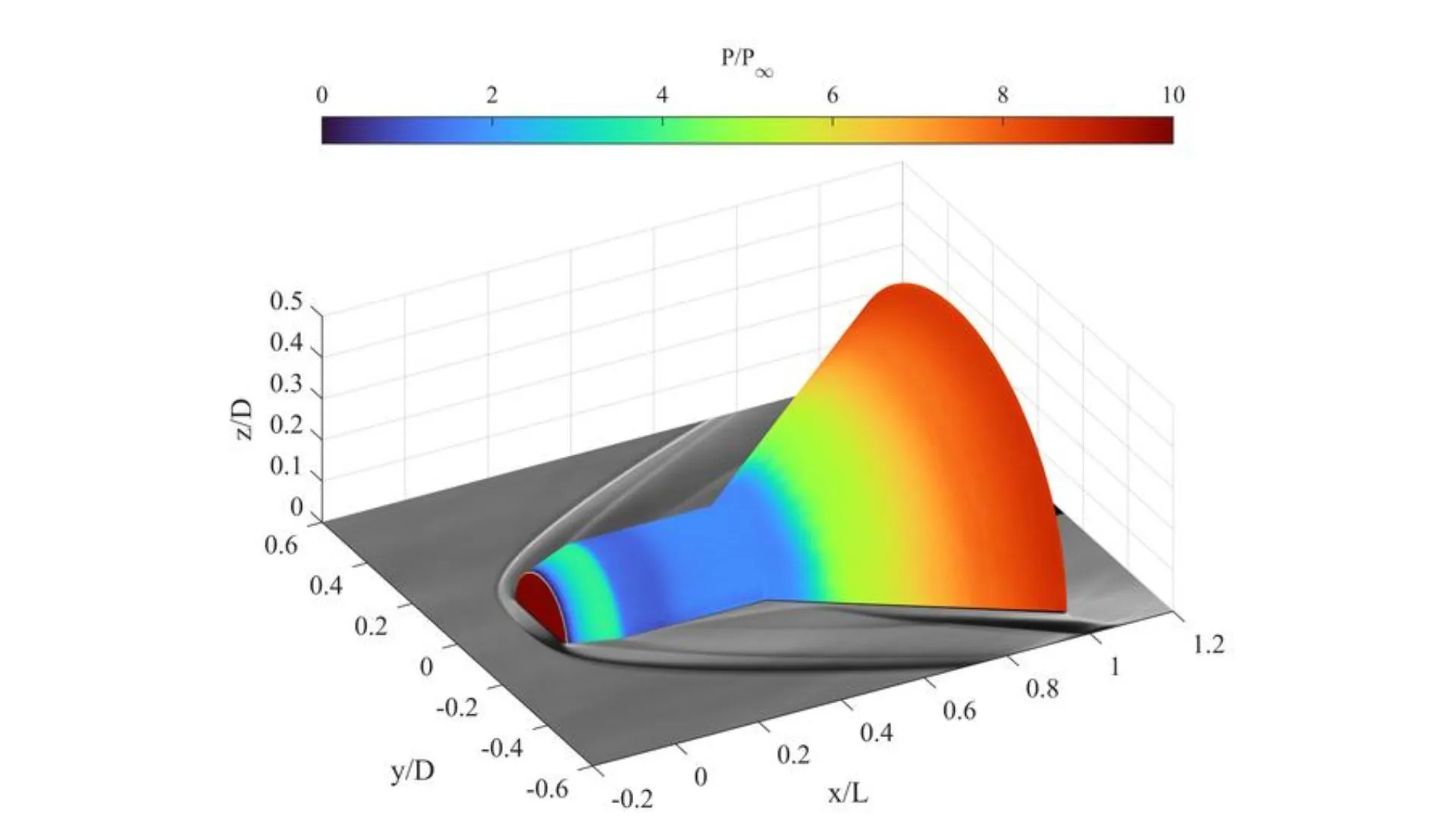
Aerodynamic performance data on a truncated cone model at supersonic flow collected using low temperature sensitivity PSP. (Image credit: The University of Manchester)
Keeping the active molecules apart
The researchers traced the improvement to the way the light-emitting molecules are held inside the coating. In conventional pressure-sensitive paints, these molecules can cluster together. That behavior can increase their temperature response and make measurements harder to interpret.
The Manchester team anchored the active compound directly into a durable plastic similar to Teflon. The compound belongs to a chemical family that includes molecules responsible for the red color of blood and the green color of leaves.
Keeping the molecules fixed within the plastic prevents them from clustering as easily. This reduces the coating’s response to temperature while allowing it to continue responding to changes in pressure.
“Getting this chemistry right was thanks to a creative collaboration between our chemistry group and the aerospace engineering team—basically, they knew what the paint needed to do in a wind tunnel, and we knew how to create something that could do it,” stated Dr. Louise Natrajan, a reader in the Inorganic Chemistry Group at The University of Manchester.
Paint tested in airflow above Mach 5
The team then tested the coating on a cone-shaped model designed to generate complicated airflow patterns. The model was placed inside a supersonic wind tunnel where air speeds can exceed Mach 5.
At these speeds, temperatures can change sharply across the model’s surface. Despite those variations, the new paint produced pressure measurements that closely matched computer simulation results.
The coating also revealed Görtler vortices, which are corkscrew-shaped airflow structures that form along concave curved surfaces. These structures provide information about the thin layer of air moving directly next to a surface.
The researchers say improved pressure measurements could support the development of more efficient and safer aircraft and spacecraft. They plan to test the coating under a wider range of temperatures and flow conditions to assess its reliability further.
The results were published in ACS Applied Engineering Materials.
Source: https://interestingengineering.com/innovation/glowing-paint-improve-aircraft-design
Related articles

SteelSeries’ new mice are super light, with ultra-wideband and swappable batteries
The new ergonomic Rival Pro and ambidextrous Sensei Pro wireless gaming mice are some of the company's most interesting models in years.

The best early October Prime Day deals happening now
It’s not even October yet and Amazon is already offering some Prime Big Deal Day discounts on its own hardware, along with plenty of other popular products.

Meta’s Muse AI sent a YouTuber’s address to a stranger
Tech YouTuber Matt Robb says that Muse gave out his home address to a total stranger this weekend, after authorizing the bot to handle his Facebook Marketplace account.

Leaked images reveal new colors for Amazon’s next entry-level Kindle
Amazon typically introduces new Kindle models a few months ahead of the holiday shopping season, and this year it looks like that will include a bigger update to the entry-level Kindle than what…

Firefox just got a redesign with round tabs, new themes, and Compact Mode
Firefox will look a little different the next time you launch it - more bubbly, with some new pops of color.

Polaroid’s new instant camera has four creative shooting modes you can experiment with
Polaroid announced a new instant camera that lets photographers get more creative and experimental with their shots than just changing the aperture or shutter speed.