
New robotic hand learns human-like grip control to stop objects from falling
A major technical challenge remains in teaching a robot to grasp an object, then rotate...
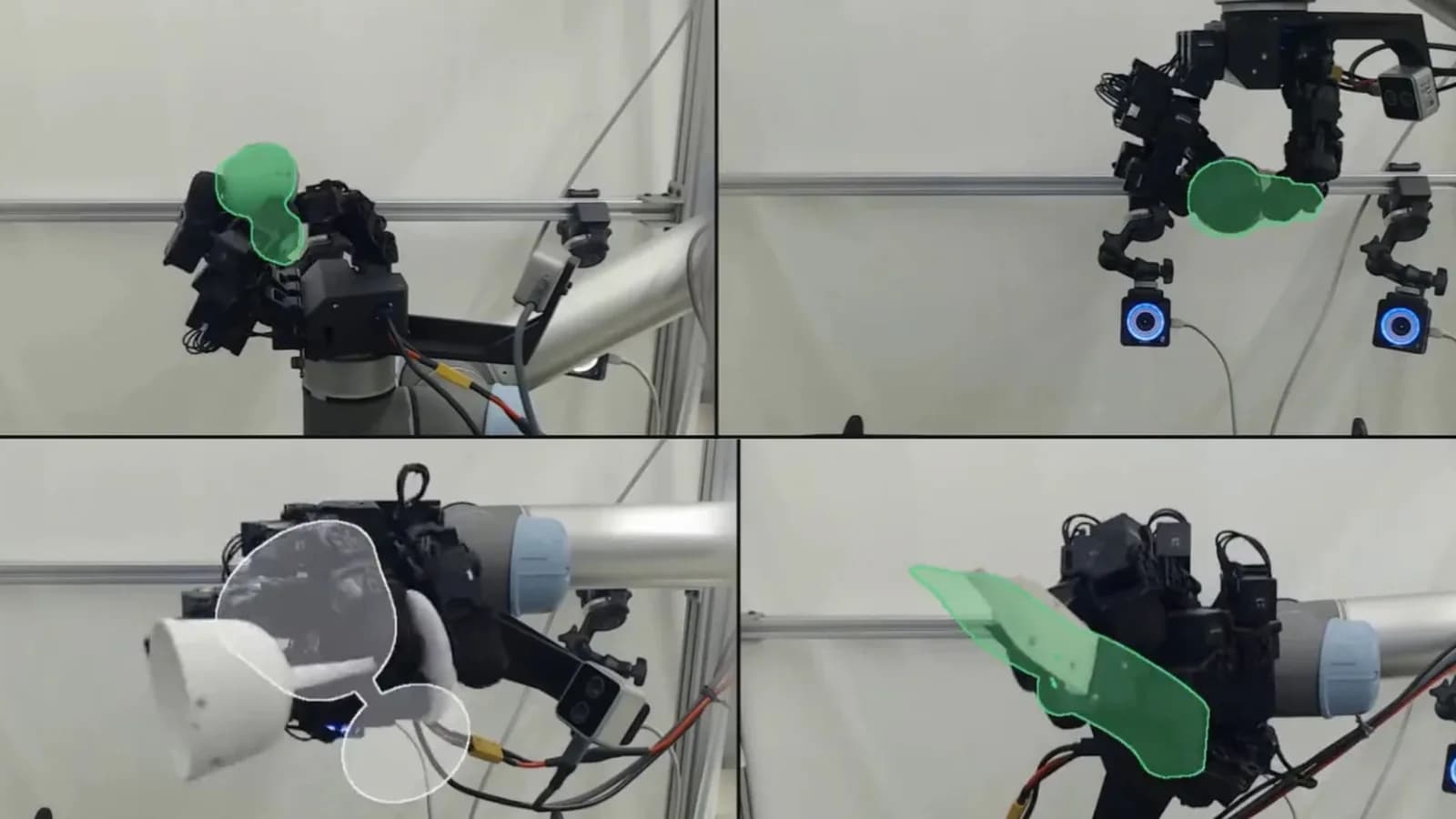
A major technical challenge remains in teaching a robot to grasp an object, then rotate that object between its fingers and reposition it to stop it from falling. Humans can instinctively adjust finger pressure, but when the palm of the hand is facing downward, the risk of the object falling is very high.
Scientists have now made significant progress in addressing this problem. In addition to being able to rotate objects and place them in various positions in the hand, the robotic hand has been fitted with a special software-based safety system to prevent objects from falling out of the hand’s fingers.
The research was conducted by Ian Chuang and colleagues at the University of California, Berkeley and Davis.
Robot trained through computer simulations
While the safety mechanism reduced the number of dropped objects from 16 to 4 in 1,200 assigned tasks, it also had a slight negative impact on the robot’s accuracy for some of its goals. However, the safety settings can be adjusted independently of the task performance and thus a balance can be found between the goal of a secure grip and successful object manipulation.
The researchers used a 16-joint LEAP robotic hand to complete tasks. It was trained through computer simulations only, without any human hand demonstration. To develop the simulation model, researchers analyzed the behavior of real-world robotic motors and incorporated this behavior into the simulation.
In the initial stage of training, millions of grasping situations were generated by a computer. In order to facilitate grasping, the friction between the fingers of the hand and the objects was set to be higher than in real-world scenarios. As the robot’s performance increased, the artificial friction was reduced to create more realistic situations. The robot was then tested in the physical world using four 3D-printed plastic objects: a knife, a wine glass, a duck, and a light bulb. Separate controllers were used for each of the objects.
The safety mechanism was trained separately from the main controller. It can adjust the robot’s movements to maintain a secure grip on an object while causing minimal disturbance to the main task. The safety mechanism does not receive information on the final target position, nor does it receive any rewards for reaching a target.
Safety improves, but accuracy slightly decreases
To test the system, 4,800 experiments were conducted with 4 objects and 6 wrist angles, with each test sequence involving 50 targets. External motion-tracking cameras were used to measure the movement of the objects in the robot‘s hand. The experiments were stopped and restarted when an object was dropped or became stuck.
The success rate without safety mechanism stood at 95.2%, while the success rate with safety mechanism was 91.5%. The success was measured with the following parameters: within 2 cm of the target, within 23 degrees of the target, within 10 seconds.
The researchers also demonstrated the robot installing a lightbulb. This included first rotating the lightbulb, then moving it to the socket and finally screwing it into place and turning on the light. The safety mechanism, however, was not as effective in every demonstration, and thus there is a trade-off between the accuracy of reaching a target and the safety of maintaining a secure grip on an object. In the future, the researchers hope to make the safety system more efficient and to create a single controller for many different objects. This could eventually lead to more dexterous robotic hands that can manipulate delicate objects.
Their findings have been published on the arXiv preprint server.
Source: https://interestingengineering.com/ai-robotics/us-robotic-hand-experiment
Get the latest news delivered to your inbox.
Related articles