Russia's Cosmos 2612 came within about 500 metres of a commercial radar satellite that supports Ukraine
Russian military satellite Cosmos 2612 manoeuvred to within roughly 500 metres of ICEYE-X36, a US-registered commercial radar-imaging satellite, according to LeoLabs. It began drifting away after the closest pass.
This story was prepared automatically by software.
A Russian military satellite, Cosmos 2612, has made an unusually close approach to a US-registered commercial radar-imaging satellite that has supported Ukraine, alarming space analysts, SpaceNews, Axios and Finland's SpacEconomy reported.
How close it came
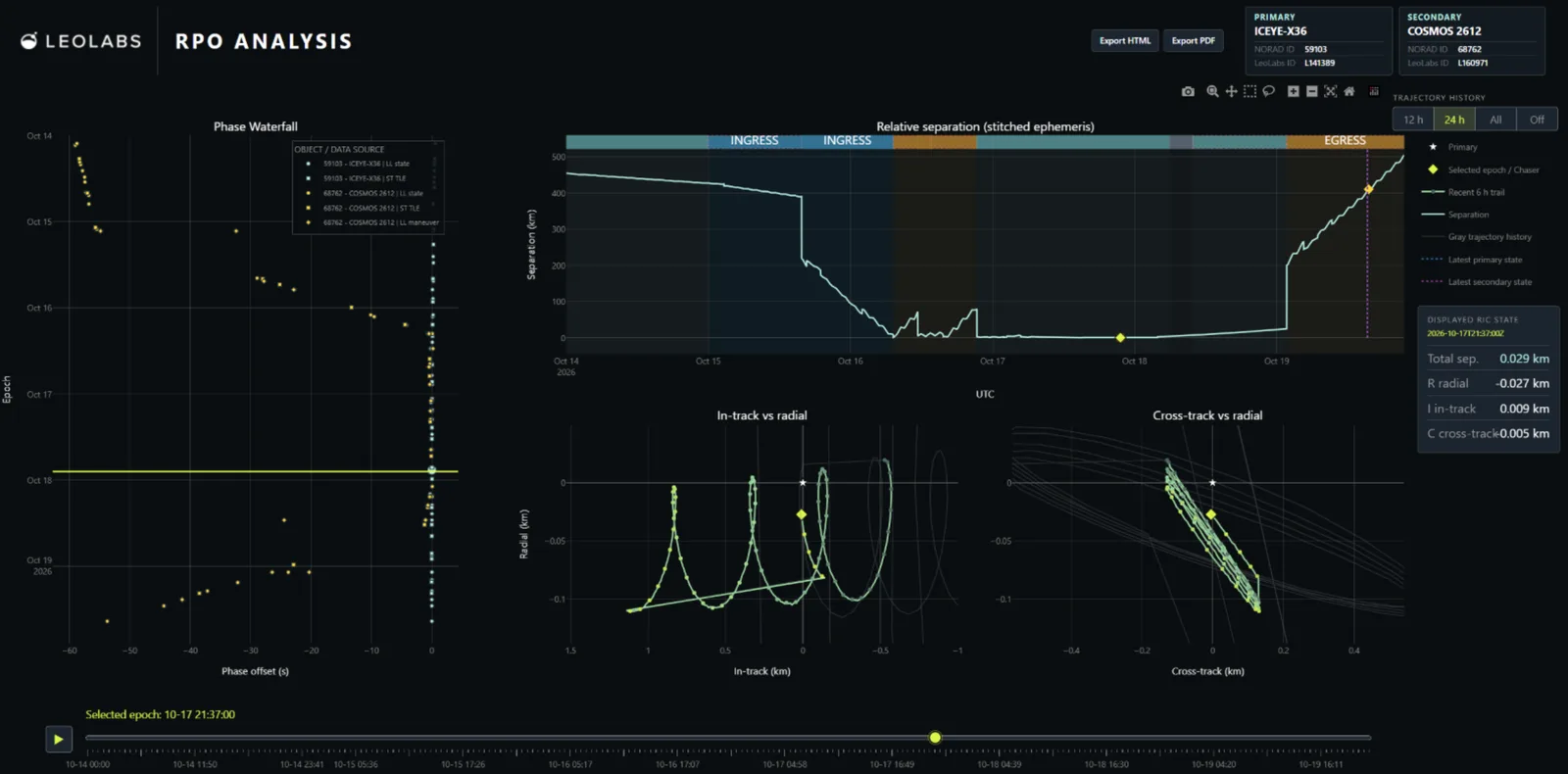
Citing analysis by space-tracking firm LeoLabs, SpaceNews reported that Cosmos 2612 manoeuvred to within roughly 500 metres of ICEYE-X36, a radar-imaging satellite operated by the Finnish-founded company ICEYE. According to Axios, the two satellites were more than 200 miles apart on October 15 and about three miles apart by the afternoon of October 16. LeoLabs said the movement "appears to be a deliberate approach toward" ICEYE-X36 and that, while the intent remains uncertain, the behaviour warrants continued monitoring.
SpacEconomy reported that the closest encounter appears to have taken place early on October 18, after which Cosmos 2612 rose to a slightly higher orbit and began to recede. By that afternoon the distance had grown to about 12 km, and there were no signs of disturbance or collision in ICEYE-X36's orbit.
Why it matters
Axios reported that ICEYE-X36 is part of a satellite network that has supported Ukraine's military. In January, ICEYE announced an agreement with a customer within Ukraine's Ministry of Defence to expand cooperation in space-based intelligence. The US Space Force had also noted Russian satellites manoeuvring near ICEYE-X36 since May.
Clayton Swope, a senior space fellow at the Center for Strategic and International Studies (CSIS), described the distance as essentially "bumper-to-bumper," while space law experts told Axios that countries generally keep their satellites more than six miles apart. The US Defense Department and ICEYE declined to comment.
Some posts on X described ICEYE-X36 as a "US spy satellite," but it is a commercial radar-imaging satellite, registered in the US and operated by a company of Finnish origin.
Sources: SpaceNews, Axios, SpacEconomy, LeoLabs
Related articles