Ranked: Countries That Visit the Doctor Most Often
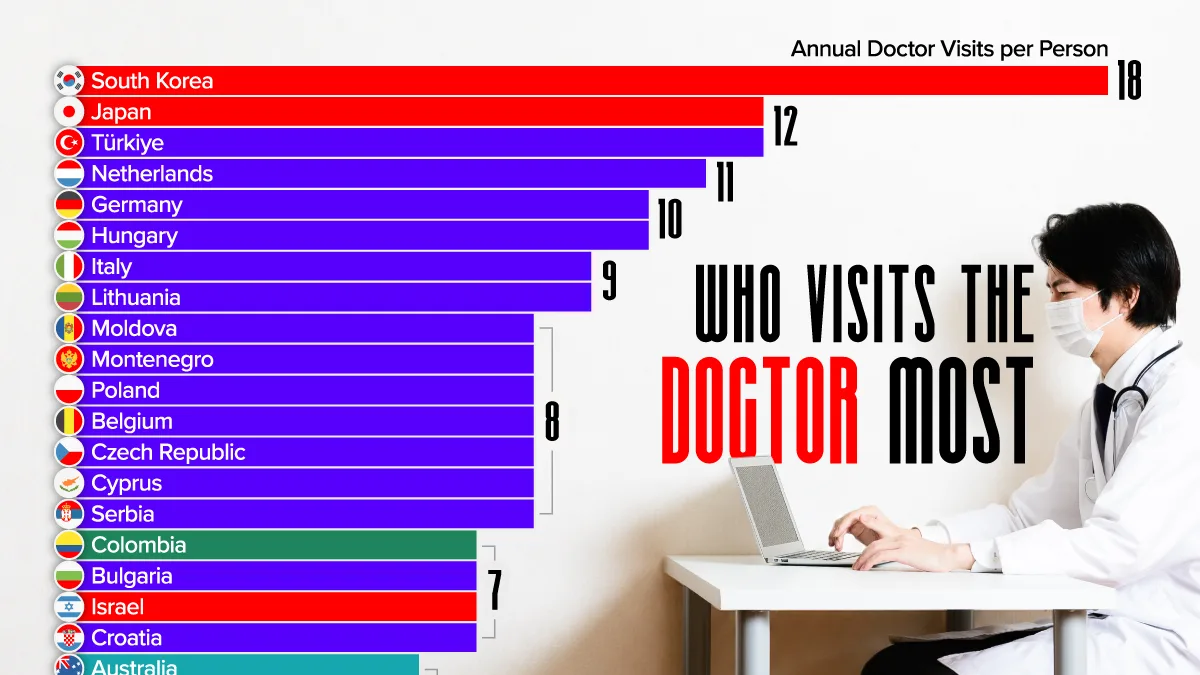
South Koreans see a doctor 18 times a year, almost five times as often as Americans. See how doctor visits compare across 40 countries.
This story was prepared automatically by software.
Which Countries Visit the Doctor Most Often?
Key Takeaways
South Koreans see a doctor 18 times a year on average, more than four times as often as Americans (4).
Sweden (2) and Finland (3) rank near the bottom partly because nurses handle more of their routine care.
How often do you visit the doctor? Depending on where you live, the answer could be a few times a year or more than once a month.
These differences reflect how healthcare systems operate, from the cost of appointments to how doctors are paid and who provides routine care.
This graphic ranks 40 countries by average annual in-person doctor consultations per person, using the latest data from OECD Health Statistics. Figures cover visits to both general practitioners and specialists.
South Koreans See a Doctor 18 Times a Year
South Korea tops the ranking with 18 doctor visits per person annually, the equivalent of one visit roughly every three weeks. That’s six more visits than second-place Japan (12) and nine times as many as last-place Mexico (2).
Much of the gap comes down to how care is delivered. Korean doctors are paid mostly per service, and short consultations let them see more patients. According to the OECD, most Koreans can get primary care on the same day, even without an appointment.
The table below ranks all 40 countries by average annual doctor visits per person, along with the year of each country’s latest data:
RankCountryAnnual Doctor Visits per Person
1 South Korea18
2 Japan12
3 Türkiye12
4 Netherlands11
5 Germany10
6 Hungary10
7 Italy9
8 Lithuania9
9 Moldova8
10 Montenegro8
11 Poland8
12 Belgium8
12 Czech Republic8
14 Cyprus8
15 Serbia8
16 Colombia7
17 Bulgaria7
18 Israel7
19 Croatia7
20 Australia6
20 Spain6
22 Slovenia6
23 Romania6
24 Luxembourg6
25 Canada5
26 France5
27 Denmark5
28 Chile5
29 Switzerland5
30 Norway4
30 Portugal4
32 Thailand4
33 Estonia4
34 U.S.4
35 Finland3
36 Greece3
37 Malta2
37 Sweden2
39 Costa Rica2
40 Mexico2
Figures are rounded.
Japan (12) and Germany (10) also rank near the top, and like South Korea, both pay doctors mostly per service. Germany’s figure is an undercount: it tallies treatment cases rather than visits, with each case counting only the first contact with a doctor in a three-month period.
Türkiye has seen the steepest rise in the data. Annual doctor visits quadrupled from three per person in 2000 to 12 in 2024, putting the country alongside Japan and just behind South Korea.
The increase followed the Health Transformation Programme, launched in 2003, which tied doctors’ pay to their performance starting in 2004 and introduced universal health insurance in 2008. A joint OECD and World Bank review found large increases in consultations per doctor after the pay change.
Does How Doctors Are Paid Affect Visit Figures?
At the other end of the ranking, Mexico, Costa Rica, Malta, and Sweden report the fewest visits, at about two per person each.
How doctors are paid is one factor. Countries that pay doctors mainly through salaries or a fixed fee per patient, such as Denmark (5), Finland (3), Mexico, and Sweden, tend to report fewer consultations than those that pay per service.
The U.S. is an exception. Its doctors are also paid mostly per service, yet Americans averaged about four visits in 2023, essentially unchanged since 2000. The OECD points to the high copayments many Americans face, which can lead patients to skip visits because of the cost of care.
Who delivers care matters too. In Finland and Sweden, nurses play a larger role in primary care, managing chronic conditions and minor health problems that might otherwise require a doctor’s visit. Swedish doctors tend to focus on more severe and complex cases.
The figures also exclude remote consultations in most countries. In 2023, more than a quarter of doctor consultations in Sweden, Denmark, Estonia, and Portugal took place remotely, meaning their in-person totals understate overall contact with doctors.
Ultimately, more doctor visits don’t necessarily mean better healthcare. The ranking reflects differences in how countries organize, deliver, and pay for medical care, not simply how healthy their populations are.
Learn More on the Voronoi App
If you enjoyed today’s post, check out The European Countries Most Dependent on Foreign-Trained Doctors on Voronoi.
Related articles