
Ranked: The Countries That Dominate the Fertilizer Trade
Global agriculture depends on three main fertilizers. Four countries are responsible for over half of all fertilizer exports.
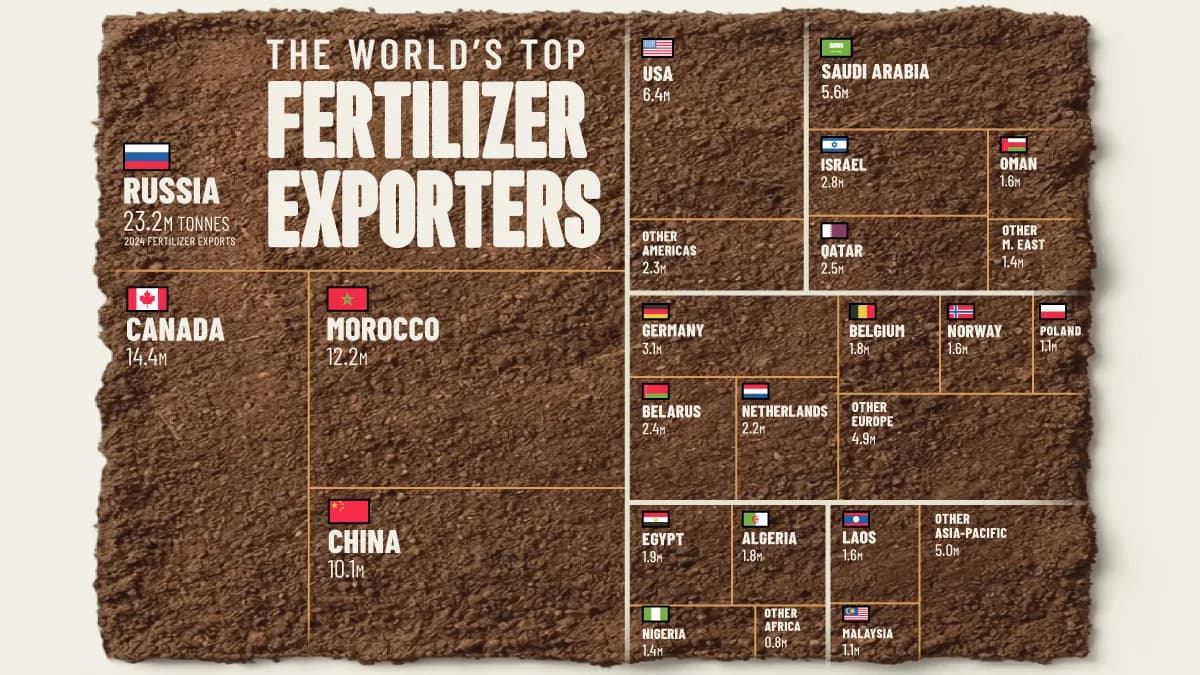
Who Leads the Global Fertilizer Trade?
Key Takeaways
Russia is the world’s largest fertilizer exporter, shipping 23.2 million tonnes by nutrient content in 2024.
Canada, China, Morocco, and Russia together account for 53% of global fertilizer exports.
Mineral deposits and energy supplies help shape which countries lead the fertilizer trade.
The global food supply depends on a fertilizer trade concentrated among a relatively small group of countries.
Farmers use fertilizers to replenish nutrients and support crop growth. Producing them at scale depends heavily on access to key mineral deposits and energy resources.
This visualization ranks the world’s largest fertilizer exporters using the latest figures available (2024) from the Food and Agriculture Organization. It combines nitrogen, phosphate, and potash exports, measured by nutrient content rather than the full weight of fertilizer products.
The Big Four Fertilizer Exporters
Global fertilizer exports topped 113.3 million tonnes in 2024, with the four largest exporters accounting for more than half of the total.
Russia leads the ranking with 23.2 million tonnes, followed by Canada (14.4 million), Morocco (12.2 million), and China (10.1 million).
The table below ranks the world’s top fertilizer exporters in 2024 based on total tonnes exported.
RankCountry2024 fertilizer exports (tonnes)
1 Russia23,234,623
2 Canada14,419,294
3 Morocco12,154,362
4 China10,126,069
5 U.S.6,372,572
6 Saudi Arabia5,589,139
7 Germany3,136,446
8 Israel2,782,901
9 Qatar2,471,034
10 Belarus2,436,719
11 Netherlands2,244,415
12 Egypt1,910,594
13 Belgium1,830,168
14 Algeria1,753,242
15 Oman1,649,407
16 Norway1,641,508
17 Laos1,629,908
18 Nigeria1,415,355
19 Poland1,070,679
20 Malaysia1,061,170
21 Turkmenistan1,024,841
22 Spain865,510
23 Indonesia748,316
24 Lithuania727,186
25 Trinidad and Tobago689,636
26 Vietnam610,681
27 Chile601,601
28 Türkiye513,686
29 Brunei497,215
30 Jordan433,747
31 Bulgaria381,202
32 South Korea374,965
33 Slovakia360,260
34 Uzbekistan359,536
35 Bahrain318,528
36 France301,235
37 Italy297,626
38 Venezuela276,721
39 Australia271,208
40 UK265,615
41 Bolivia263,910
42 Kazakhstan260,759
43 Azerbaijan259,871
44 South Africa254,092
45 Greece245,335
46 Tunisia223,833
47 Brazil205,427
48 Sweden201,946
49 Thailand198,058
50 Serbia184,174
51 Portugal175,072
52 Hungary174,732
53 India155,111
54 Czechia145,631
55 Georgia131,526
56 Taiwan124,326
57 Mexico121,036
58 Japan105,137
59 Romania95,519
60 Côte d'Ivoire94,742
61 Croatia86,147
62 Latvia64,310
63 Slovenia59,726
64 Lebanon59,118
65 Finland51,017
66 Colombia40,997
67 Namibia40,182
68 Honduras36,650
69 Mozambique34,813
70 Tanzania29,417
71 Denmark29,249
72 Senegal28,976
73 Kenya28,094
74 Dominican Republic22,095
75 Peru21,757
76 United Arab Emirates20,627
77 Guatemala19,637
78 Ghana19,325
79 Philippines19,041
80 Iran16,938
81 Austria15,574
82 Singapore15,198
83 Ireland14,811
84 Madagascar14,692
85 Costa Rica13,587
86 Ukraine13,291
87 Mali13,089
88 Luxembourg12,538
89 El Salvador12,420
90 Eswatini9,464
91 Uruguay7,628
92 Estonia6,768
93 Panama4,340
94 Guyana3,527
95 North Macedonia2,869
96 Ecuador1,585
97 Bosnia and Herzegovina1,543
98 North Korea1,265
99 Hong Kong1,244
100 Kuwait1,237
101 Malawi1,000
102 Paraguay972
103 Bahamas884
104 Syria612
105 Angola583
106 Iraq579
107 Pakistan570
108 New Zealand543
109 Burkina Faso539
110 Cameroon523
111 Tajikistan450
112 Libya349
113 Uganda334
114 Switzerland327
115 Togo315
116 Botswana233
117 Moldova232
118 Kyrgyzstan176
119 Mauritius155
120 Bangladesh131
121 Armenia116
122 Gambia101
123 Benin54
124 Jamaica42
125 Albania36
126 Liberia20
127 Congo18
128 Cyprus9
129 DR Congo8
130 Palestine8
131 Cuba6
132 Niger6
133 Cambodia3
134 Montenegro3
135 Sri Lanka2
136 Suriname1
Total113,373,883
These totals combine different parts of the fertilizer industry, each supplying essential nutrients for agriculture. Potash supplies potassium, while phosphate fertilizers supply phosphorus. Nitrogen fertilizers follow a different production process.
As a result, strength in one fertilizer category does not necessarily translate to strength in another. The four leading exporters dominate different parts of the market.
Mining Potash and Phosphate
Canada’s position starts underground. Its potash industry draws on extensive deposits in Saskatchewan, giving the country an advantage that producers without comparable resources cannot easily replicate.
Canada supplies over 70% of the potash consumed in the United States. Efforts to replace Canadian supply with smaller producers, such as Belarus (2.4 million tonnes), therefore face significant logistical challenges.
Morocco, meanwhile, is a major producer of phosphate rock. State-owned OCP Group mines the resource and processes it into phosphoric acid and phosphate fertilizers. OCP alone holds over 30% of the global phosphate market, generating revenue of nearly $10 billion in 2024.
Energy-Intensive Nitrogen Production
For nitrogen fertilizer, the constraint is different. Nitrogen is abundant in the air, but converting it into ammonia, the starting point for mineral nitrogen fertilizers, requires substantial energy and a source of hydrogen.
Natural gas commonly provides both the fuel and the raw material needed to produce that hydrogen. Access to relatively low-cost gas has helped Russia, along with exporters such as Qatar (2.5 million tonnes) and the U.S. (6.4 million tonnes), expand ammonia production.
China, meanwhile, developed much of its ammonia industry around abundant coal supplies instead. The country produces more coal than the rest of the world combined.
Learn More on the Voronoi App
To see how one major market has maintained demand for fertilizer, check out EU Has Continued to Buy Russian Fertilizer Throughout War on Voronoi.
Related articles
Which BRICS Countries Trade the Most With Each Other?
Which BRICS countries trade the most with each other? This chart maps bilateral exports across the 10-member group.