Ranked: The World’s Best Countries at Computing in 2026
Which countries have the best computing skills? See how 15-year-olds rank in computational problem-solving, according to PISA 2025.
This story was prepared automatically by software.
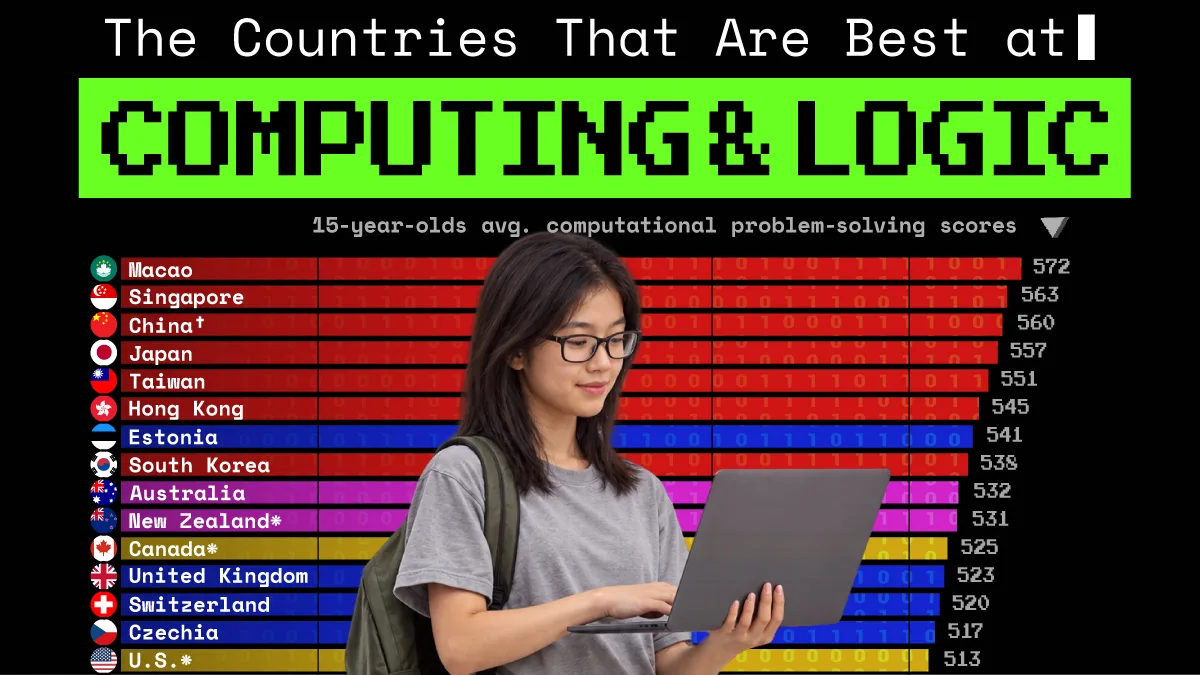
Which Countries Have the Best Computing Skills?
Key Takeaways:
Eight of the world’s top 10 education systems for computational problem-solving are in Asia.
Macao leads with 572 points, followed by Singapore (563) and China’s Beijing, Shanghai, Jiangsu, and Zhejiang regions (560).
The United States ranks 15th with 513 points, above the OECD average of 500.
As artificial intelligence reshapes the workplace, students’ ability to solve problems using logic and computational thinking is becoming increasingly valuable.
This visualization ranks countries and economies by the computational problem-solving performance of their 15-year-old students, using the OECD’s PISA 2025 results, published in September 2026.
The assessment evaluates skills such as logical reasoning, modeling, and algorithmic thinking rather than simply knowing how to use a computer.
Ranking Countries by Computing Skills
The following table shows average computational problem-solving scores from PISA 2025. Scores represent assessment points, not the percentage of students who are computer literate.
RankCountry / EconomyMean Score (PISA points)
1 Macao (China)572
2 Singapore563
3 B-S-J-Z (China)560
4 Japan557
5 Chinese Taipei551
6 Hong Kong (China)545
7 Estonia541
8 South Korea538
9 Australia532
10 New Zealand*531
11 Canada*525
12 United Kingdom523
13 Switzerland520
14 Czechia517
15 United States*513
16 Lithuania512
17 Ireland511
18 Austria509
19 Belgium508
20 Latvia507
21 Poland507
22 Finland507
23 Netherlands*506
24 Denmark506
25 Luxembourg506
26 Sweden503
27 Portugal501
28 Spain499
29 Germany498
30 France497
31 Slovak Republic497
32 Brunei Darussalam496
33 Hungary495
34 Norway*491
35 Italy490
36 Iceland490
37 Slovenia486
38 Malaysia484
39 Ukrainian regions (17 of 27)478
40 Thailand476
41 United Arab Emirates476
42 Türkiye473
43 Chile466
44 Croatia464
45 Malta463
46 Uruguay462
47 Viet Nam461
48 Greece461
49 Mexico453
50 Moldova452
51 Qatar452
52 Costa Rica452
53 Kazakhstan449
54 Israel444
55 Mongolia443
56 Romania442
57 Serbia437
58 Albania*437
59 Peru436
60 Philippines434
61 Colombia432
62 Cyprus427
63 Indonesia427
64 Saudi Arabia426
65 Bulgaria425
66 Montenegro423
67 Ecuador422
68 Georgia413
69 Jordan408
70 Brazil406
71 Argentina403
72 Uzbekistan402
73 El Salvador401
74 Palestinian Authority393
75 North Macedonia389
76 Azerbaijan388
77 Kyrgyzstan388
78 Dominican Republic379
79 Morocco374
80 Guatemala369
81 Kosovo359
82 Lebanon358
83 Armenia354
84 Paraguay352
85 Kenya278
Note: China refers to Beijing, Shanghai, Jiangsu, and Zhejiang. An asterisk indicates sampling limitations. Scores are averages for participating education systems.
Japan, Taiwan, and Hong Kong round out the top six, while Estonia leads Europe with 541 points. Australia and New Zealand also rank among the top 10, highlighting strong performance beyond East Asia.
Why Does Asia Dominate the Rankings?
East Asian education systems also perform strongly in international mathematics rankings, suggesting that foundational mathematical reasoning may complement computational problem-solving.
Educational expectations, curriculum design, and sustained investment in technical education may help explain the pattern. A Brookings analysis also highlights the importance of academic culture and domestic STEM talent development in China’s technological advancement.
However, these rankings do not establish which educational policies directly contribute to stronger results.
Does Better Internet Access Mean Better Computing Skills?
Widespread internet access does not automatically translate into stronger computational problem-solving skills.
For example, the UAE has internet penetration exceeding 99%, according to internet access statistics, yet scores 476 points in this assessment.
The OECD also finds that moderate educational technology use is associated with stronger academic performance, while excessive use and digital distractions are associated with weaker outcomes.
Ultimately, computational proficiency depends not just on access to technology, but on how it supports learning, alongside foundational skills such as mathematics and reading comprehension.
Learn More on the Voronoi App
For another perspective on global education, see Comparing Education Levels Across 45 Countries, which explores educational attainment across countries worldwide.
Source: https://www.visualcapitalist.com/ranked-the-worlds-best-countries-at-computing-in-2026/
Related articles