
Ranked: Which Industries Have More Women Than Men?
Discover which industries have the highest share of women, from healthcare and education to mining, and why gender gaps persist.
Are Industries Male-Dominated or Women-Dominated?
Key Takeaways:
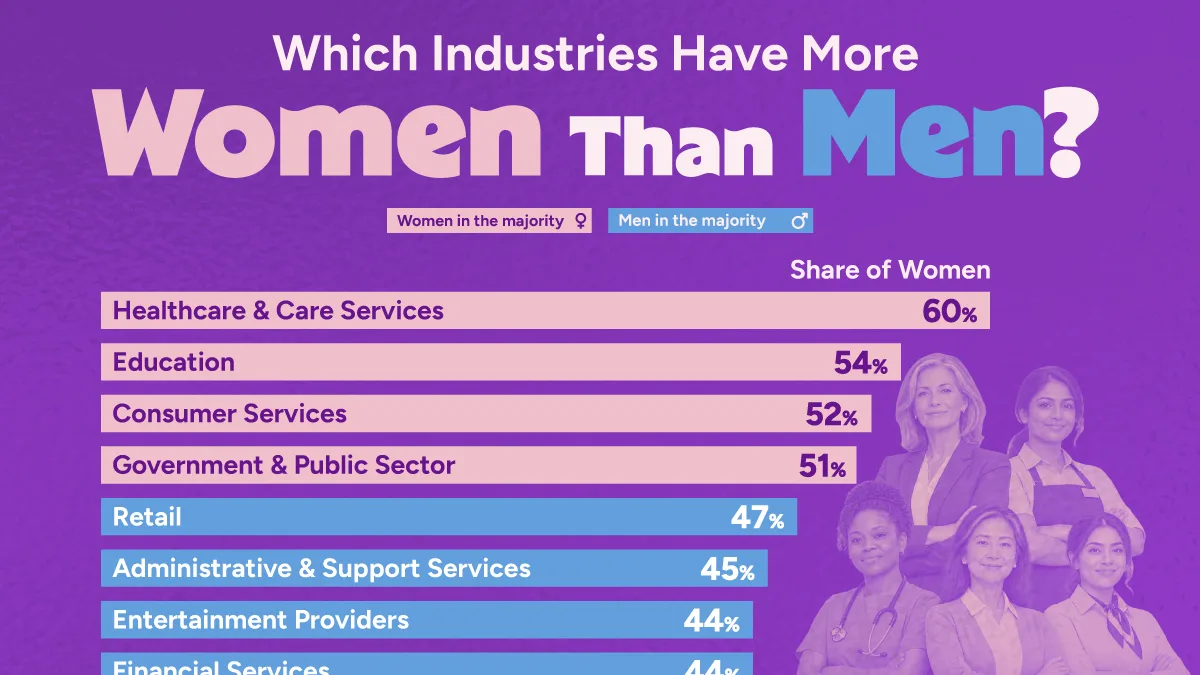
Women outnumber men in four of 18 industries, led by healthcare and care services (60%) and education (54%).
Infrastructure (24%) and oil, gas, and mining (25%) have the lowest shares of women workers.
Women account for 46% of entry-level workers but just 23% of C-suite executives.
Women have made significant gains in education and employment, but their representation in the workforce still varies widely by industry.
Data from the World Economic Forum’s Global Gender Gap Report 2026 ranks 18 industries by their share of women workers, using unweighted industry averages from LinkedIn data covering 61 economies through June 2026.
Which Industries Have the Most Women?
The following table ranks industries by their share of women workers, according to the World Economic Forum.
IndustryShare of Women (%)
Healthcare and Care Services60
Education54
Consumer Services52
Government and Public Sector51
Retail47
Administrative and Support Services45
Entertainment Providers44
Financial Services44
Real Estate43
Professional Services42
Accommodation and Food42
Technology, Information and Media35
Wholesale34
Manufacturing33
Utilities32
Supply Chain and Transportation32
Oil, Gas and Mining25
Infrastructure24
Cross-industry average42
Healthcare and care services has the highest share of women workers at 60%, followed by education (54%), consumer services (52%), and government and the public sector (51%).
At the other end of the ranking, infrastructure has the lowest share at 24%, a 36-percentage-point gap from healthcare and care services.
Why Do Healthcare and Education Lead?
Women’s stronger representation in these sectors partly reflects educational pathways and longstanding occupational patterns.
Women increasingly outnumber men in higher education around the world, particularly in certain fields. According to the Association of American Medical Colleges, women have made significant gains in medical education and the physician workforce, although disparities in leadership and career advancement persist.
Historically, teaching and caregiving have also been associated with women, shaping recruitment, career expectations, and workforce demographics.
Why Are Blue-Collar Industries Dominated by Men?
Infrastructure, mining, manufacturing, and transportation remain heavily male-dominated. Traditional apprenticeship pathways, occupational stereotypes, and workplace culture all contribute to this divide.
A McKinsey study found that women in mining reported limited advancement opportunities and exclusionary workplace cultures, suggesting that hiring alone cannot close the gap.
Meanwhile, younger workers are showing renewed interest in skilled trades, attracted by job security and alternatives to expensive degrees. However, growing demand for blue-collar workers does not necessarily translate into greater gender balance.
Representation Doesn’t Guarantee Leadership
Workforce representation tells only part of the story. Across the dataset, women account for 46% of entry-level workers but just 23% of C-suite executives.
This gap highlights a separate challenge from workforce participation: advancement into senior leadership. Women continue to face barriers to promotion, including unequal access to career development opportunities and professional networks. These challenges can persist even in industries where women make up the majority of employees.
The disparity also underscores the importance of looking beyond employment figures when measuring gender equality. Education, occupational segregation, and promotion barriers all matter when evaluating gender equality across labor markets and societies.
Learn More on the Voronoi App
To explore another dimension of workplace inequality, see Mapped: America’s Gender Earnings Gap by State, which examines differences in earnings between women and men across the United States.
Related articles

Tesla driver says he was asleep and using FSD when he crashed into highway patrol cars
After this horrific crash involving a Tesla driver who said he was asleep and using the driver assist mode, the California Highway Patrol warns that "Despite its name, full self-driving is not fully…

We can finally hear some of Wu-Tang Clan’s Once Upon A Time in Shaolin album
Wu-Tang's Once Upon A Time in Shaolin album has, for the most part, been extremely difficult to listen to, but you can now hear two snippets of the album thanks to the podcast Pablo Torre Finds Out,…
Claude’s new quantum circuit design uses 17 times fewer gates than earlier approach
Anthropic’s Claude Mythos 5 has developed a quantum circuit design that uses 17 times fewer...


Why Apple is finally making its own smart home devices
For more than a decade, Apple has told other companies to build smart home devices for its platform. This week, Apple launched its own.

New smart recycling tech makes iron alloys 15% stronger, 73% more stretchable
Researchers in China and Germany have used recycled scrap to develop a total of 14...