Record 19.6% efficiency: Large perovskite solar modules reach milestone in mass production
Solar manufacturer UtmoLight and researchers at the University of New South Wales (UNSW) in Sydney...
Solar manufacturer UtmoLight and researchers at the University of New South Wales (UNSW) in Sydney have achieved a major breakthrough. They recorded a 19.6% conversion efficiency for ultra-large perovskite solar modules.
The modules measure 2.81 square meters, matching standard commercial panel dimensions. This milestone is a major jump from the company’s previous benchmark of 17.44 percent for panels of the same size. It also brings UtmoLight’s total tally to 11 world records in perovskite module efficiency.
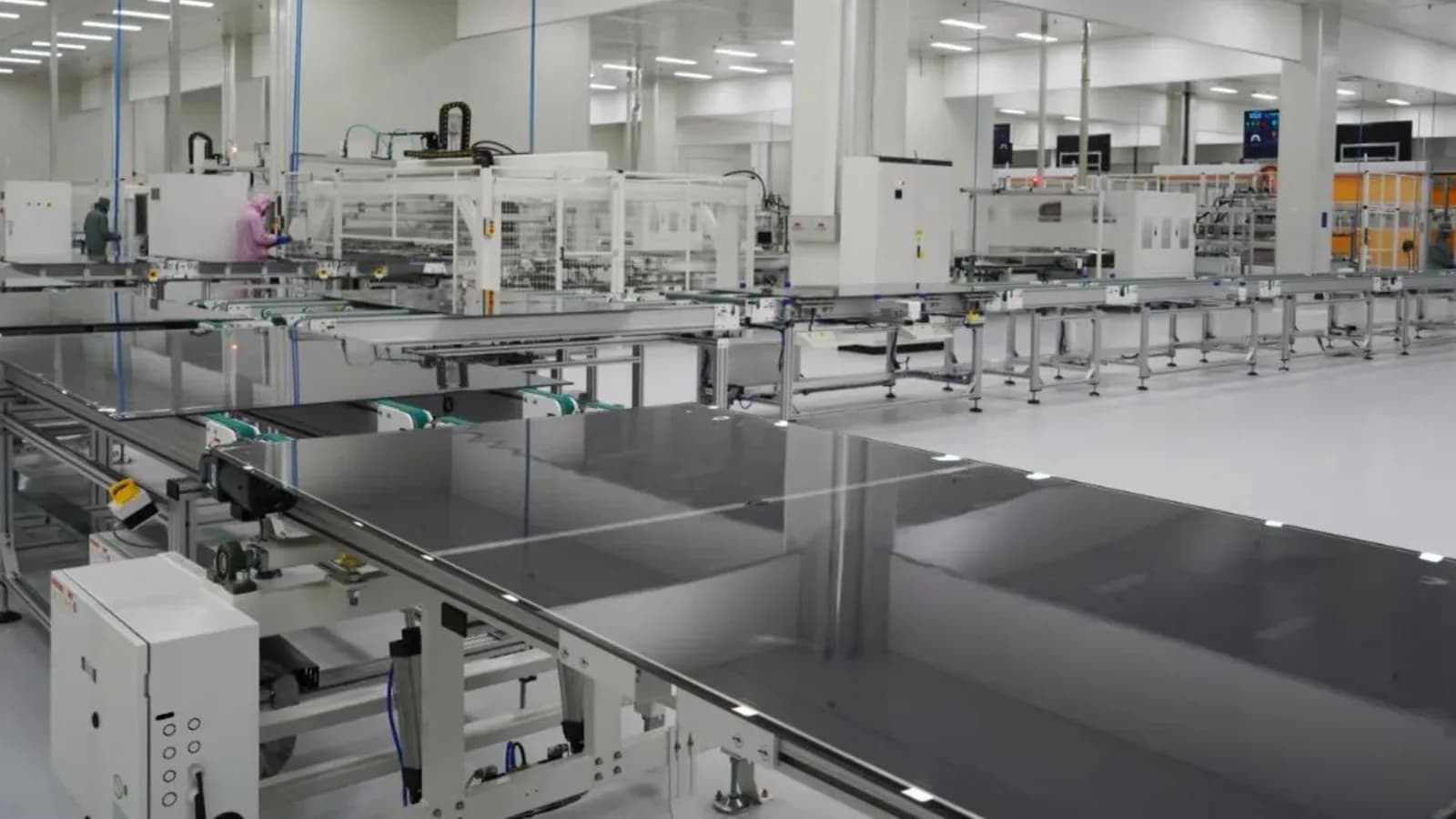
What sets this achievement apart is where it took place. The 19.6 percent efficiency rating did not come from an isolated laboratory prototype. But engineers recorded it directly on an active gigawatt-level (GW) mass production line.
UtmoLight currently operates a 150-megawatt (MW) pilot line. It also runs the industry’s first GW-level manufacturing line capable of continuous output and commercial shipping. The first 2.81-square-meter module rolled off this line at the end of 2024. Since then, production capacity and yield have steadily improved.
Overcoming scale-up bottleneck
Perovskite technology has long struggled with “scale-up degradation,” where high efficiency achieved in small laboratory cells drops when transitioned to large, mass-produced commercial modules.
Expanding the active area introduces manufacturing defects, uneven crystallization, and structural vulnerabilities that accelerate material breakdown. Overcoming these uniformity and stability hurdles remains key for making perovskite solar panels commercially viable at scale.
To overcome this challenge, UtmoLight formed a targeted research partnership with UNSW Sydney. Together, they tackled the core physical challenges of large-area manufacturing. First, the joint team focused on thin-film crystallization. It ensured the perovskite material forms a highly uniform crystal layer across a 2.81-square-meter surface.
“They have tackled key difficulties such as large-area thin-film crystallization control, defect passivation, and interface loss suppression,” added the firm.
The researchers optimized material formulations, device architecture, and fabrication techniques. As a result, they boosted both energy conversion efficiency and long-term operational stability.
Applying discoveries to mass production
The research breakthroughs from Sydney were integrated directly into UtmoLight’s proprietary manufacturing system. This allowed the company to transition smoothly from scientific discovery to industrial output.
“Relying on the four-step industrialization development system of ‘laboratory – small pilot line – intermediate pilot line – GW-level mass production line’, the company has now put into operation a 150MW perovskite module pilot line and the world’s first GW-level mass production line,” the researchers noted.
“The GW line has achieved continuous and stable production, with continuous improvement in capacity and yield. It is the first production line of its kind in the industry with the ability to continuously produce and ship products.”
Combining university-led materials innovation with active gigawatt-scale manufacturing marks a turning point for next-generation photovoltaics. Perovskite modules are widely viewed as a promising alternative to traditional silicon solar panels, offering lower production costs and high efficiency potential.
“Looking ahead, the company will continue to deepen its expertise in core perovskite technologies and, relying on industry-academia-research platforms such as joint laboratories, collaborate with more partners across the industry chain to solidify confidence in industrialization with real-world operational data,” concluded the press release.
Source: https://interestingengineering.com/energy/perovskite-solar-modules-milestone
Get the latest news delivered to your inbox.
Related articles