
Sentinel ICBM explained: Inside America’s next-generation nuclear missile
For more than five decades, the U.S. land-based nuclear deterrent has relied on the LGM-30...
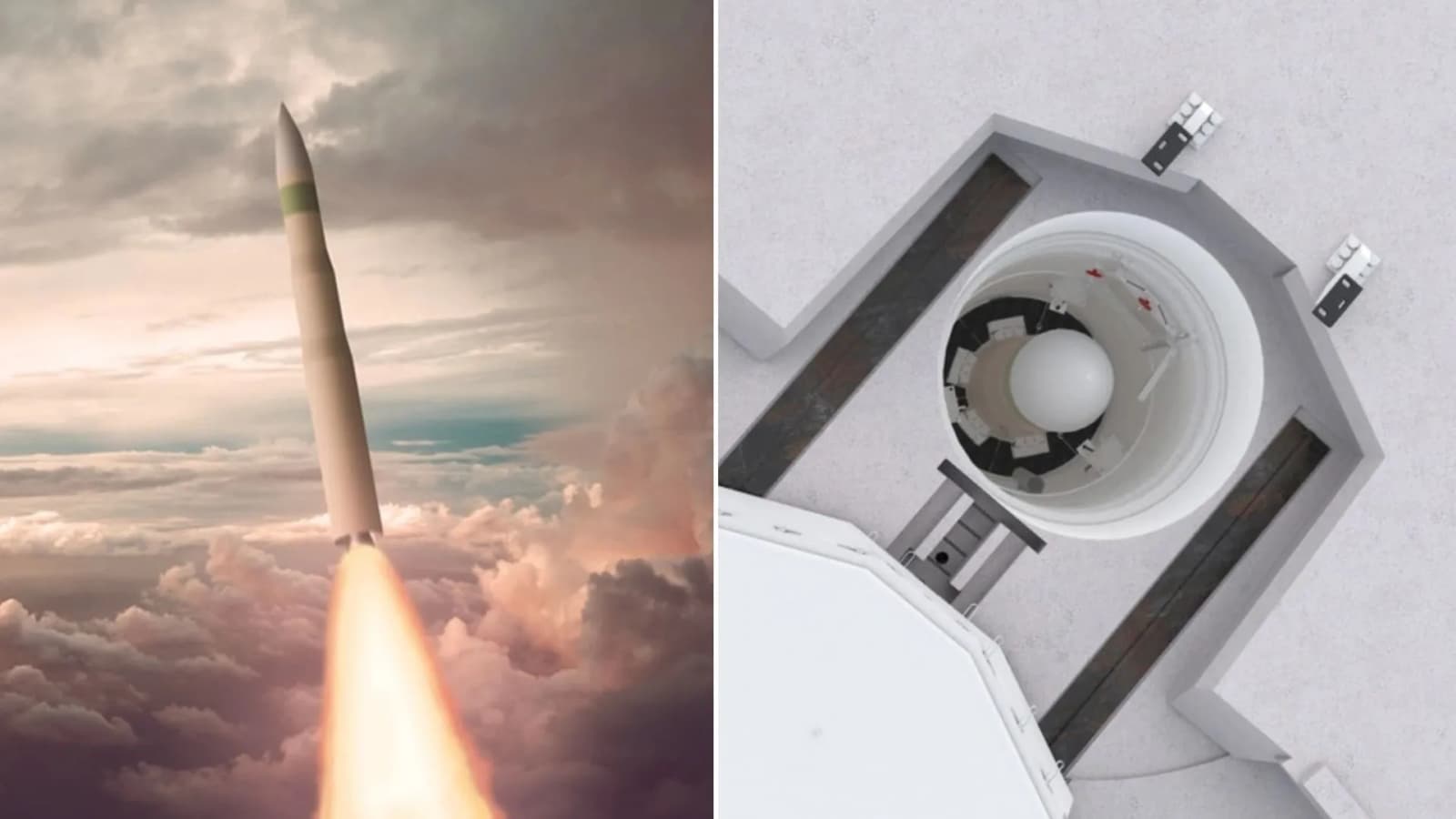
For more than five decades, the U.S. land-based nuclear deterrent has relied on the LGM-30 Minuteman III. Its replacement is now taking shape.
Known as the LGM-35A Sentinel, the new intercontinental ballistic missile (ICBM) is intended to modernize the land-based leg of the U.S. nuclear triad. But Sentinel is more than a new missile.
The program involves new launch silos, communications networks, launch centers, support vehicles, and command-and-control infrastructure spread across thousands of square miles.
What is the Sentinel ICBM?
Sentinel is a silo-launched, three-stage, solid-fuel ICBM being developed by Northrop Grumman for the U.S. Air Force. It will replace the Minuteman III, which has been in service for more than 50 years.
The Air Force plans to deploy Sentinel at F.E. Warren Air Force Base in Wyoming, Malmstrom Air Force Base in Montana, and Minot Air Force Base in North Dakota. Current Air Force information lists a projected inventory of 400 operational missiles, while the broader modernization effort involves more than 450 missiles and 450 hardened silos.
The missile is designed for a range of more than 6,000 miles and can reach approximately 15,000 mph, or about Mach 23, at burnout, according to Air Force specifications. Its exact weight and thrust remain classified or unavailable publicly.
How does Sentinel work?
Like other ICBMs, Sentinel uses rocket propulsion to accelerate a payload onto a ballistic trajectory. The missile has three solid-propellant stages. The first stage launches the missile from its underground silo. The second stage continues accelerating it after it leaves the atmosphere, while the third stage provides additional control before the missile reaches the post-boost phase.
A post-boost attitude-control system then positions the reentry vehicle for the final portion of its trajectory. The reentry system carries the nuclear payload through the atmosphere toward its target. The three-stage architecture is not revolutionary on its own. Much of Sentinel’s technological change lies in the broader weapon system surrounding the missile.
A missile built as part of a larger system
The Air Force is replacing much of the infrastructure supporting its ICBM force rather than simply putting a new missile inside old Minuteman facilities. Sentinel will use 450 new hardened silos, modern launch centers, and hardened fiber-optic communications.
The system is also being integrated with upgraded nuclear command, control, and communications, or NC3, architecture. Two-person launch crews will continue to operate the missiles around the clock.
The Air Force describes the effort as the largest construction project in its history. More than 600 supporting facilities across five states are involved in the modernization effort. One reason for rebuilding the infrastructure is the age of the existing system.
Rather than excavating and extensively modifying hundreds of unique Minuteman-era facilities, the Air Force is developing a standardized, modular construction approach for the new silos. A full-scale prototype silo broke ground in Utah in 2026 to test that approach before larger-scale construction.
What makes Sentinel different from Minuteman III?
One of Sentinel’s most important features is its modular, open architecture. The idea is to make future upgrades easier without redesigning the entire missile system. The Air Force says this architecture should allow new technologies to be incorporated as threats and requirements change.
Northrop Grumman says the missile also uses newer composite materials in its rocket stages, along with a new guidance system designed to improve accuracy, reliability, and maintainability. These are contractor-reported design characteristics rather than independently demonstrated operational performance.
The modernization also extends to the communications and launch infrastructure, allowing Sentinel to remain connected to the broader nuclear command-and-control system.
What nuclear warhead will Sentinel carry?
Sentinel is being developed alongside the W87-1 nuclear warhead, which is intended to replace the older W78 used on Minuteman III. The W87-1 is based on previously tested nuclear components and incorporates updated safety and security features. The National Nuclear Security Administration (NNSA) says it will be certified without requiring additional underground nuclear testing.
The warhead program has also reached a major manufacturing milestone. In 2024, NNSA completed and qualified the first plutonium pit for the W87-1 at Los Alamos National Laboratory. The missile and warhead programs therefore have to progress together, but they are managed by different parts of the U.S. government.
Why has Sentinel been delayed?
Sentinel has faced high cost and schedule issues. In 2024, the program triggered a Nunn-McCurdy breach after projected costs exceeded statutory thresholds. A subsequent Defense Department review identified problems including an unrealistic schedule, incomplete system design, and weaknesses in the ICBM industrial base.
The program continued, but the Air Force rescinded its previous baseline and Milestone B approval while restructuring the program. GAO reported in February 2026 that the program’s first flight had slipped by roughly four years from its original estimate and was then planned for March 2028. It also estimated that the program would cost at least $141 billion, although the final cost remained uncertain during restructuring.
The timeline has since moved forward. In September 2026, the Air Force said it had fully assembled an inert Sentinel missile and that critical subsystems were on track for initial flight testing in 2027. The Air Force is targeting initial operational capability in the early 2030s, meaning the missile is still years away from replacing the Minuteman III force.
Why is the US building Sentinel?
The basic objective is to replace an aging nuclear weapons system before its infrastructure and components become increasingly difficult to maintain. The Minuteman III will remain in service during the transition so the United States does not lose land-based ICBM capability while Sentinel is developed and deployed.
The Air Force describes Sentinel as a system designed to remain relevant into the 2070s and beyond. Sentinel therefore represents more than a new missile. It is an attempt to rebuild an entire ICBM infrastructure around a weapon designed for the coming decades. At the same time, the program also faces the engineering, construction, and cost challenges of replacing a system that has operated since the Cold War.
Related articles
World’s first zero-degradation elastocaloric cooling device maintains 1 million operational cycles
Researchers from the Hong Kong University of Science and Technology (HKUST) have unveiled the world’s...

Beijing to Shanghai in 30 minutes: China ready to test its Supersonic TMS-10 plane
China is moving its next-gen supersonic passenger aircraft research into a more demanding phase, with...

MARTAC expands US drone boat production with 100 more Devil Rays per year
MARTAC partners with SŌLACE Boats to increase production of its Devil Ray autonomous vessels by...
Why promising battery materials break down when researchers build real cells
A battery material can look impressive in a laboratory and still fail when turned into...

China showcases Type 99B tank in live-fire drills after 2025 parade debut
China has released footage of live-fire drills of its Type 99B main battle tank roughly...

Raytron brings AI understanding to thermal imaging with new infrared vision-language model
Thermal imaging is moving beyond simply capturing heat signatures. At CIOE 2026, Raytron unveiled an...