
Texas A&M students build 6-pound drone that carries cargo twice its own weight
A team of Texas A&M University students built a drone light enough to carry more...
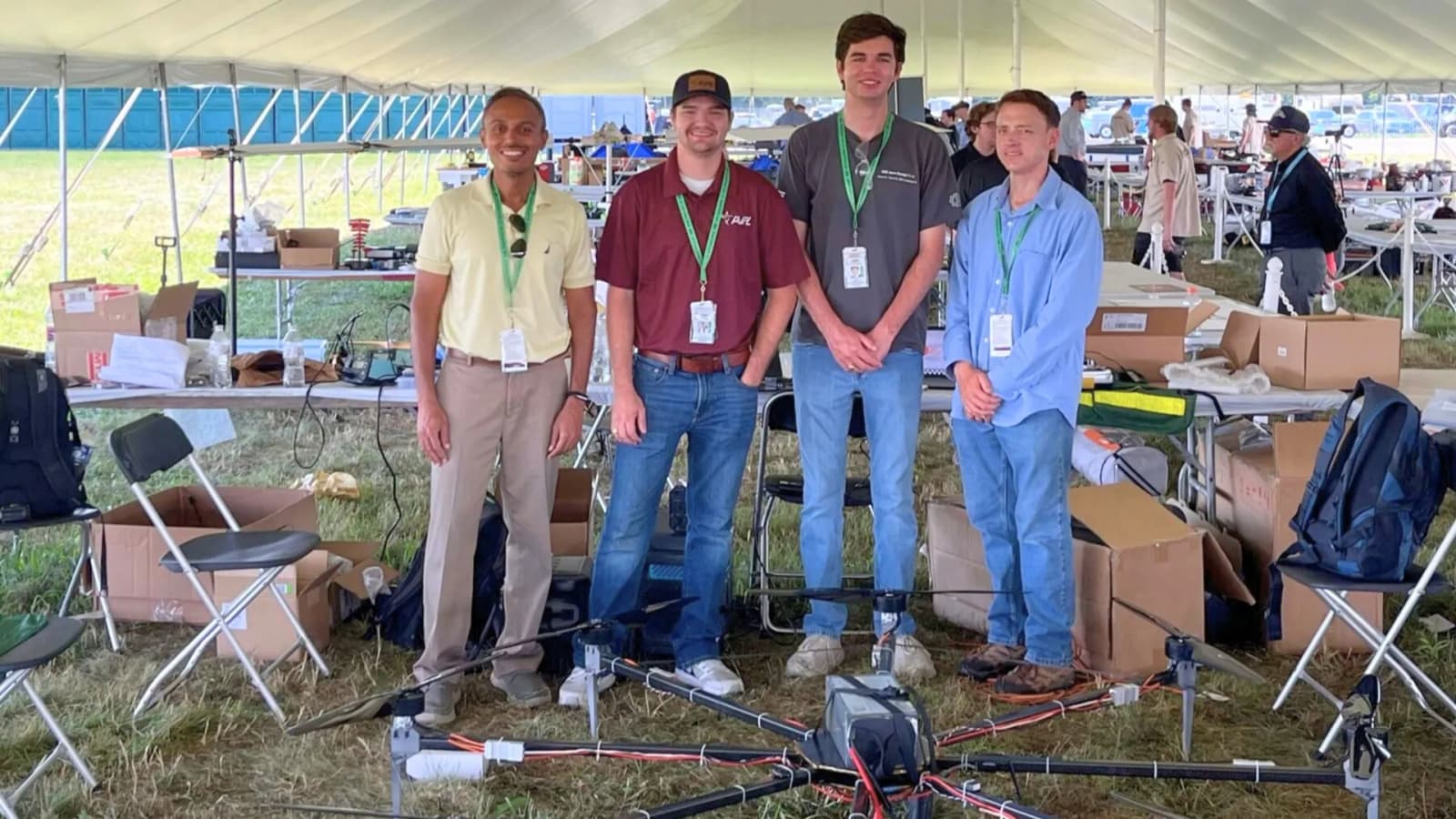
A team of Texas A&M University students built a drone light enough to carry more than double its own weight, helping them become one of only six U.S. teams to complete the course at the DARPA Lift Challenge. The competition, held Aug. 9 near the National Museum of the U.S. Air Force in Dayton, Ohio, tasked drones with carrying as much weight as possible across 4 nautical miles (7.4 kilometers).
Led by aerospace engineering professor Moble Benedict, the team’s Advanced Vertical Flight Laboratory built a 50-pound (22.7-kilogram) drone that carried 110 pounds (50 kilograms) in barbell weights across the full course in 12 minutes.
A crowded field
This was the first year DARPA held the competition. Around 480 teams initially submitted design concepts, and only 110 were invited to compete. On the day of the event, just 87 teams actually made it to the starting line, making the Texas A&M team’s finish especially notable.
Most commercial drones today can only manage roughly a one-to-one payload-to-weight ratio, according to Benedict. Reaching more than double that ratio, regardless of final placement, was itself a significant engineering achievement for the team.
Built light on purpose
Reaching that performance required several redesigns before competition day. The final drone used a carbon fiber frame holding a central battery, with eight arms extending outward to carry the motors and propellers. Rather than assembling the frame with nuts and bolts, which add weight, the team bonded the components together directly, helping the frame weigh just 6 pounds (2.7 kilograms) without its battery attached.
Benedict said the team’s main innovation came down to attaching that much weight cleverly enough to keep the structure light.
Choosing battery over gas
Team member Cayden Brown said the group chose a battery-powered system over a gas-powered alternative, even though gas engines typically weigh less as fuel burns off during flight. A battery’s weight stays constant throughout a flight, meaning the team had to account for the same total weight from takeoff to landing. Brown noted that a charged battery weighs the exact same as a dead battery, an engineering constant a gas-powered design would not share.
In the end, the battery accounted for more than half of the drone’s total weight, shaping many of the team’s design decisions around minimizing weight elsewhere on the aircraft.
Built in eight months
The team designed and built five prototypes in just eight months, a process Benedict said would typically take a couple of years. Most of that time went toward design work and virtual simulation, with the actual physical build taking only a few weeks.
Benedict said drones built this way could eventually support disaster relief efforts, package delivery, and surveillance missions. With a materials cost of around $10,000, he added, the design could also prove considerably more affordable than many drones currently on the commercial market.
Source: https://interestingengineering.com/ai-robotics/texas-am-drone-darpa-lift-challenge
Related articles

Firefox just got a redesign with round tabs, new themes, and Compact Mode
Firefox will look a little different the next time you launch it - more bubbly, with some new pops of color.

Polaroid’s new instant camera has four creative shooting modes you can experiment with
Polaroid announced a new instant camera that lets photographers get more creative and experimental with their shots than just changing the aperture or shutter speed.

Fairphone’s next repairable wireless earbuds will launch on October 14th
Following leaks revealing a major redesign earlier this month and an official teaser posted to X yesterday, Fairphone has shared some exclusive details with The Verge about the first follow-up to its…

Anthropic warns of ‘catastrophic’ AI risks in its own IPO filing
As Anthropic gears up for its greatly anticipated public debut, a preview of the company's IPO filing reportedly details its mounting losses, leadership proposals to retain power, and how its AI…
Aviation-grade carbon-ceramic brakes survive 1,832°F, weigh 75% lighter than steel
A brake disc the size of a car wheel that can withstand temperatures above 1,832°F...
China unveils world’s first humanoid built around a domestic electronic architecture
China has unveiled what it describes as the world’s first embodied AI robot equipped with...