
Tiny chip stores memories in flowing water without conventional electronics
Yale researchers have found a way to make flowing fluids remember what happened before, using...
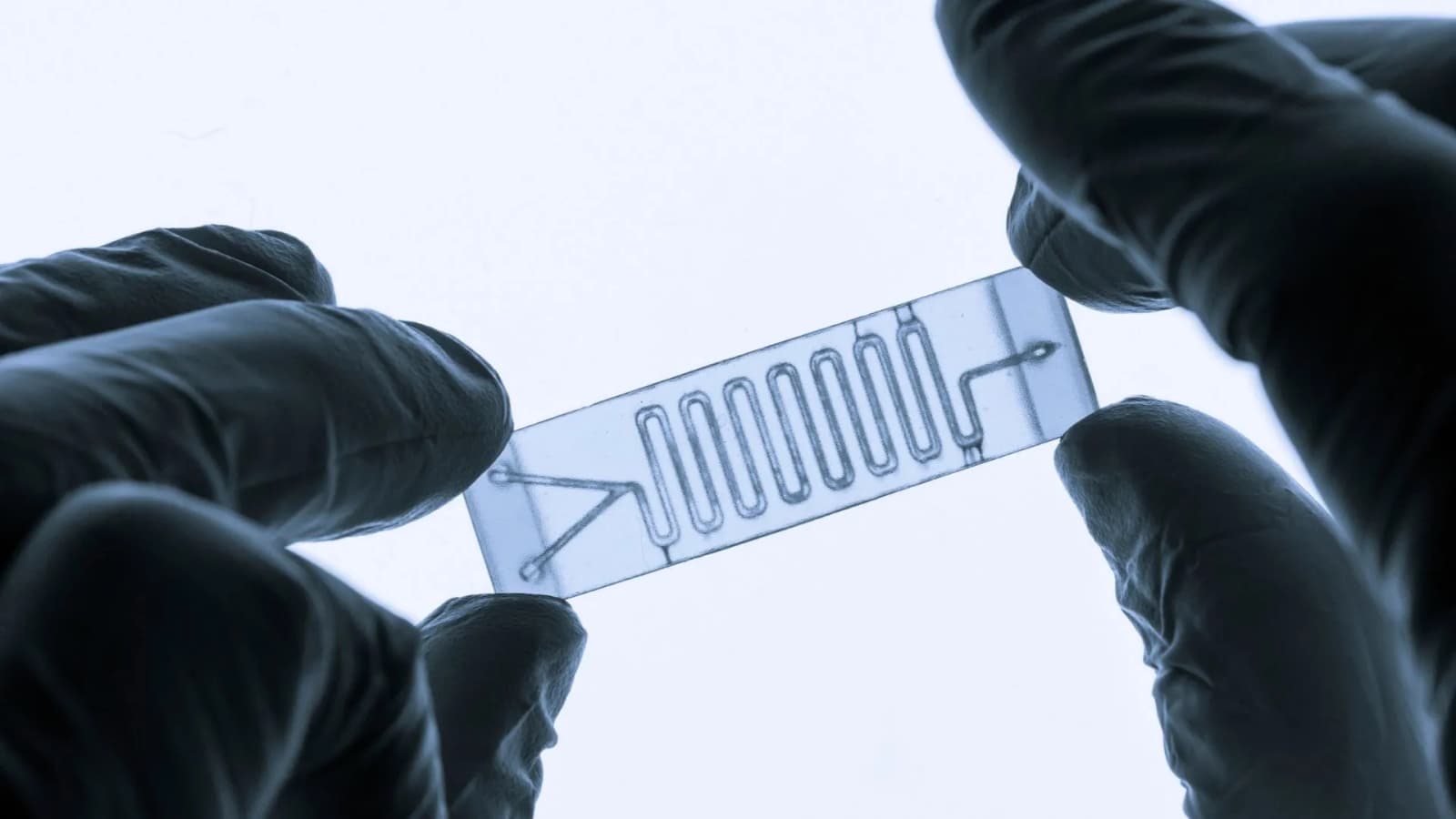
Yale researchers have found a way to make flowing fluids remember what happened before, using tiny flexible fibers that change shape under pressure. The discovery could help engineers develop soft robots that process information without conventional electronic controllers.
The idea turns a familiar engineering problem on its head. Most fluid systems respond to the conditions they encounter, but the Yale design can retain traces of earlier flows. Its physical components effectively store information, allowing past events to influence how the system behaves next.
Fibers that remember
Inside a microfluidic chip, researchers placed flexible fibers within a network of narrow channels. Each channel measures roughly half the width of a human hair in depth.
As fluid moves through the channels, pressure pushes individual fibers between two stable configurations. Each position changes the path available to the fluid, creating a physical record of the system’s previous state.
Engineers could represent the two configurations as binary digits, or zeros and ones. Unlike conventional computer memory, the arrangement does not need electronic components to switch between states.
Abhineet Rajput, the study’s lead author and a graduate student in Professor Amir Pahlavan’s lab, explained the distinction. “While conventional microfluidics relies on active elements, this system uses microfibers to passively store information,” Rajput said.
The fibers can also influence one another. Their interactions allow individual changes to shape the behavior of the wider network, producing a more complex form of physical memory.
Brain made of fluid
The research could open another route to controlling soft robots. Such machines often need to bend, squeeze through tight spaces, or operate in environments that challenge conventional hardware.
A fluidic controller could use pressure and flow rates to carry signals. Channels would connect different parts of the system, while the flexible fibers would regulate fluid movement and retain information.
Pahlavan sees particular value in environments where electronics face limitations. “We could design a fully fluidic controller that can be integrated into a soft robot and effectively act as its brain,” said Pahlavan, an assistant professor of mechanical engineering at Yale.
Electromagnetic interference can disrupt electronic systems in certain operating environments. A controller built around fluid movement could offer an alternative, although researchers still need to demonstrate how reliably it can direct a robot through practical tasks.
Can the system learn?
Memory is only part of the researchers’ ambition. The next question is whether engineers can train fluidic networks to produce specific responses.
Training could change how a network reacts to incoming flows, giving it a way to adapt its behavior. Achieving that would extend the system beyond retaining past information toward physical learning.
The same principle could interest biologists studying organisms that navigate their surroundings without a brain. Slime molds, for example, can find efficient routes through mazes. Researchers also want to understand how fungi and plant roots respond to environmental changes.
Fluidic networks could offer a physical model for investigating how interactions and accumulated experience shape behavior. Whether the technology can eventually learn useful tasks remains an open question.
The findings appear in the journal Physical Review X.
Related articles
Oxygen-based chipmaking method controls 2D crystal growth with over 99% success
Researchers in South Korea have developed a semiconductor manufacturing technique that controls where individual crystals...

Meta releases Muse Wonder, its first frontier model for personal and professional agents
Meta’s Superintelligence Lab launched Muse Wonder and Muse Wonder Full, its first frontier-class models, emphasizing Active Memory and long-running agent work. Wonder is available via the Meta Model API and Muse Code; Wonder Full is limited to Muse Code subscribers.

Anthropic to share first Q3 figures with investors as it prepares for a possible record IPO
CNBC reports Anthropic will disclose third-quarter financials for the first time to institutional investors meeting at its San Francisco headquarters this week, as the AI lab prepares for what could be a roughly $2 trillion IPO.

Reuters: OpenAI and Anthropic sought control over what outside AI safety evaluators can publish
According to Reuters, OpenAI and Anthropic pushed for significant control over outside evaluators’ publications over trade-secret concerns, even after publicly endorsing editorial independence. Talks have shifted in recent days, and both labs dispute parts of the characterization.

OpenAI and Anthropic tell UK lawmakers voluntary AI pledges are not enough
At a UK parliamentary hearing, OpenAI and Anthropic backed a statutory AI safety framework, saying voluntary commitments are not a durable plan for frontier risk. Google DeepMind and Meta declined to support new legislation, deepening a public split among labs.

Google DeepMind launches Gemini 4 Argon globally for coding, science and cyber defense workloads
Google on October 13, 2026 made Gemini 4 Argon available worldwide via the Gemini API, the Gemini app and Antigravity. The frontier model ships with a 1M-token unified context window and introductory API pricing of $2 per million input tokens and $10 per million output tokens.