Tiny cracks turn liquid metal droplets into circuits inside soft, stretchable electronics
Virginia Tech engineers have worked out how liquid metal droplets buried in soft materials link...
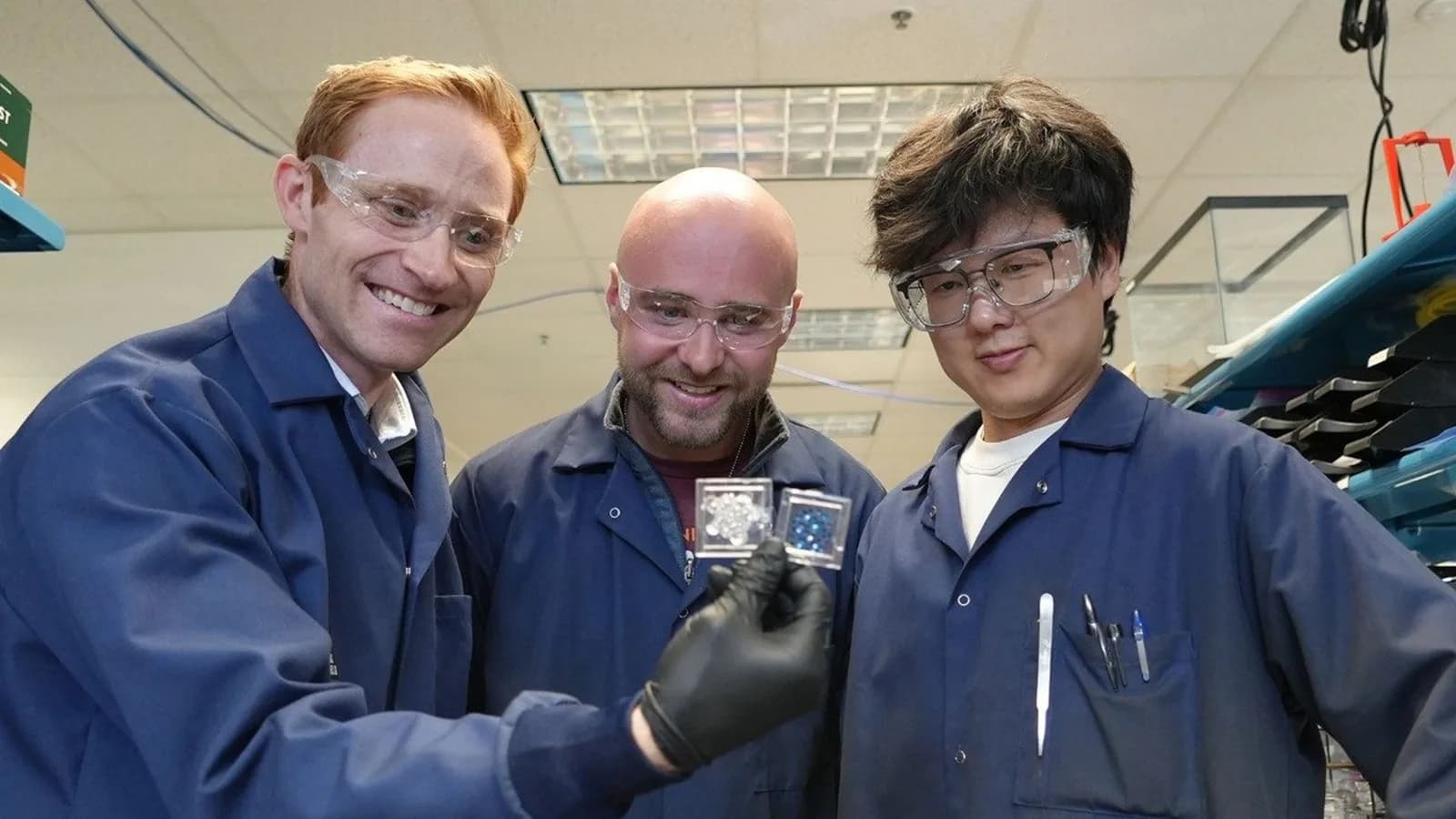
Virginia Tech engineers have worked out how liquid metal droplets buried in soft materials link up into working circuits, a long-standing puzzle for stretchable electronics. The answer lies in tiny cracks that open when the material is pressed and then stay filled with metal.
The study comes from the lab of mechanical engineer Michael Bartlett, with doctoral candidates Wuzhou Zu and Hugh P. Grennan as co-authors. It is connected to Bartlett’s National Science Foundation CAREER award.
Why liquid metal matters
Electronics that stretch, bend or flex, such as wearable sensors and shape-changing robots, often rely on liquid metal to carry current. Liquid metal composites combine a metal’s conductivity with the pliability of a soft material.
Bartlett’s team uses eutectic gallium indium, an alloy that is liquid at room temperature. Under a microscope it looks like a collection of tiny spheres, and when the spheres touch they merge into pathways for electrical current. A polymer or rubber holds the droplets in place, but that material also fills the gaps between them.
That raises a puzzle: if an insulator sits between the droplets, how does current get through? Researchers around the world have used mechanical pressure to turn such composites into conductors for years, Bartlett said, but without understanding what happens inside. He said the goal was to uncover the physical mechanism that lets isolated liquid metal droplets suddenly become an electrical network.
Cracks build circuit
The team used microscopes and 3D X-ray imaging to watch what happens as the material is compressed. When pressed, the material between nearby droplets cracks, and liquid metal flows into the gaps. After the pressure is released, metal stays in the cracks, forming a pathway that electricity can follow.
Zu said the team watched the process in two dimensions, then reconstructed the pathways in three to see how local cracks grow into a conductive network.
A force prediction model
The researchers also built a mathematical model that predicts how much force is needed to make the material conductive. It held up for many designs, from millimeter-sized droplets (about 0.04 inch) to droplets only a few dozen micrometers (a few thousandths of an inch) wide.
Grennan said tying pathway formation to a fracture mechanics model means researchers can now “design liquid metal composites that activate at necessary forces and length scales.”
Programming conductivity into devices
The framework could help manufacturers control where conductivity forms in stretchable sensors, wearable electronics and soft robots. Because the mechanism is now understood, designers can use it to guide material design and manufacturing.
Bartlett said that opens the door to soft electronic systems in which conductivity is programmed in through the material architecture and the way the device is processed.
The study was published in the journal Matter.
Related articles