Mapped: Your Lifetime Tax Bill, by U.S. State
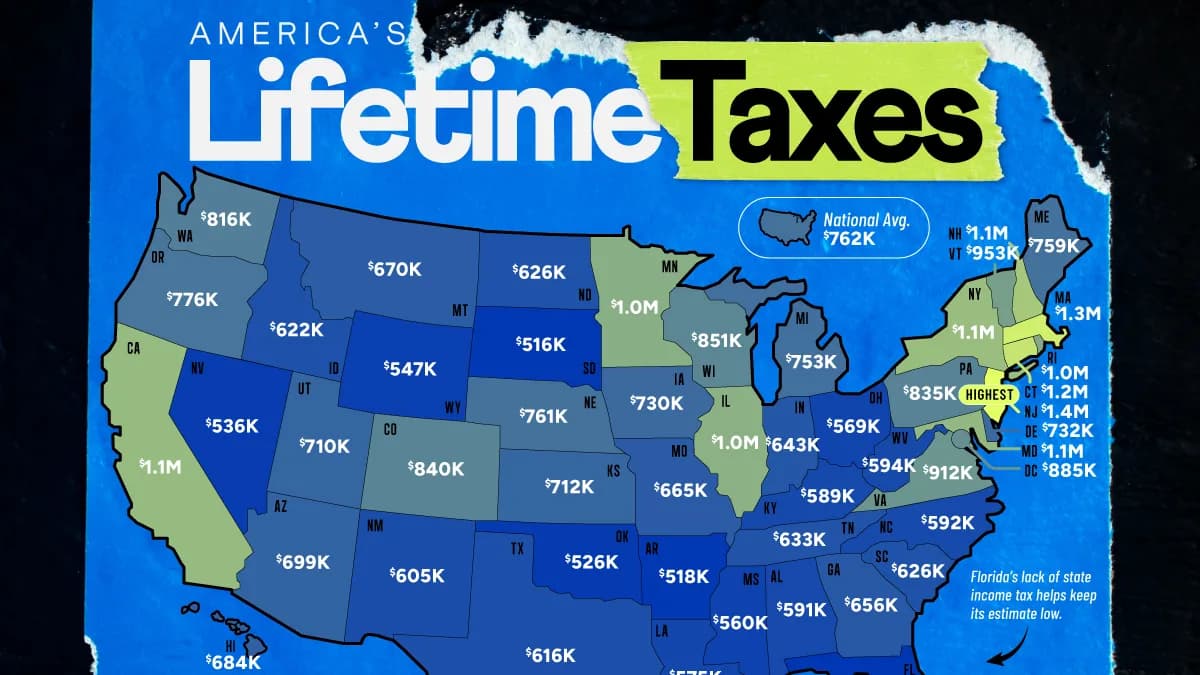
The average American pays about $762,000 in taxes over their lifetime, but this figure nearly doubles in some northeastern states.
How Much Will Americans Pay in Taxes Over a Lifetime?
Key Takeaways
New Jersey has the highest estimated lifetime tax bill at $1.36 million, nearly three times Florida’s $508,980.
California’s lifetime estimate exceeds $1 million, compared with approximately $616,000 in Texas.
The average American is estimated to pay about $762,000 in taxes over their lifetime.
Over a lifetime, taxes can add up to hundreds of thousands of dollars. But where Americans live can make a substantial difference in how much they earn and how much they pay.
This map shows estimated lifetime taxes across all 50 states and Washington, D.C., using 2026 estimates from Self Financial. The calculations cover income, property, vehicle, and sales taxes, assuming a single filer working for 45 years and owning a home from age 40, with earnings and tax rates held constant.
How Lifetime Taxes Compare by State
New Jersey leads the country with an estimated lifetime tax bill of $1,359,406, followed by Massachusetts ($1,297,130) and Connecticut ($1,249,749). All three states exceed $1.2 million, while Florida’s estimated total of $508,980 is less than 40% of New Jersey’s.
The contrast also extends to some of the country’s most populous states. California’s estimated lifetime tax bill exceeds Texas’s by more than $450,000 and Florida’s by more than half a million dollars.
The following table ranks U.S. states by their estimated lifetime taxes on income, sales, property, and vehicles.
RankStateLifetime Taxes
1New Jersey$1,359,406
2Massachusetts$1,297,130
3Connecticut$1,249,749
4New Hampshire$1,125,478
5New York$1,084,561
6California$1,075,061
7Maryland$1,060,255
8Illinois$1,033,447
9Minnesota$1,018,872
10Rhode Island$999,704
11Vermont$953,322
12Virginia$911,706
13Wisconsin$851,139
14Colorado$839,899
15Pennsylvania$835,067
16Washington$816,217
17Oregon$775,976
18Nebraska$761,072
19Maine$758,818
20Michigan$753,076
21Delaware$731,824
22Iowa$730,349
23Kansas$711,966
24Utah$709,803
25Alaska$702,376
26Arizona$698,824
27Hawaii$684,028
28Montana$669,934
29Missouri$665,381
30Georgia$655,532
31Indiana$643,299
32Tennessee$632,562
33South Carolina$626,485
34North Dakota$626,340
35Idaho$621,705
36Texas$615,932
37New Mexico$605,411
38West Virginia$593,639
39North Carolina$591,911
40Alabama$591,168
41Kentucky$588,953
42Louisiana$575,122
43Ohio$569,376
44Mississippi$560,448
45Wyoming$546,617
46Nevada$535,652
47Oklahoma$526,333
48Arkansas$517,942
49South Dakota$515,732
50Florida$508,980
Florida’s lack of a state personal income tax helps keep its estimate low. However, residents still pay federal income taxes, along with taxes on property and purchases.
The dollar totals also tell a different story when measured against earnings. Wyoming ($546,617) has the lowest estimated share of lifetime earnings going toward the taxes covered, at 24.8%, compared with Florida’s 25.5% and New Jersey’s 48.2%. By this measure, Wyoming residents retain the largest share of their lifetime earnings.
Higher Earnings, Higher Taxes?
A larger lifetime tax bill can partly reflect a larger lifetime paycheck. The earnings assumptions vary by state, so the comparison does not calculate what the same person would owe in different locations. For example, people in Massachusetts tend to earn higher salaries than those in Mississippi.
Federal income taxes reinforce this effect. Under progressive tax brackets, higher portions of taxable income are taxed at higher rates. Someone earning more can therefore pay more federal income tax even before differences in state tax policies come into play.
This distinction matters when comparing California and Florida. Moving between the two states would not automatically produce the savings suggested by subtracting their lifetime totals. Actual savings would depend on income, housing costs, spending, and individual circumstances.
Taxes Beyond the Working Years
Property taxes are another recurring expense that can continue after retirement or even after a mortgage is paid off. The amount depends on local tax rules, a home’s taxable value, and available exemptions.
In Texas, for example, local governments levy property taxes to help fund schools, roads, police, and fire protection. Homeowners’ bills can therefore vary within the same state, depending on their location and the taxing jurisdictions that cover their property.
Ultimately, a lower lifetime tax bill doesn’t necessarily mean a state is more affordable. Higher earnings, housing costs, and everyday expenses can change the picture considerably. These estimates are best understood as a comparison of typical tax burdens across states, rather than a prediction of what any one person would save by moving.
Learn More on the Voronoi App
To see how taxes affect a typical household each year, check out The Average Middle Class Family in the U.S. Pays $17.9K in Taxes on Voronoi.
Related articles