Ranked: The Best and Worst Countries to Start a Career In
Which countries are best and worst for starting a career? Compare youth unemployment rates across 41 countries in 2025.
Which Countries Are Best and Worst for Starting a Career?
Key Takeaways:
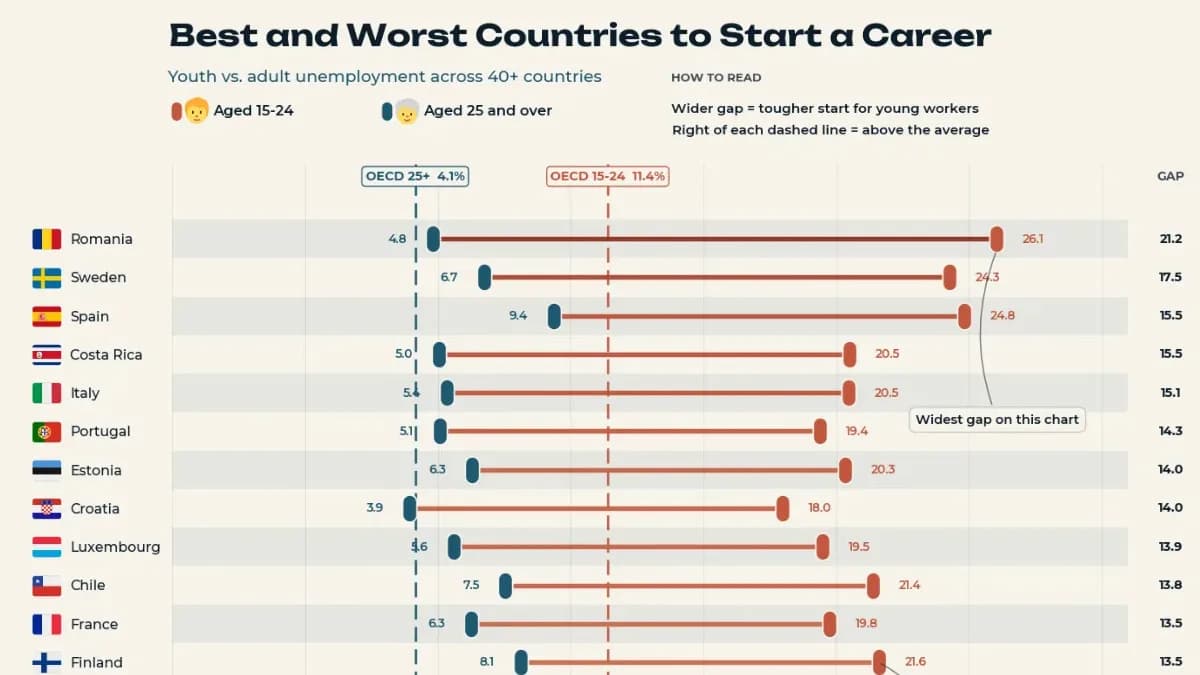
Romania has the largest youth-adult unemployment gap at 21.2 percentage points, followed by Sweden (17.5) and Spain (15.5).
Japan has the smallest gap at just 1.4 percentage points, followed by Israel (2.0) and Germany (3.6).
Several European countries with strong worker protections still have large unemployment gaps between younger and older workers.
Starting a career can be considerably harder than finding work later in life, even in countries known for strong economies and worker protections.
This visualization by Valerii Emelianov uses OECD harmonized unemployment data to compare unemployment rates among people ages 15–24 and adults ages 25 and older across 41 countries in 2025. A wider gap indicates a greater unemployment disadvantage for younger workers.
Where Is It Hardest to Start a Career?
The following table ranks 41 countries by the percentage-point gap between youth and adult unemployment.
RankCountryUnemployment Rate (%)
Youth (15-24)Adults (25+)Gap (percentage points)
1 Romania26.14.821.2
2 Sweden24.36.717.5
3 Spain24.89.415.5
4 Costa Rica20.55.015.5
5 Italy20.55.315.1
6 Portugal19.45.114.3
7 Estonia20.36.314.0
8 Croatia18.03.914.0
9 Luxembourg19.55.613.9
10 Chile21.47.513.8
11 France19.86.213.5
12 Finland21.68.113.5
13 Belgium17.35.112.2
14 New Zealand15.73.512.1
15 UK14.93.411.6
16 Norway14.12.811.3
17 Greece19.18.310.8
18 Colombia18.27.510.7
19 Slovakia15.44.910.4
20 Hungary13.93.810.2
21 Bulgaria13.13.19.9
22 Poland12.22.59.6
23 Slovenia12.03.28.8
24 Denmark13.85.08.8
25 Latvia14.86.38.4
26 Turkiye15.37.18.2
27 Canada13.85.78.1
28 Czechia10.52.48.1
29 Ireland11.73.78.0
30 Lithuania14.26.47.8
31 United States10.03.46.5
32 Austria11.44.96.5
33 Australia9.53.26.4
34 Netherlands8.82.86.0
35 Iceland9.23.45.8
36 Switzerland8.84.34.4
37 Mexico5.92.13.8
38 South Korea6.42.63.8
39 Germany7.03.43.6
40 Israel4.72.72.0
41 Japan3.82.41.4
One of the most striking results is Sweden, which ranks second despite its reputation for strong social protections. Youth unemployment reaches 24.3%, compared with 6.7% among adults.
Spain also ranks near the top, with youth unemployment at 24.8%. At the other end of the ranking, Japan has a youth unemployment rate of just 3.8%.
Why Do Some Countries Have Smaller Gaps?
Germany stands out with a relatively narrow 3.6-point gap. Its dual vocational education system combines classroom instruction with paid apprenticeships, providing an established pathway from education into employment.
However, youth unemployment gaps reflect more than education and training. Economic conditions, hiring practices, and the share of young people combining education with job searches can all influence the figures. Sweden and Finland, for example, have relatively large gaps despite their strong social protections.
Broader global unemployment patterns reflect differences in economic growth, labor demand, and workforce participation.
Finding a Job Isn’t Everything
A smaller unemployment gap doesn’t necessarily mean better career prospects. Wages, job security, training opportunities, and working conditions also matter.
For example, Remote’s 2025 Global Life-Work Balance Index ranks New Zealand, Ireland, and Belgium among its leaders, based on factors including annual leave, healthcare, and working hours.
International mobility can also open up opportunities through working-holiday programs, skilled-worker visas, and digital nomad destinations.
Ultimately, the unemployment gap offers a narrower but important perspective: how much harder it is for young people to find work compared with older adults in the same country.
Learn More on the Voronoi App
As young workers navigate changing labor markets, artificial intelligence is creating another layer of uncertainty. Explore Which Jobs Are Safest from AI? to see which occupations may be more resilient to automation.
Related articles