
Touch-free brain-inspired sensor spots moisture from 0.04 inches away with 97% precision
An international team of researchers has developed a brain-inspired electronic device that can reportedly detect...
An international team of researchers has developed a brain-inspired electronic device that can reportedly detect moisture without physical contact while also storing information about what it senses.
The humidity-sensitive memristor can respond to moisture from a human finger positioned just 0.04 inches (one millimeter) away. It was developed by scientists from Jeju National University in South Korea, Shivaji University in India as well as Queensland University of Technology in Australia.
Made from porous nickel pyrophosphate (Ni2P2O7), an advanced nanomaterial, the memristor senses humidity and mimics functions associated with biological memory. It could find uses in touch-free human-machine interfaces, electronic skin, environmental monitoring, and soft robotics.
The team highlighted its broader significance. “What excites us most is that this device doesn’t just sense humidity, it remembers it,” the researchers explained.
Moisture affects resistance
A memristor (or a memory resistor), is a two-terminal electrical component that regulates current flow while remembering the amount of charge that has passed through it before. Its electrical resistance can change based on previous electrical activity.
This makes it particularly interesting for neuromorphic computing, which seeks to recreate aspects of how biological neurons and synapses process data. To explore this potential, the researchers designed a device consisting of gold, porous nickel pyrophosphate, and fluorine-doped tin oxide.
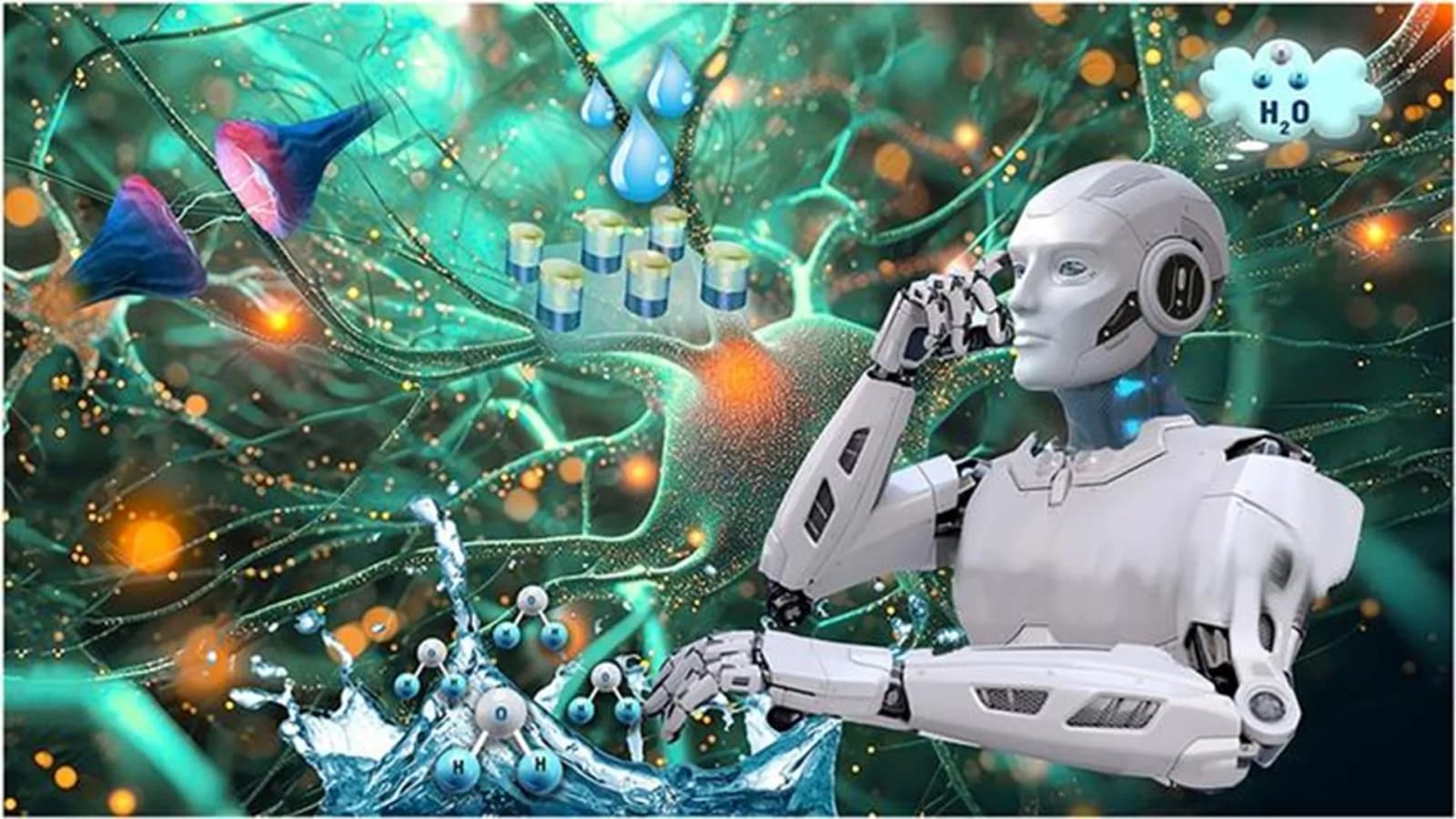
Brain-like AI empowering biomimetic research on microscopic water dynamics. Credit: Mahesh Y. Chougale, et al.
They then carried out tests at relative humidity levels from 42 to 82 percent. The results revealed that the device’s electrical behavior changed consistently as the humidity decreased. The scientists explained that water molecules adsorbed by the material modify its electronic structure.
Computer calculations showed that the presence of water narrows the material’s bandgap. It also introduces new electronic states near its conduction band, thus increasing the material’s conductivity. This means that moisture can effectively act as a signal that changes the device’s resistance.
The scientists also tested whether the sensor could work without direct contact. A moist finger held 0.04 inches (one millimeter) away caused measurable changes in its conductivity. Moving the finger closer generated stronger and longer-lasting changes. It allowed the device to imitate both short-term and long-term memory.
Sensing and memory
The sensor was also combined with machine-learning algorithms to distinguish between different humidity and proximity conditions. Support vector machine (SVM) and multilayer perceptron algorithms (MLP) classified these states with more than 97 percent accuracy.
“The moisture actually changes the material’s electronic structure in a way that’s reversible and tunable, which means we can use humidity itself as a programming signal,” the team said. The device also maintained clear high- and low-resistance states over hundreds of switching cycles, and retained stored data for extended periods.
“And because we can do this without any physical contact, it opens up entirely new possibilities for applications where touch isn’t possible or desirable – like in sterile environments, through packaging, or even in future e-skin systems that need to feel the environment without direct contact,” the team concluded in a press release.
Integrating sensing and memory into a single device could reduce the need to transfer signals between separate sensing and computing units. The researchers believe that the technology could support future neuromorphic systems. Potential applications include touch-free interfaces, healthcare monitoring, environmental sensors, and soft robotics. Combined with machine learning, it could also enable smart IoT devices that both sense their surroundings and learn from them.
The study has been published in the journal eScience.
Related articles

One company is at the center of a wave of rogue AI attacks
In July, OpenAI revealed that its AI agents had attacked Hugging Face without permission, sparking widespread concerns about AI safety.

Sony and UMG are suing Suno again
Sony and Universal Music Group filed yet another suit against Suno.

Cricut’s new compact crafter prints, cuts, and laminates stickers
Cricut announced its first crafting machines with printing capabilities that are primarily designed as all-in-one solutions for turning photos and other images into pre-cut stickers.

5W handheld quantum sensor tracks underground subway train, could help spot submarines
Researchers at China’s University of Science and Technology have shown that their handheld quantum magnetometer...
EOS partners with Dutch MinDef to develop 100-kW laser system to destroy drone swarms
The Netherlands is partnering with Australian defense technology company Electro Optic Systems (EOS) to develop...
Nuclear fusion reactors’ magnet wire put to factory test with high-pulse lasers
A factory trial now underway in Japan could solve one of the biggest bottlenecks in...