Unitree humanoid robot suffers ‘heatstroke’ in mountain race, raises endurance concerns
A Unitree G1 humanoid robot overheated and had to be carried down Mount Taishan on...
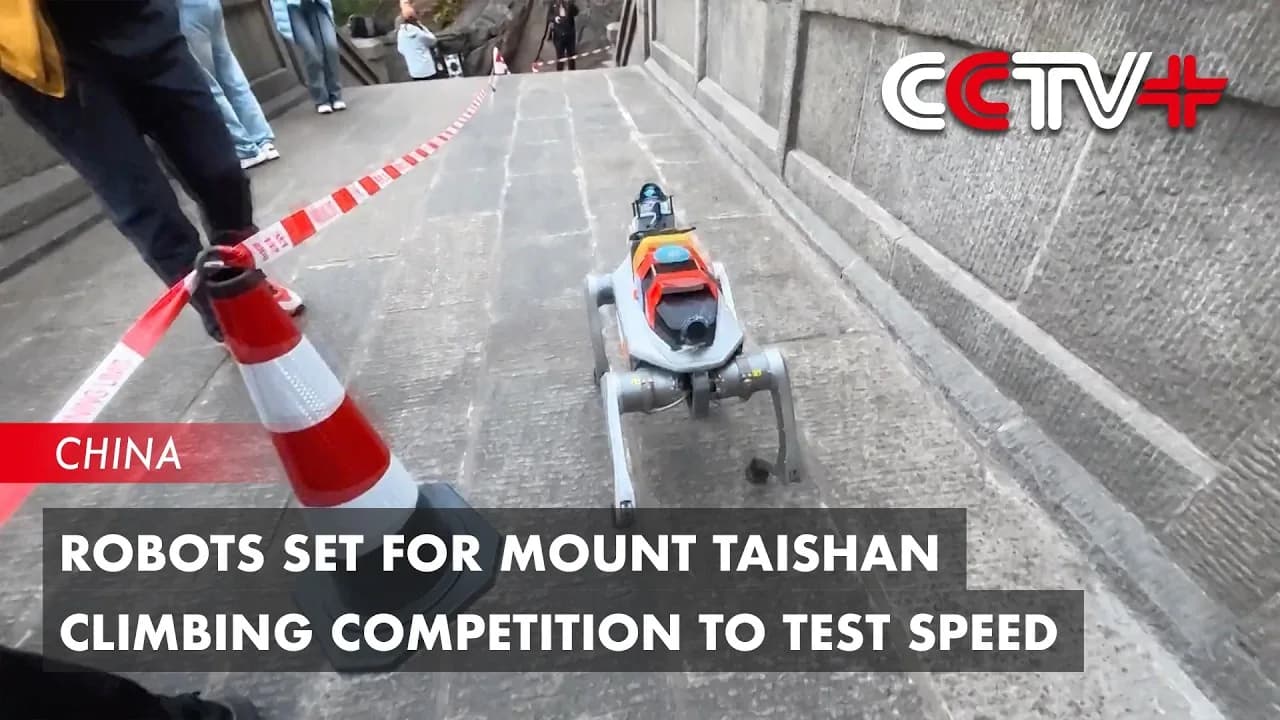
A Unitree G1 humanoid robot overheated and had to be carried down Mount Taishan on a stretcher during a robot competition in China. The incident occurred during the inaugural CMG World Robot Mount Taishan Competition in Shandong Province of China.
Unitree later suggested that the robot may have entered the competition without proper tuning, sparking online debate about humanoid robot endurance and their ability to operate in demanding real-world environments.
Recently, the robotics firm demonstrated its G1 humanoid autonomously sparring with a human using its UnifoLM-X2-1.0 AI model, showcasing advances in real-time robotic control.
Humanoid endurance tested
The Chinese humanoid robot faced an endurance challenge after overheating during a competitive climb up Mount Taishan on November 2, highlighting the technical difficulties of operating bipedal machines for extended periods on demanding terrain.
The G1 development version, also used in China’s Spring Festival Gala, overheated during the race, and its operator had to withdraw it. Event staff subsequently placed the humanoid on a stretcher and carried it down the mountain.
The competition offered a demanding test of the robot’s mobility, balance, and thermal management systems. The course covered approximately 3.9 kilometers (2.4 miles), running from Hongmen to Zhongtianmen, with more than 3,100 steps and an elevation gain of around 600 meters (1,970 feet). Unlike demonstrations on flat indoor surfaces, the route required the humanoid to navigate uneven terrain and repeated stair climbs while maintaining its balance, Global Times reported.
According to experts, such conditions place considerable demands on a humanoid robot’s mechanical and electronic systems. Walking involves continuous coordination between its joints, actuators, sensors, and onboard control systems. Climbing thousands of steps adds further demands, requiring repeated adjustments to leg movements, body posture, and balance as the robot negotiates elevation changes.
Thermal management is another important consideration during sustained operation. Motors, actuators, computing hardware and power electronics generate heat while performing demanding tasks. If the heat produced exceeds the system’s ability to dissipate it, internal temperatures can rise and affect operating reliability. The incident therefore raised questions about how well humanoid robots can manage heat during prolonged physical activity rather than short demonstrations.
G1 faces scrutiny
Unitree suggested that the G1 development version may have entered the competition without tuning. The company did not provide further technical details about the overheating incident or identify the specific component responsible for the temperature increase.
The robot’s withdrawal also prompted discussion about the distinction between demonstrating mobility and sustaining it under demanding conditions. A humanoid may successfully walk, run, or perform complex movements for relatively short periods, but maintaining those capabilities over extended operations requires reliable coordination between its mechanical hardware, control software, and thermal management systems.
According to analysts, the Mount Taishan competition exposed these challenges in the field. The combination of thousands of steps, sustained movement, and significant elevation changes provided a different test from the controlled conditions typically used for laboratory demonstrations. It also highlighted the importance of evaluating robots beyond their ability to complete individual movements.
The incident does not necessarily indicate a fundamental limitation of the G1 platform, particularly given Unitree’s suggestion that the development model may not have been properly tuned for the event. However, it illustrates why endurance, thermal stability, and adaptability are becoming important measures of humanoid robot performance.
Get the latest news delivered to your inbox.
Related articles