
US company’s new reactor can make 800 barrels of sustainable aviation fuel per day
Houston, Texas-based company Velocys has launched AlphaCore 800, its newest reactor that uses Fisher-Tropsch (FT)...
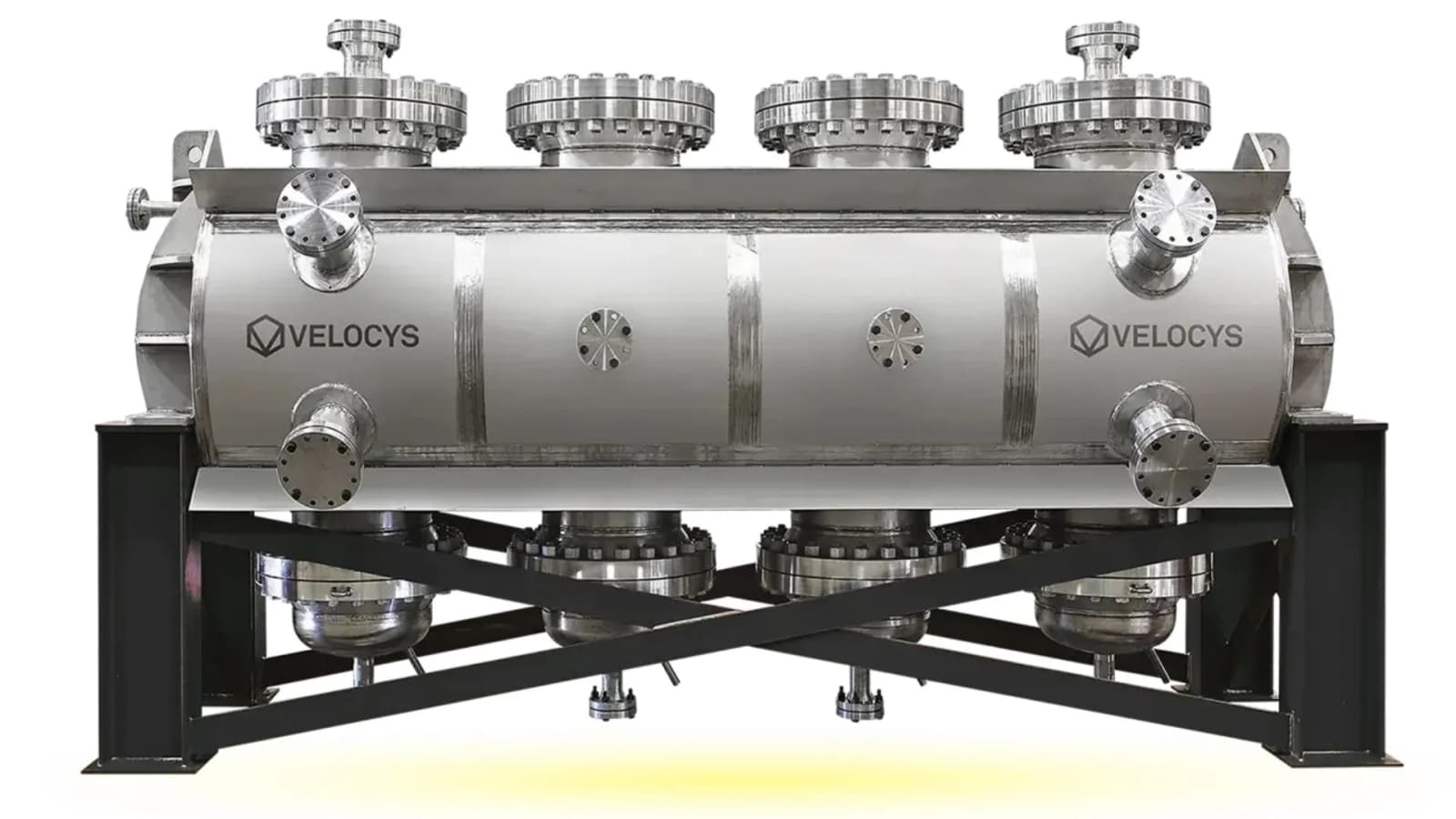
Houston, Texas-based company Velocys has launched AlphaCore 800, its newest reactor that uses Fisher-Tropsch (FT) technology to produce upto 800 barrels of sustainable aviation fuel (SAF) every day. AlphaCore 800 joins Velocys’ fleet of reactors and promises more output per reactor without a drop in performance or reliability.
As countries look to move away from fossil fuels, renewable and nuclear energy adoption is on the rise. While these technologies solve the problem of not letting more carbon into the atmosphere without sacrificing the energy demand, there are specific applications that they simply cannot serve.
High-octane fossil fuels can be burnt to generate short bursts of energy needed for large aircraft takeoff, which neither renewable nor nuclear energy can match. To continue using these modes of transport, we need an alternative fuel that matches the energy density of fossil fuels but not their carbon footprint. This is where synthetic fuel made using the Fischer-Tropsch process comes in handy.
What is the Fischer-Tropsch process?
Fischer-Tropsch (FT) is a complex chemical process that turns syngas, a mixture of carbon monoxide and hydrogen, into liquid hydrocarbon fuel. First developed nearly a century ago, the FT process passes a syngas, or synthesis gas, over a metal catalyst such as iron or cobalt under high heat and pressure to polymerize into long-chain hydrocarbons.
This results in a synthetic crude oil that can be further refined and used a fuel for cars, trucks and even airplanes. The reason this approach is considered sustainable is that it does not tap into the underground crude oil reserves. Instead, it uses carbon dioxide that already exists in the atmosphere and binds it into a fuel, which is burnt again, so it does not add to the planet’s emissions.
FT helps generate replacement fuels for petrol, diesel and aviation fuel without using non-oil sources while also helping convert captured carbon dioxide and green hydrogen into sustainable e-fuels.
How does Velocys generate SAF?
The FT process involves a series of reactions conducted at temperatures between 302-572 degrees Fahrenheit (150-300 degrees Celsius) and several tens of atmospheres of pressure.
Velocys uses microchannel FT reactors and proprietary catalysts to increase fuel yield and make the technology easier to deploy for field use. The company currently has a portfolio of AlphaCore 50,200 and 400 reactors and has now added a high-capacity reactor offering.
“Customers are asking us to bring our microchannel FT technology into larger projects with simpler configurations,” said Matthew Viergutz, CEO of Velocys. “AlphaCore 800 is a direct response. As SAF projects move toward 100,000 tonnes per year and beyond, we are increasing capacity per reactor so developers can configure larger FT plants with fewer units while building on the technology platform and operating experience of Velocys.”
As the name suggests, The AlphaCore 800 doubles the capacity of its predecessor AlphaCore 400 and is designed to produce 800 barrels per day or 30,000 tonnes per year (30 kt/a) of FT output from a single reactor.
Adding more capacity to this offering, Velocys makes it possible for its customers to scale their production while deploying fewer reactors, which simplifies the plant setup, reduces use of associated equipment, and lowers unit cost.
For instance, a facility looking to produce 1,600 barrels of FT fluid per day can now do so using two units of Velocys AlphaCore 800 instead of eight AlphaCore 200 units, reducing reactor count by 75 percent without changing performance or reaction chemistry, a press release said.
Related articles
World’s first 33 feet deep submarine solar power plant trialed in China
Scientists at the Yunnan University in China have achieved a global first by building a...
Single-atom technique could tackle 350 million tons of global PET plastic waste
To break down a plastic bottle, science doesn’t need a hammer, but a microscopic scalpel....

UFO? Mysterious lights over Tehran spark online buzz 50 years after 1976 sighting
A strange cluster of lights was seen over Tehran, and videos of the event are...
Australia’s 10,000-ton AUKUS nuclear attack submarines to get UK-built reactors
The UK is expanding its role in the AUKUS submarine program, with Rolls-Royce set to...

Caught on camera: How smart home devices are reshaping courtroom evidence law
A Taiwanese man used footage from his family’s robot vacuum to catch his wife in...
New EV battery adds 62 miles of range every minute, reaches 97% in 9 minutes
Chinese battery maker Sunwoda unveiled its latest fast-charging EV battery technology at a battery industry...