
World’s first 33 feet deep submarine solar power plant trialed in China
Scientists at the Yunnan University in China have achieved a global first by building a...
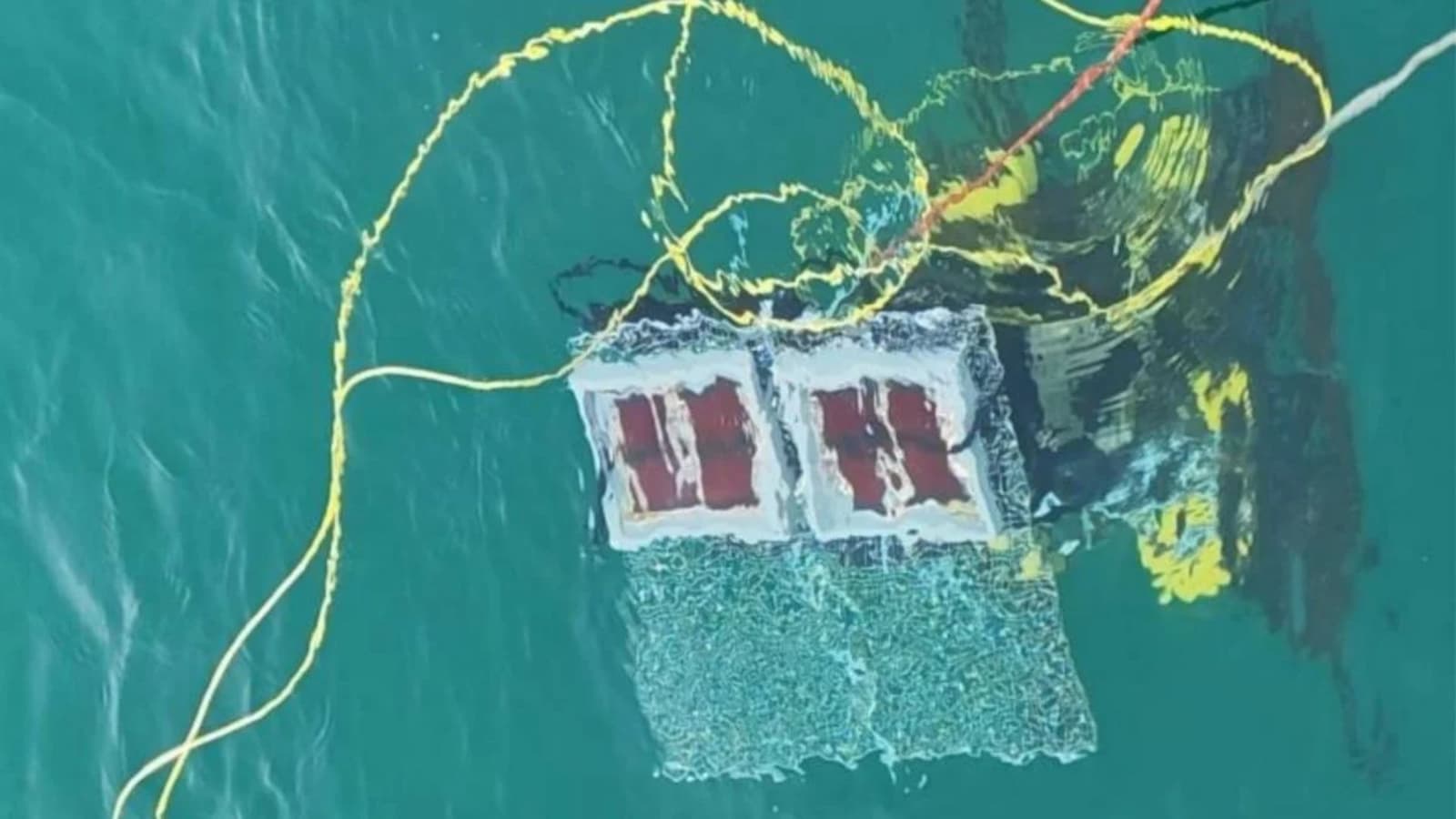
Scientists at the Yunnan University in China have achieved a global first by building a solar power plant underwater. The researchers used a perovskite-based photovoltaic system to build this trial power plant, 33 feet (10 m) below the sea, where red light does not even reach.
In our bid to move away from fossil fuels, we have embraced renewable energy technologies like wind and solar. While wind power projects must be large to be effective, solar energy is having a private moment, with many do-it-yourself (DIY) solutions available in the market.
Whether you live in a small apartment on the third floor or a want to charge your smartphone during your hiking trip, there is now a DIY solar-based solution for this. Solar-powered cars have been in the works for quite a few years now and if there was one area where sunlight couldn’t actually generate electricity, it was underwater. However, a research team in China seems to have addressed this too.
Underwater solar power
The researchers were looking to ways to power up underwater sensors, cameras, detectors, communication systems and other such devices using solar energy. These devices have become more common in recent years and can help with deeper-sea exploration if they can be reliably powered.
Work on underwater solar cells has been done before. However, these solar cells were operational in shallow water of depths of about six feet (two meters or less). This is not the depth where real-world underwater devices are used. So, a team led by Zhang Wen-hua at Yunnan University decided to explore this further and make solar cells functional at a depth of 33 feet (10 m).
The problem, however, is that at these depths sunlight fades rapidly, and red light, where silicon cells perform best, is completely absorbed. The researchers therefore turned to a perovskite solar cells with a wide band gap of 1.96 electron volts, which is in line with the blue-green seawater. perov
Solving for seawater
Perovskite solar cells are highly tunable and can work in dimmer light. However, researchers also faced the corrosive nature of seawater and the risk of leakage under pressure. To overcome this, they added polyhexamethylene guanidine hydrochloride, or PHMG, a crystallization additive to improve their stability.
In laboratory test simulations of 33 feet, the researchers trialed a small solar cell measuring 0.014 sq. inches (0.0895 sq cm) which reached a power conversion efficiency of 34.71 percent. A larger module measuring 4.46 sq.in (28.79 sq. cm.) reached 29.4 percent efficiency, demonstrating that even weak light can be used efficiently.
To ensure durability in saline conditions, the researchers used butyl rubber and cover glass, topped with a transparent epoxy resin outer protective layer to build a waterproof, pressure-resistant, and corrosion-resistant armor. In simulated seawater tests, the device retained 99.58 percent of its initial PCE after 1,000 hours of immersion.
At 77 degrees Fahrenheit (25 degrees Celsius), the cell had a T80 lifetime of 48,904 hours, meaning it could keep 80 percent of its output even after more than five years.
The researchers also carried out real-world tests in the South China Sea to charge lithium-ion batteries at depths of six feet, 18 feet, and 33 feet (2,6 and 10 m), respectively. Under two hours of light, the batteries charged 1,416 mWh, 752 mWh, and 324 mWh at these depths, enough to light up a LED panel.
The research findings were published in the journal Joule.
Related articles
US company’s new reactor can make 800 barrels of sustainable aviation fuel per day
Houston, Texas-based company Velocys has launched AlphaCore 800, its newest reactor that uses Fisher-Tropsch (FT)...
Single-atom technique could tackle 350 million tons of global PET plastic waste
To break down a plastic bottle, science doesn’t need a hammer, but a microscopic scalpel....
UFO? Mysterious lights over Tehran spark online buzz 50 years after 1976 sighting
A strange cluster of lights was seen over Tehran, and videos of the event are...
Australia’s 10,000-ton AUKUS nuclear attack submarines to get UK-built reactors
The UK is expanding its role in the AUKUS submarine program, with Rolls-Royce set to...
Caught on camera: How smart home devices are reshaping courtroom evidence law
A Taiwanese man used footage from his family’s robot vacuum to catch his wife in...
New EV battery adds 62 miles of range every minute, reaches 97% in 9 minutes
Chinese battery maker Sunwoda unveiled its latest fast-charging EV battery technology at a battery industry...