US team develops open-source microcontroller chip that could simplify next-gen wearables
Researchers at the New Jersey Institute of Technology (NJIT) and collaborating institutions have developed an...
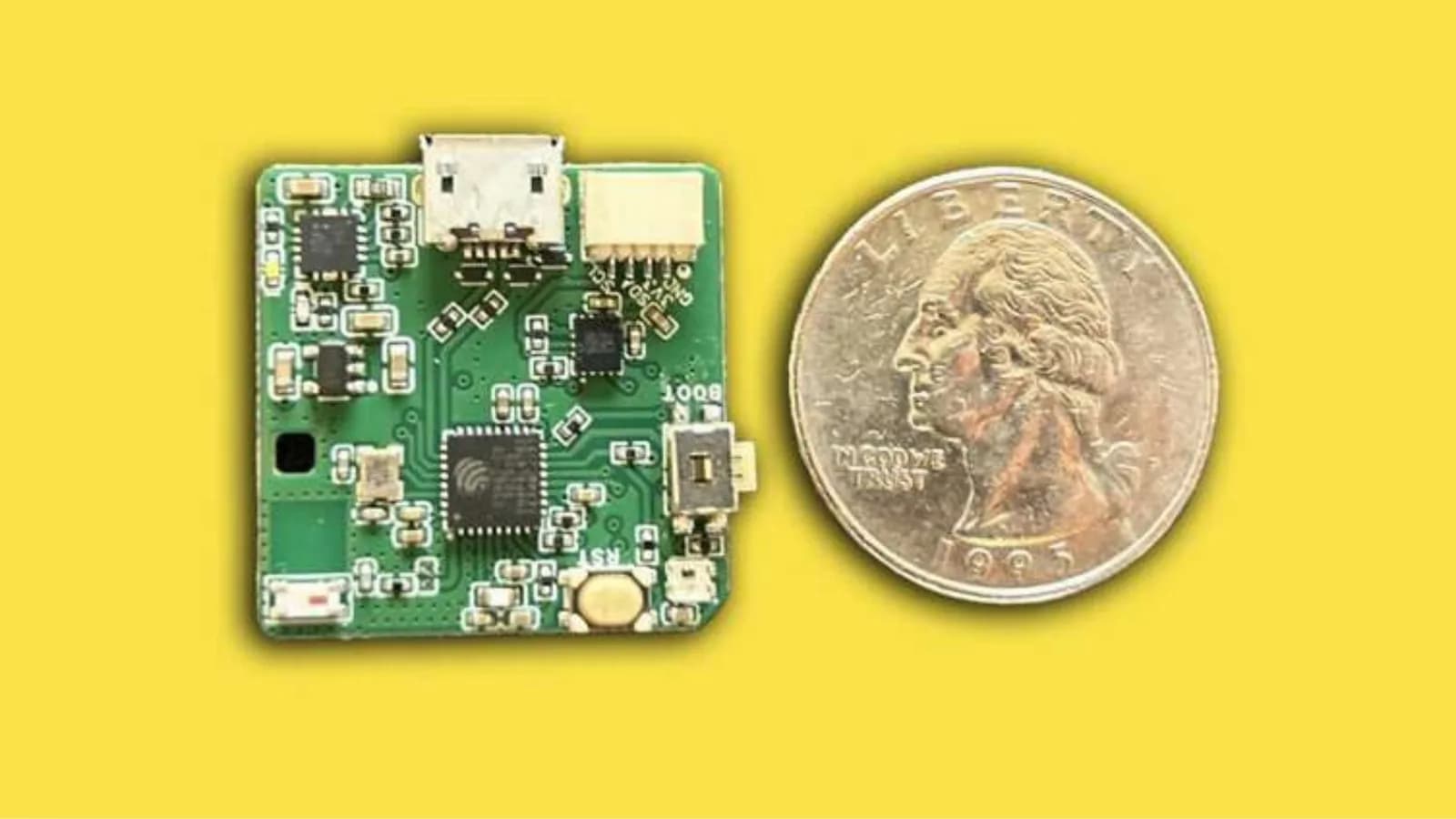
Researchers at the New Jersey Institute of Technology (NJIT) and collaborating institutions have developed an open-source microcontroller that combines sensing, wireless connectivity, onboard storage, and battery management into a device about the size of a quarter, opening the door to compact wearables, robotic systems, and other connected electronics.
They named it TinZr (pronounced “TIN-zer”), which is the square-shaped microcontroller that measures just 0.98 inches (2.5 centimeters) on each side. Despite its compact footprint, it integrates an inertial measurement unit (IMU) for tracking motion and orientation, a microSD card reader for local data storage, a battery management circuit, and built-in Wi-Fi and Bluetooth connectivity.
Researchers positioned TinZr as a flexible, open-source system that can be adapted for a range of applications covering physiological monitoring to robotics and industrial sensing.
Built to simplify wearable electronics
Microcontrollers act as the central processing units of many embedded devices that can collect information from sensors, store data, and communicate with other electronics. However, combining all of these functions into a compact board often requires engineers to compromise on size or capability.
According to the researchers, the chip was designed to overcome those limitations by integrating multiple functions into a single miniature platform without significantly increasing its footprint. Besides keeping it tiny, the the microcontroller has wireless connectivity; the board supports analog, digital, and serial communication interfaces through general-purpose input/output (GPIO) pins. Together, these features could let developers connect a wide variety of external sensors.
Lead author Ludvik Alkhoury, who completed his doctoral research at NJIT and is now a postdoctoral associate at Weill Cornell Medicine, said the team could not find an existing microcontroller that combined the required size, form factor, and functionality.
“You couldn’t find anything on the market that has the same size, same form factor, and also has all the functionalities that we wanted,” Alkhoury said.
The project originated while researchers were developing a wearable oximeter for the U.S. Navy to monitor pilots’ heart rate and blood oxygen levels amid high-speed maneuvers that can cause pilots to lose consciousness. Those strict size and weight constraints ultimately led the team to design an even smaller and more versatile electronics platform.
Designed as flexible research platform
With onboard battery management, wireless communications, and removable storage, TinZr can continuously collect data from attached sensors without relying on external hardware. The researchers described it as a general-purpose data acquisition platform that can be customized for many different scientific and engineering projects.
Potential applications could go far beyond wearable health monitors. The team envisions the device monitoring brain activity in laboratory animals, measuring movement and physical strain in construction workers. They also hope to use the device to coordinate swarms of drones and support robotics research that requires compact, low-power electronics.
The researchers have made the quarter-sized controller fully open source to encourage wider adoption. Its Arduino software library is available on GitHub, while printed circuit board designs, component lists, and 3D-printable enclosure files are available through the Zenodo research repository. This allows engineers to modify both the hardware and software to suit specialized applications.
Rather than targeting a single use case, the developers hope TinZr will form a foundation for new wearable technologies, sensor platforms, and robotic systems that benefit from combining wireless communication, onboard storage, and sensor integration in a compact, customizable package.
The researcher described the platform in the journal HardwareX.
Get the latest news delivered to your inbox.
Related articles