US textile-inspired molecular filter captures 97.9% of benzene from mixtures
Scientists at the University of Texas at Austin (UT Austin) and Zhejiang University have developed...
Scientists at the University of Texas at Austin (UT Austin) and Zhejiang University have developed a molecular textile that could offer chemical manufacturers a new way to separate compounds while reducing reliance on energy-intensive processes.
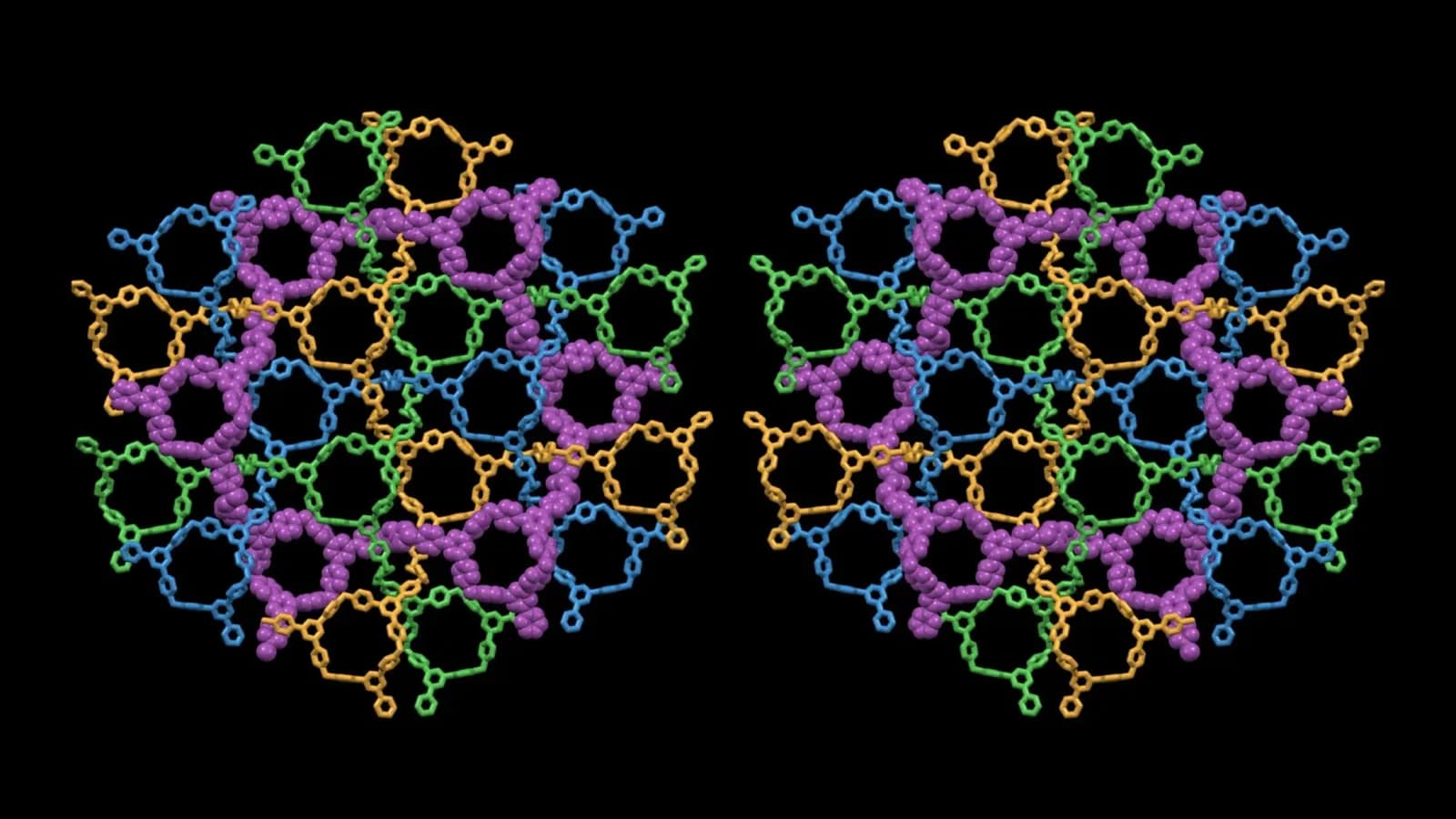
The material takes inspiration from traditional weaving. Its molecular networks interlock to form a textile-like structure that selectively captures benzene from mixtures containing cyclohexane.
Cyclohexane is widely used in the production of nylon, paints, polyurethane foams and detergents. However, benzene can be present in cyclohexane mixtures and needs to be removed because it is a known carcinogen.
Separating the two chemicals is difficult because their boiling points are very close. Chemical manufacturers generally rely on distillation, which involves heating a mixture so its components can be separated through evaporation. When two substances evaporate at similar temperatures, the process becomes more complicated. It can require repeated heating and separation stages, increasing energy consumption and operating costs.
Jonathan Sessler, a chemist at UT Austin and the study’s corresponding author, described the scale of the problem.
“Unbelievable amounts of energy go into chemical separation. It’s one of the top energy sinks in the modern world.”
Scientists build a chemical filter using molecular weaving
The research team developed the material using four interconnected molecular networks. These networks pass over and under one another. Following the basic arrangement used in conventional weaving. The molecular layers can twist in clockwise or anticlockwise directions. This produces mirror-image structures, a property known as chirality.
By combining layers with opposite twisting directions, the researchers created a material with elasticity and improved mechanical strength. Its interwoven arrangement also helps hold the structure together. The textile forms through self-assembly, meaning its molecular components organize themselves through chemical interactions rather than requiring each layer to be positioned manually.
“The whole thing converges by itself based on the underlying chemistry, which is especially cool because it allows the creation of these new materials in a facile way,” Sessler said.
Reusable textile captures 97.9% of benzene from chemical mixtures
To measure its separation performance, the researchers tested the textile using a mixture containing equal amounts of benzene and cyclohexane. The material captured 97.9% of the benzene in the mixture, demonstrating its ability to selectively remove the unwanted compound. The textile can also be used again. Researchers recover the trapped benzene by heating the material, causing the chemical to evaporate and leaving the textile available for another separation cycle. The team also demonstrated that the material could separate several other valuable compounds, suggesting that its applications may extend beyond benzene removal.
The study involved Jonathan Sessler and researchers from Zhejiang University, including professors Feihe Huang and Guangfeng Li. The late Sir Fraser Stoddart, co-winner of the 2016 Nobel Prize in Chemistry, was also among the co-authors.
Researchers at Zhejiang University demonstrated that the material has potential for production at a larger scale. However, a full economic analysis has not yet been completed. If further testing confirms its performance and economic viability, the textile could offer chemical manufacturers another option for separating compounds used in the production of nylon, paints, polyurethane and other industrial products. The research introduces a molecular weaving method that brings together the principles of textile construction and chemical separation. Further work will determine whether the material can move from laboratory experiments to practical use in industrial chemical processing.
The research was published in Nature.
Get the latest news delivered to your inbox.
Related articles