Watch: Virgin Galactic unveils six-seat Delta spaceship Apeiron for commercial flights
Virgin Galactic has named its first Delta-class spaceship Apeiron, choosing an ancient Greek term meaning...
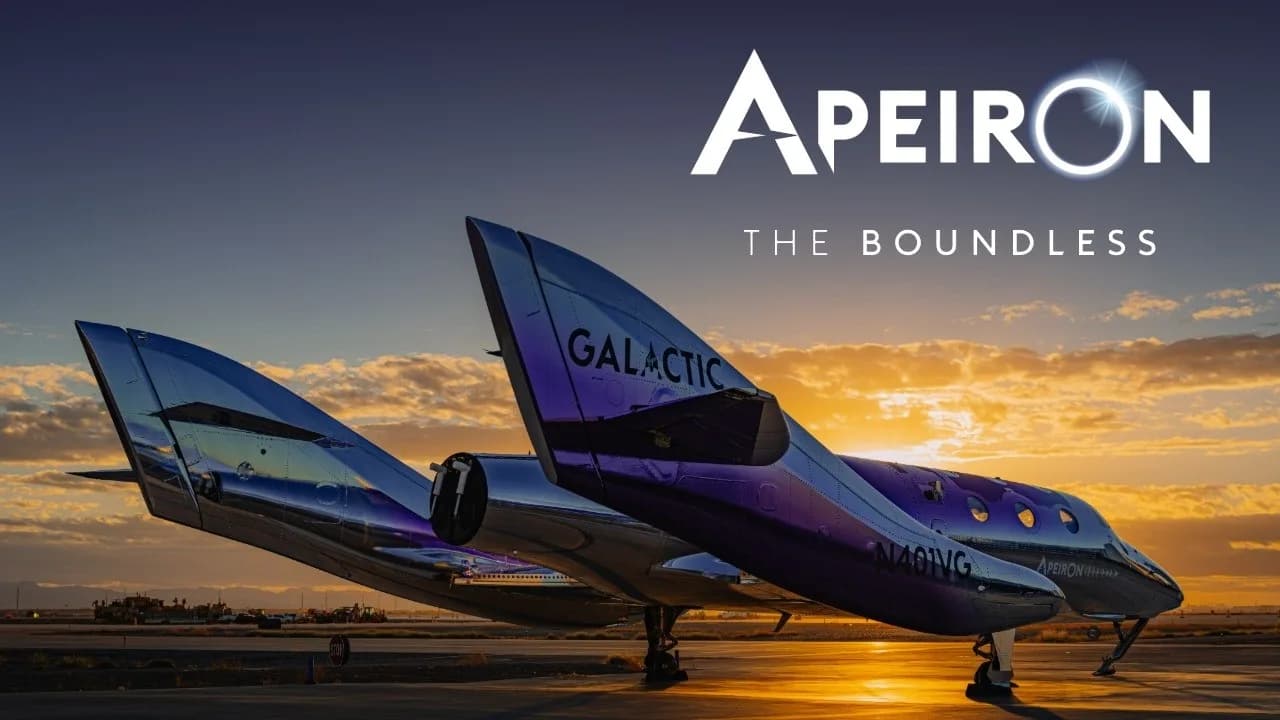
Virgin Galactic has named its first Delta-class spaceship Apeiron, choosing an ancient Greek term meaning “boundless” for the vehicle intended to restart its commercial space tourism operations. The name emerged from a public vote that attracted thousands of responses from 83 countries across six continents.
Designed to carry six private passengers, Apeiron is expected to enter commercial service in early Q2 2027 from Spaceport America in New Mexico. It will succeed VSS Unity, which completed its final commercial flight in June 2024, as Virgin Galactic works toward a fleet capable of flying more frequently.
Chief executive Michael Colglazier said the name reflects the ambition of human spaceflight and the possibilities it creates for people drawn to exploring beyond familiar limits.
Six seats for the next commercial chapter
Apeiron’s cabin increases passenger capacity from Unity’s four seats to six. That gives Virgin Galactic two additional paying seats on each flight, expanding capacity without requiring a separate launch. The spacecraft will follow the company’s established air launch approach. Its carrier aircraft, Eve, will lift it to roughly 50,000 feet before releasing it. Apeiron will then ignite its rocket motor and climb toward suborbital space.
Passengers will experience a brief period of weightlessness before the spacecraft returns through the atmosphere and glides to a runway landing. The journey remains suborbital, meaning Apeiron will return to Earth without completing an orbit.
The central change is the vehicle intended to deliver that experience, with additional seats and a design aimed at supporting repeated operations.
Modular construction targets faster turnaround
Virgin Galactic says each Delta class spaceship is designed to support up to eight flights a month. That target would represent a substantial increase over the flight frequency achieved by Unity.
Achieving it will depend on how quickly crews can inspect, service, and prepare each spacecraft between missions. Delta vehicles use modular construction, allowing teams to manufacture and maintain individual sections and systems separately.
The approach is intended to simplify production and maintenance as Virgin Galactic builds out its fleet. However, the projected flight rate remains a design target that will need to be demonstrated through testing and commercial operations will need to demonstrate.
For the company, carrying more passengers and shortening the interval between flights are closely connected goals. Together, they could increase the number of customers each spacecraft carries.
Testing comes before passenger service
Apeiron’s next phase centers on preparations at Spaceport America, where engineering teams will check its avionics software before flight testing begins.
Virgin Galactic’s revised schedule places the start of commercial operations in early Q2 2027. A second Delta spaceship is expected to follow in Q2 or Q3 that year.
The timing reflects additional software work and verification. Those checks will help establish whether the spacecraft is ready to progress through testing toward passenger service.
Beyond private astronaut flights, Virgin Galactic plans to pursue scientific research and government missions.
Further details on its operating plans are expected during its third-quarter results call in November, as Apeiron moves from a newly named spacecraft toward its intended commercial role.
Related articles