Why can’t data centers simply move to the Arctic or beneath the ocean?
Data centers have a rather inconvenient habit of getting hot. Thousands of processors crunching through...
Data centers have a rather inconvenient habit of getting hot. Thousands of processors crunching through calculations, training AI models, and storing the world’s digital information generate enormous amounts of heat. Keeping all that hardware from overheating takes substantial amounts of electricity, making cooling one of the industry’s biggest engineering challenges.
So, why not put these facilities somewhere naturally cold? The Arctic has plenty of freezing air, while the ocean offers a vast reservoir of relatively cool water. Better still, why not put servers directly underwater and let the sea do the cooling?
It sounds like an obvious solution. And engineers have explored both ideas. But building a data center is about considerably more than keeping its servers chilly.
The Arctic has a cooling advantage
Data centers in cold climates can use a technique known as free cooling. Instead of relying entirely on energy-intensive chillers and refrigeration systems, facilities can use cold outside air or water to remove heat from their equipment.
This can significantly reduce the electricity needed for cooling. It is one reason companies have established data center operations in places such as Sweden, Finland, Iceland, and Norway. Google’s facility in Hamina, Finland, for example, uses seawater from the Gulf of Finland as part of its cooling system.
But there is a difference between building in a cold country and building in the Arctic wilderness. The farther north a facility goes, the harder it can be to access reliable electricity, high-capacity fiber-optic networks, skilled workers, and transport infrastructure. A data center may need less energy to cool its servers, but it still needs enormous amounts of electricity to run them.
That is becoming an increasingly important constraint. The International Energy Agency has highlighted the growing electricity demands of data centers, while grid connection delays and limited power infrastructure are becoming major obstacles to expansion. In other words, finding a cold patch of land is easy compared with finding one that can reliably power a massive computing facility.
There is also the matter of getting there. Construction materials, replacement servers, and maintenance crews have to travel through regions where harsh weather, long distances, and limited transport links can complicate even routine operations. Permafrost and changing Arctic conditions introduce further engineering challenges for buildings and infrastructure.
What about putting data centers underwater?
The ocean offers another tempting proposition. Submerge a sealed facility, circulate heat into the surrounding water, and potentially reduce the need for conventional cooling equipment.
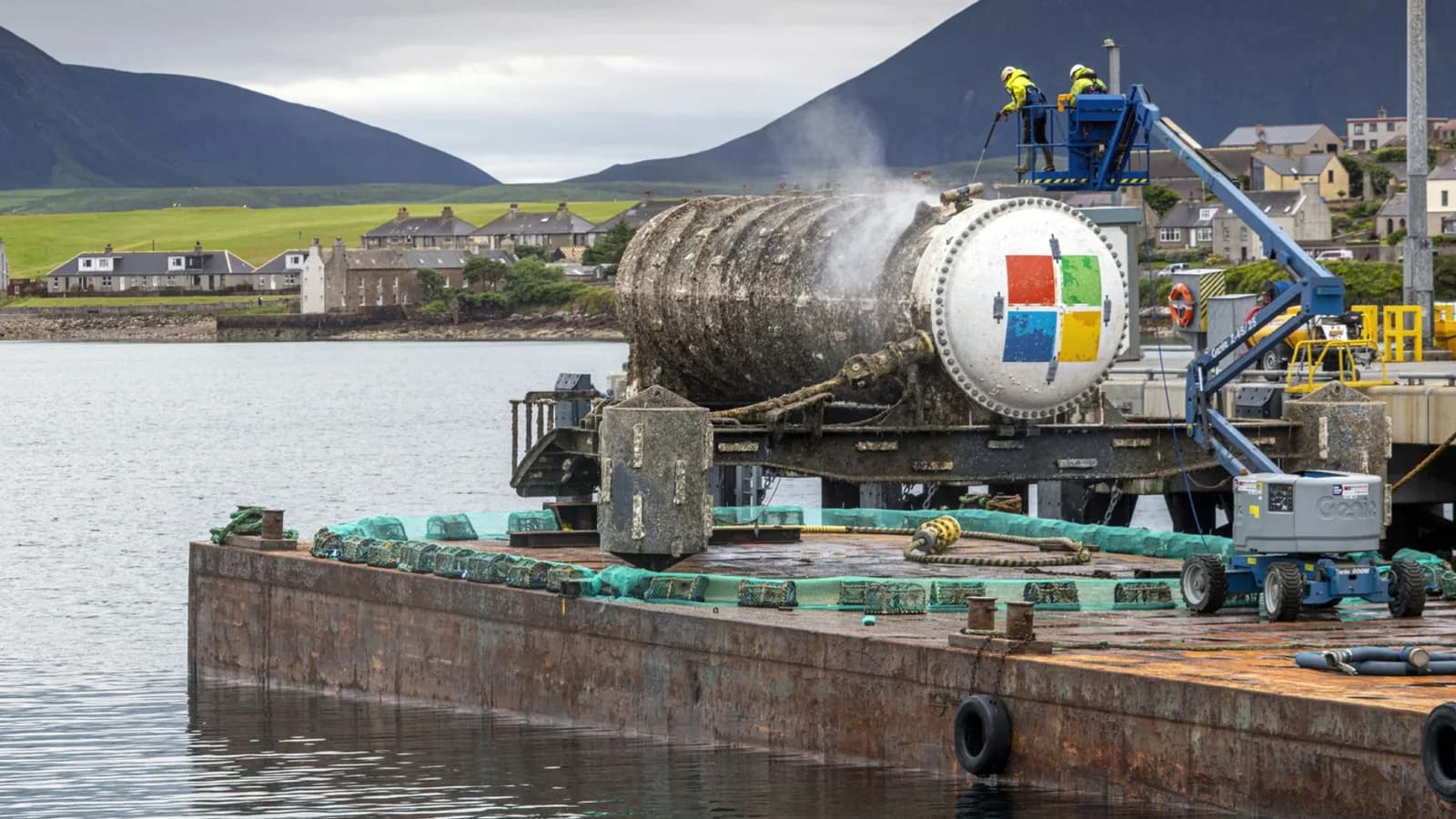
Microsoft actually tested this idea through Project Natick. In 2018, the company deployed a sealed data center module off the coast of Scotland’s Orkney Islands. Roughly the size of a shipping container, the underwater facility housed 864 servers and operated for more than two years.
The results were intriguing. According to Microsoft Research, servers in the underwater installation experienced a failure rate one-eighth that of a comparable land-based control group. The company suggested that a controlled environment, filled with dry nitrogen rather than ordinary air, could help explain the difference.
The project demonstrated that underwater data centers were technically feasible. It did not, however, establish that they were commercially practical at scale.
The problem with fixing a server at the bottom of the sea
Imagine a hard drive fails in a conventional data center. A technician can walk over, replace it, and get the equipment running again. Now imagine that same failure several dozen meters underwater. The entire sealed module may need to be recovered, transported to the surface, opened, repaired, and redeployed. That is a rather expensive way to replace a component.
Subsea facilities also need reliable power and high-capacity connections to land-based networks. Laying and maintaining undersea cables adds cost and complexity, while saltwater, pressure, corrosion, and marine conditions create additional engineering challenges.
Microsoft’s experiment was successful in important technical respects, but the company eventually moved on. In June 2024, Data Center Dynamics reported that Microsoft had confirmed it was no longer pursuing subsea data centers. The company said it would apply lessons from the project to other areas of its operations.
Cooling isn’t the whole business
Another consideration is where the data center’s customers are. Cloud services, online gaming, financial transactions, and many AI applications depend on fast communication between users and servers. Placing a facility far from population centers and network hubs can increase latency, the time it takes for data to travel between devices and servers.
That may not matter much for some large-scale computing tasks, but it can be important for applications that need near-instant responses. Then there is the economics. Data center operators must weigh land, construction, electricity, cooling, networking, staffing, maintenance, and regulatory costs over decades. A cheaper cooling system does not automatically make the entire facility cheaper to build and operate.
The American Society of Heating, Refrigerating and Air-Conditioning Engineers (ASHRAE) identifies power availability, grid capacity, cooling requirements, and permitting as important factors in data center site selection.
The Arctic and the ocean will likely remain interesting options for specialized facilities, particularly where renewable energy, suitable network connections, and local infrastructure are available. But for now, the best place for a data center isn’t necessarily the coldest place on Earth.
It is the place where the electricity, connectivity, cooling, maintenance, and economics all work together. Unfortunately for anyone hoping to put the cloud in an actual cloud of ice, geography is a little more complicated.
Source: https://interestingengineering.com/culture/why-arent-data-centers-built-in-arctic-underwater
Get the latest news delivered to your inbox.
Related articles