World’s largest electric cargo ship with 23.5 MWh battery set for maiden voyage
The world’s largest battery-powered bulk carrier has left China and is on its way to...
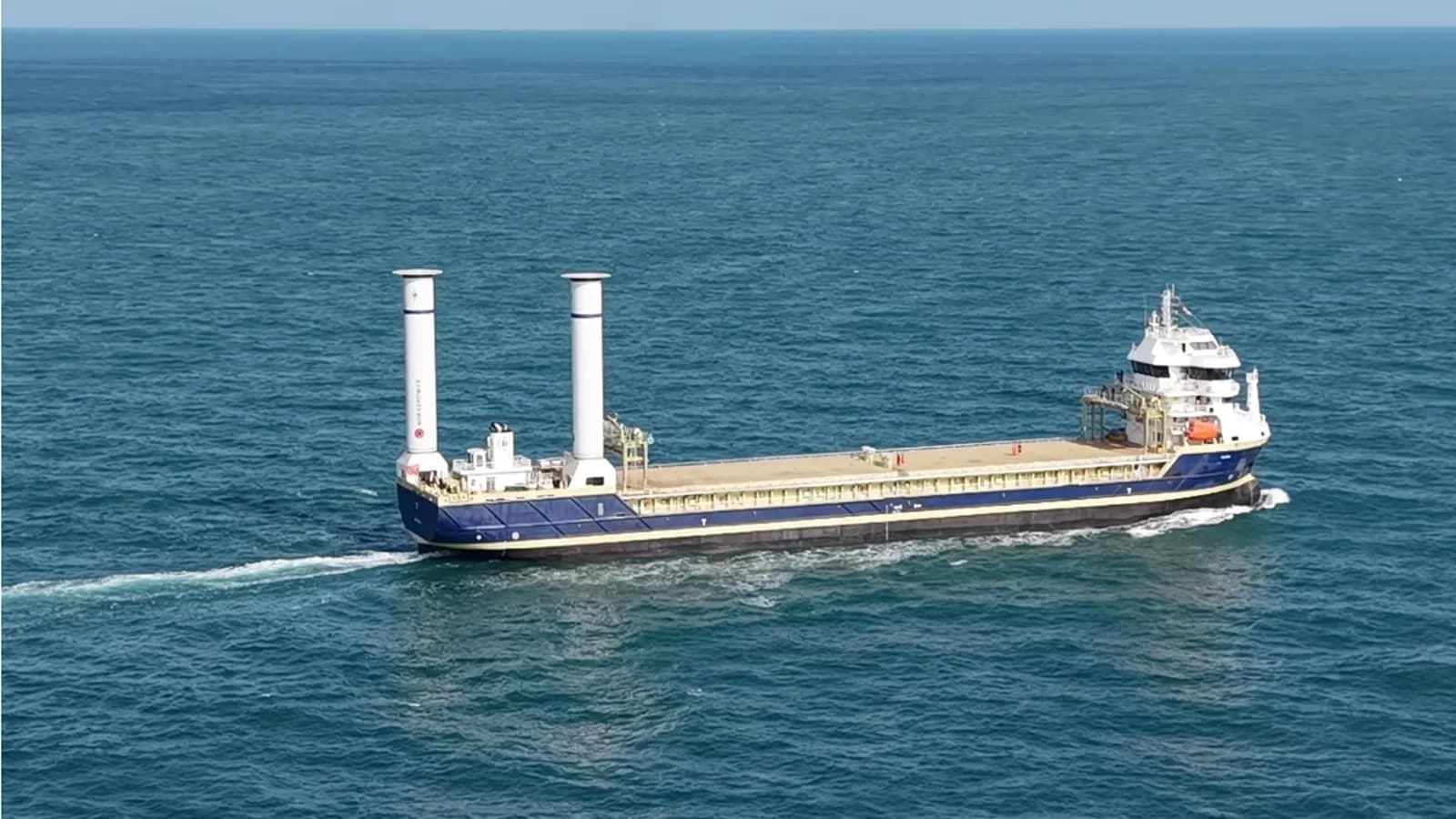
The world’s largest battery-powered bulk carrier has left China and is on its way to Norway, where it will be equipped with a massive 23.5-megawatt-hour (MWh) battery.
The 426-foot (129.9-meter) ship, known as BRF Froan, was built by Jiangsu SOHO Marine Heavy Industry for Norwegian shipping firm Berge Rederi. It will transport marble along the Norwegian coast without burning fuel.
“We are pleased to announce the successful registration of BRF Froan under the Norwegian flag,” the Norwegian Maritime Authority shared. “This latest addition further strengthens Norway’s position as an attractive and competitive flag state.”
The vessel has a cargo capacity of 13,250 deadweight tonnes (DWT) and has two 79-foot (24-meter) rotor sails to slash electricity consumption. Once operational, it will significantly reduce carbon dioxide (CO2) emissions.
Battery and rotor sails
For propulsion, BRF Froan will rely on its battery system. Berge Rederi pointed out that charging facilities at both ends of its route will provide the electricity needed for each journey. The ship will travel approximately 230 nautical miles (265 miles) between Brønnøy and Elnesvågen.
Berge Rederi explained that this is considerably longer than the 15-nautical-mile journey the Trøndelag-headquartered company currently identifies as the longest route operated by a battery-electric ferry. “Furthermore, the vessel will exemplify the extraordinary potential of achieving large-scale maritime operations with zero emissions,” Berge Rederi representatives added.
The BRF Froan during construction. Credit: Berge Rederi
The ship has two rotor sails. Each measures 79 feet (24 meters) tall and 13 feet (four meters) wide. These rotating cylinders use wind to generate additional thrust and reduce the amount of power required from the ship’s propulsion system.
Berge Rederi estimates that the two sails will provide average power savings of 339 kilowatts (kW) per voyage. The vessel will also feature an electric excavator for cargo operations. Moreover, the company plans to install 10,764 square feet (1,000 square meters) of solar panels on the ship’s hatch covers.
The shore charging facilities will consume 5.13 million kilowatt-hours of electricity annually. “Shore power facilities will be installed in both ports, allowing the vessel to recharge the batteries,” the company said.
Cleaner marble transport
BRF Froan will operate under a five-year contract to transport over 14 US tons (up to 13,000 tonnes) of marble from Brønnøy and Visnes to Omya Hustadmarmor’s processing facility in Elnesvågen. The marble will then undergo processing to produce calcium carbonate, a material used in various industries.
The project goal is to eliminate emissions during cargo transport and loading by using batteries, electric equipment, and electricity supplied from ports. Apart from reducing CO2 emissions by roughly 10,000 US tons (9,000 tonnes) annually, the vessel will prevent around 220 US tons (200 tonnes) of nitrogen oxides (NOx) emissions each year.
Artist’s rendering of the BRF Froan electric bulk carrier. Credit: Berge Rederi
The total cost of the project is approximately USD 52 million (NOK 500 million). Around USD 28 million (NOK 270 million) comes from Norway’s Enova and NOx Fund. A second vessel, named BRF Frøya, is already under construction in China and is scheduled for delivery in 2027.
The Norwegian Maritime Authority congratulated Berge Rederi Future AS on the successful delivery and registration of the vessel. “We are proud and grateful for your continued confidence in the Norwegian flag,” the agency shared. “We wish BRF Froan and her crew safe and successful voyages in the years ahead.”
Get the latest news delivered to your inbox.
Related articles