YouTuber’s DIY electric paddleboard hits 25.6 mph, targets world’s fastest title
Daniel Riley, who runs the rctestflight YouTube channel, says a paddleboard he rebuilt with two...
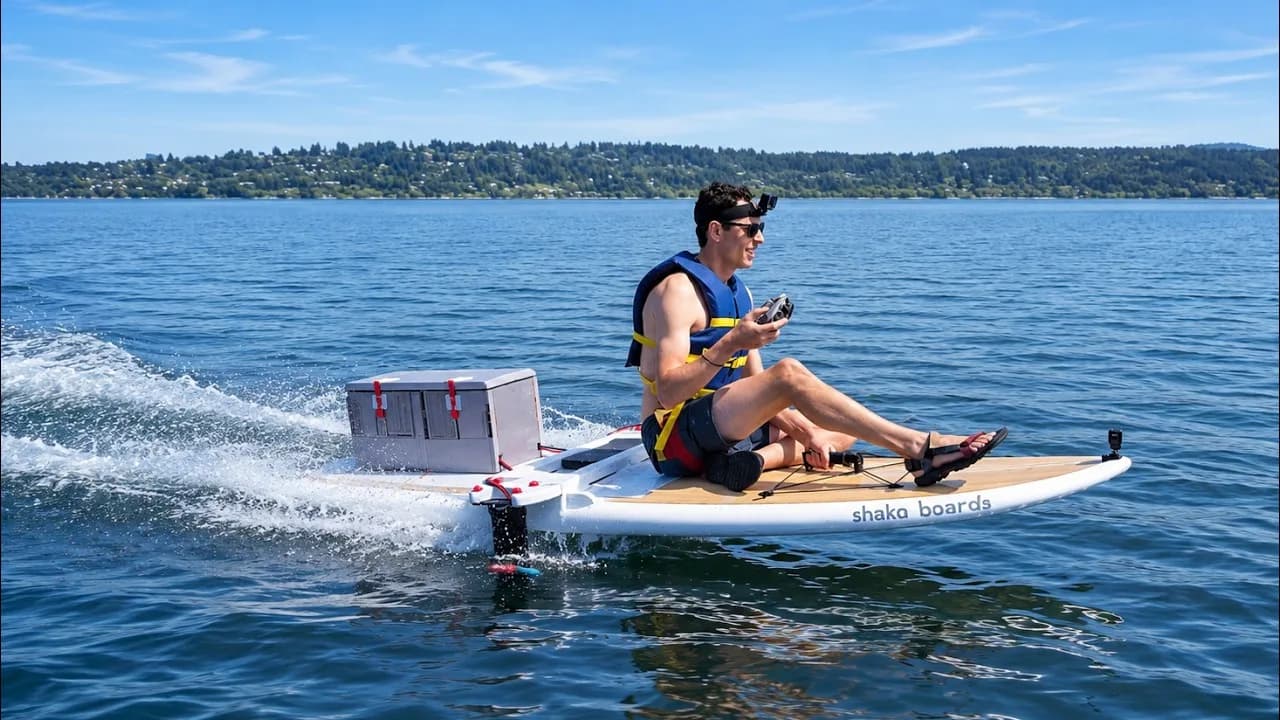
Daniel Riley, who runs the rctestflight YouTube channel, says a paddleboard he rebuilt with two electric motors reached 25.6 mph (41.3 kph) in a measured run. He says it may be the world’s fastest powered paddleboard, though he cites no official record. One of the two motors failed afterward.
Riley said he got the idea from social media clips of powered paddleboards with poor hydrodynamics, including bolt heads in the water and bulky shrouds around the propellers. He rebuilt an electric hydrofoil board he made a few years earlier. A hydrofoil is an underwater wing that lifts a board out of the water. Riley shortened the masts, the vertical posts that carry the motors, and left the foil off.
The new motors are Flipsky 65220 units, each rated at 6,000 watts, a measure of power, with the speed controller (ESC) built in. Riley described the build in a YouTube video.
Printed props and a higher current limit
On the old board, motor wires ran up the masts to separate speed controllers. Now only power and data cables run up the masts. Riley also switched to a new mast profile and redesigned the motor mount to suit it. Hackaday reported that the batteries sit in a waterproof case and a remote controls the motors.
Riley 3D printed his own propellers and tested them against stock ones. His data showed a custom prop was 11 percent more efficient at full throttle, and the fastest runs came with a smaller three-bladed version.
For the speed run, Riley raised the controller’s current limit to 140 amps, a measure of electric current. The spec sheet lists 100 amps. He reached 25.6 mph with each motor drawing almost 5,900 watts. Riley described the draw as about 16 horsepower (11.8 kilowatts) of electrical power, not mechanical power. Hackaday, which covered the build, wrote that the board travels at about 25 miles per hour (over 40 kilometers per hour).
A failed motor and an unofficial claim
The next day, Riley refitted hydrofoils to smooth the ride rather than lift the board clear of the water, and tested on Seattle’s Lake Union. Back at the dock, one motor started ticking, heated up while idling, and died. He opened it and found a blown transistor. His best guess is that a random current spike hit transistors that were already hot. “I cooked the ESC,” he said. He has heard the same noises from several Flipsky controllers.
However, the ‘fastest’ claim and the cause of the failure remain unproven. The cause of the failure is his guess, and he hasn’t tied it to the 140-amp setting. Riley said the motor and controller could probably handle that limit if the spike problem is fixed, but he tells owners to stay at 100 amps, since the motors aren’t cheap. TechEBlog reported that a replacement motor is on backorder.
The video, “Building The World’s Fastest Electric Paddleboard,” is on rctestflight’s YouTube channel.
Source: https://interestingengineering.com/innovation/electric-motors-paddleboard-diy-rctestflight
Get the latest news delivered to your inbox.
Related articles