
10 ancient weapons that reveal how sophisticated early warfare became
Ancient armies fought with more than swords, spears, and brute force. Their arsenals included weapons...
Ancient armies fought with more than swords, spears, and brute force. Their arsenals included weapons with sophisticated loading mechanisms, precision metal components, and materials chosen for specific mechanical properties.
Across China, India, Mesopotamia, and the Mediterranean, engineers developed ways to shoot repeatedly, store more energy, breach walls, and damage enemy ships. Some designs survive as artifacts. Others are known through technical descriptions and modern reconstructions.
These 10 ancient weapons show how much engineering went into warfare long before modern factories and firearms.
1. Polybolos repeating catapult
A repeating projectile launcher sounds like a relatively modern invention. Hellenistic engineers explored the idea in the third century BCE.
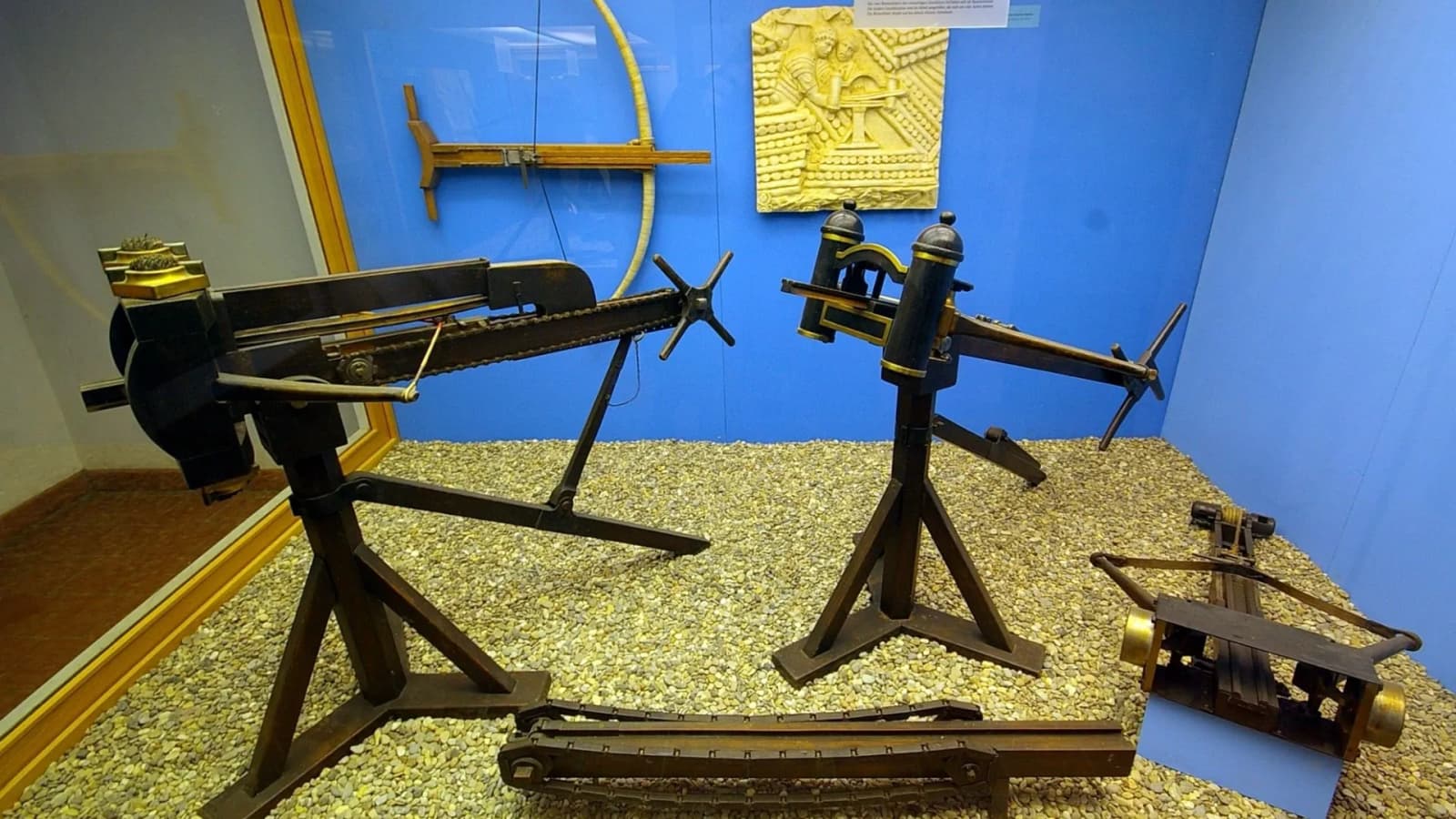
Attributed to Dionysius of Alexandria, the polybolos used a magazine, rotating feed mechanism, and chain drive to coordinate loading and shooting. An operator worked the mechanism to move bolts into position and draw back the string.
Its sophistication lies in combining several operations into a repeatable mechanical cycle. However, descriptions and reconstructions establish the design more clearly than its widespread battlefield deployment.
2. Qin bronze-trigger crossbow
The Qin crossbow’s most remarkable component was small enough to fit inside its stock.
Its multipart bronze trigger held the bowstring under tension, allowing the soldier to aim before releasing the shot. This separated the effort of drawing the bow from the moment of firing.
Research on Terracotta Army crossbow triggers also reveals organized batch production.
Measurements and their distribution within the burial complex offer clues about workshops, storage, and assembly, making these weapons evidence of sophisticated manufacturing as well as military design.
3. Chu repeating crossbow
An excavated crossbow from China’s Warring States period shows that repeated shooting was already an engineering problem more than 2,000 years ago.
The Chu design combined ammunition storage with a mechanism intended to deliver successive shots. Researchers have studied the surviving evidence to reconstruct its operation.
It should be distinguished from the later, better-known Zhuge crossbow. Treating every Chinese repeating crossbow as the same weapon obscures changes in design across centuries.
The ancient example is impressive enough without borrowing specifications from later versions.
4. Composite bow
The composite bow turned several natural materials into a carefully engineered spring. Typical designs combined a wooden core with horn on the belly and sinew on the back. Horn resisted compression, while sinew handled tension as the bow bent.
Together, they allowed powerful bows in relatively compact forms.
Surviving Egyptian sections provide physical evidence of this construction. Producing such a weapon required skilled assembly and reliable bonding, while its organic materials introduced challenges involving moisture, maintenance, and durability.
5. Gastraphetes belly bow
The Greek gastraphetes used the operator’s body weight to solve a practical problem: cocking a powerful bow.
The user pressed an abdominal support against the body while pushing the weapon against a stable surface. A sliding mechanism drew the bow and retained it under tension.
The soldier could then aim without continuously holding the full draw force.
Known through ancient descriptions and reconstructed examples, the gastraphetes illustrates an important step toward mechanical projectile weapons, although its size made handling less convenient than an ordinary bow.
6. Torsion ballista
Greek and Roman artillery engineers found another way to store energy: twisting bundles of fibers.
A torsion ballista placed its throwing arms within tightly twisted bundles, commonly made from sinew or hair. Drawing back the string rotated the arms against that resistance. Releasing it transferred stored energy to a projectile.
The system allowed artillery to move beyond the limitations of a conventional bow. Its performance nevertheless depended on construction, adjustment, and maintenance.
The related polybolos demonstrates how torsion artillery could also support elaborate loading machinery.
7. Wootz-steel blades
Some advances happened inside the metal itself.
Ancient Indian crucible-steel production developed methods for producing high-carbon steel under controlled conditions. This material became associated with prized blades and, later, the patterned swords commonly called Damascus steel.
The engineering story involves carbon content, heating, cooling, and forging. These processes influenced the steel’s structure and properties.
Ancient production should be distinguished from much later surviving swords, but the underlying achievement remains significant: craftspeople developed demanding metallurgical techniques without modern instruments.
8. Assyrian protected battering ram
Assyrian siege machines combined wall-breaking force with protection for their crews.
Reliefs depict wheeled structures containing battering rams, with archers firing from elevated positions. Other scenes show operators using water against incendiary attacks.
The advance was the integration of several battlefield functions. Crews could approach fortifications, strike them repeatedly, and receive supporting fire from the same machine.
Its usefulness still depended on access to the walls, suitable ground, and protection from defenders determined to disable it.
9. Lead-bullet sling
The sling was simple, but its ammunition could be carefully manufactured.
Greek and Roman collections include shaped lead bullets carrying symbols and inscriptions. These artifacts show deliberate choices about material and projectile form rather than reliance on whatever stones were available.
Lead allowed compact, dense ammunition. However, claims about exceptional range or penetration require evidence from particular weapons and tests. \
The launcher also demanded considerable skill, reminding us that effective engineering did not necessarily make a weapon easy to master.
10. Bronze naval ram
Ancient naval warfare turned entire ships into striking platforms.
Purpose-built bronze rams fitted to warship bows provided the contact point for attacks against enemy vessels. Their effectiveness depended on the surrounding hull structure, maneuvering, and impact circumstances.
Recovered rams from the Egadi battle site, associated with the naval clash of 241 BCE, provide tangible evidence for studying these weapons.
They bring the list back to a recurring lesson: sophisticated ancient weapons worked through the combination of design, materials, and skilled operation.
Engineering before the modern battlefield
These weapons show that ancient military innovation went far beyond sharper blades and heavier projectiles.
Engineers combined materials, refined mechanisms, and organized production to solve specific battlefield problems. Their designs also involved compromises in cost, reliability, and ease of use.
Understanding both the achievements and the limitations reveals the ingenuity behind weapons built centuries before modern manufacturing.
Related articles

Who Controls the Critical Minerals Powering AI?
AI’s rapid growth depends on critical minerals. Here’s which countries dominate production of gallium, rare earths, and tantalum.

Steam Deck 2: Is AMD Gainsborough the chip Valve’s been waiting for?
The Steam Deck is four and a half years old, and handheld gamers are eagerly awaiting a Steam Deck 2 - but Valve has consistently said it needs a new chip with a "generational leap" in performance…

US Navy adds M-Code GPS to shield carrier landings from jamming threats at sea
BAE Systems has secured a $16 million award to modernize GPS guidance aboard U.S. Navy...

Judge dismisses antitrust lawsuits over Google’s AI Overviews
A federal judge has dismissed a pair of antitrust lawsuits filed by Chegg and Rolling Stone parent company Penske Media Corporation, which accused Google of driving away web traffic with its…

MindOn’s new Mind-1 model brings human-speed execution to robots
MindOn has unveiled Mind-1, a new physical AI model designed to make robots perform everyday...

Airbus A350F takes maiden flight with 111-ton payload and 5,400-mile range
Airbus’s A350F cargo jet has taken to the skies for the first time and completed...