64 missile launch cells: Upgraded F-110 warship packs four times the capacity
The Spanish Navy is working with Navantia to develop a much more powerful air-defense variant...
This story was prepared automatically by software.
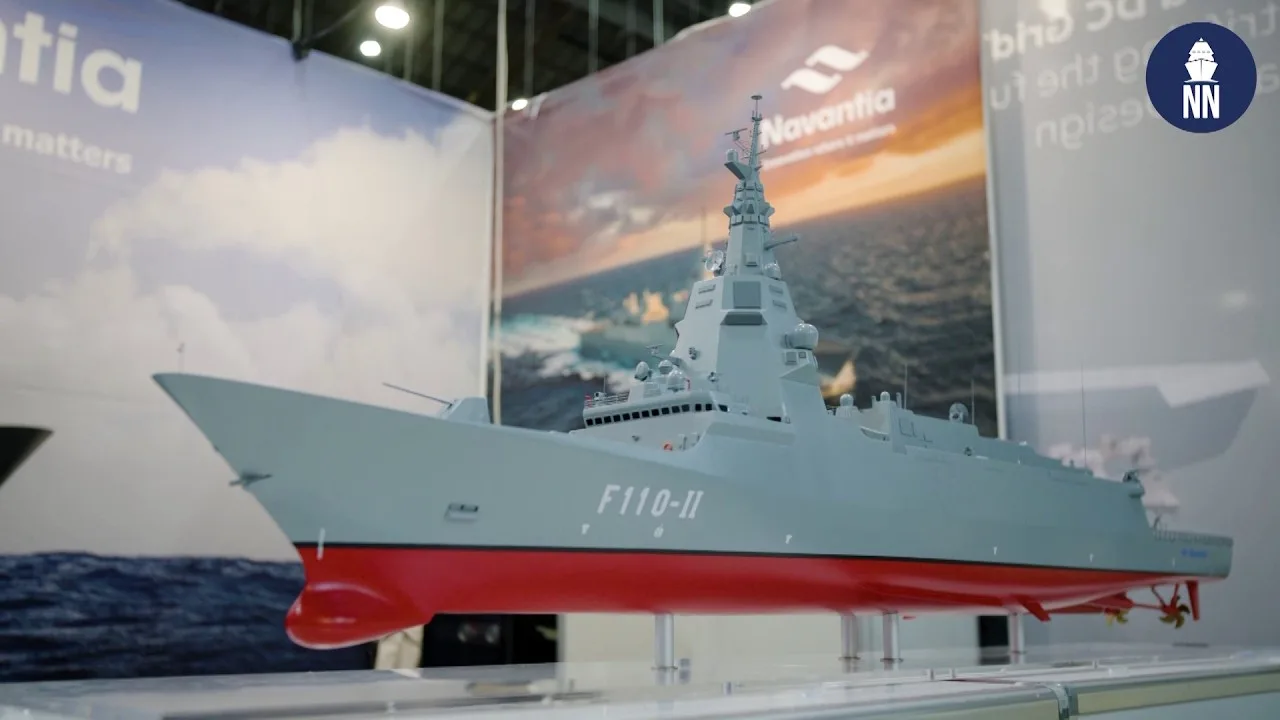
The Spanish Navy is working with Navantia to develop a much more powerful air-defense variant of its new F-110 frigate. These plans will effectively transform the anti-submarine-focused design into a formidable fleet defense platform.
The Navy is currently building five F110 Bonifaz-class frigates. These ships are intended to be modern multirole vessels, but they primarily focus on anti-submarine warfare (ASW).
The first of the line, the Bonifaz, was launched in September of last year and is expected to be officially commissioned into the Navy by 2028. The last, the Barceló, is expected sometime in 2032.
Each ship comes with 16 missile launch cells, a Lockheed Martin SPY-7 radar, an anti-submarine warfare (ASW) helicopter, and other cutting-edge missile defense capabilities.
Improving on the F-110
The new F-110 IAMD model, on the other hand, will reportedly come with somewhere close to 64 missile launch cells. It will also feature an enhanced radar and “additional aviation flexibility.”
The new ship will also be longer, measuring around 16 feet (5 meters) longer than the F-110 at 492 feet (150 meters). It will also measure around 61 feet (18.6 meters) in the beam and have a full-load displacement of around 6,700 tonnes.
Arguably the most significant change is the upgrade in vertical launch system (VLS) capacity. Compared to the F-110, the new ship will be capable of carrying around 48 strike-length cells forward of the bridge and 16 tactical-length cells aft for a total of 64.
These cells will be capable of carrying a combination of missiles, including longer-range SM-2 missiles and shorter-range Evolved Sea Sparrow Missiles (ESSM).
An interesting detail is that four ESSMs can fit into one compatible launch cell. So the theoretical maximum is 256 ESSMs rather than 64 missiles, although a practical loadout would probably mix missile types.
Summed up, this all provides the ship with significant firepower potential. 64 total cells with a mix of armaments gives it not only pure missile capacity, but also options. Especially if the ship is required to counter a mixture of threats from air, sea, and land.
More missiles, many more options
This would significantly expand the ship’s ability to protect an entire naval task group, rather than primarily concentrating on defending itself and nearby assets. But this is only part of the equation.
The planned improved radar will enable it to deal with a large suite of threats, from low-flying cruise missiles to fast, maneuverable anti-ship threats. Another interesting feature is the planned ship’s so-called “naval combat cloud.”
Essentially, this means the ship will form one node in a network of ships that share and coordinate data in real time. This will enable all ships in a fleet to build a shared tactical picture to better coordinate responses to threats.
At the time of writing, the new ship is still very much in the planning stages and has not had an official construction contract agreed. The Spanish Navy and Navantia are working from operational requirements, and the final design must still go through procurement.
Related articles